
Payment orchestration vs. payment gateway: Which one do you need?
Payments 101
8 Jan 2026
6 min

Andrii Kononenko
Head of Merchant Operations, Solidgate
Deciding between a payment gateway and an orchestration platform is key to scaling your business. Learn the differences and find out which solution best fits your growth and operational needs.
Choosing between a payment gateway and a payment orchestration platform will impact your ability to scale, compete, and grow in global markets.
Both process payments, but they operate at different levels of complexity and capability. For mid-market digital businesses processing over $300k monthly, these differences matter. They determine whether you can optimize your payment stack, reduce operational overhead, and enter new markets without rebuilding your infrastructure.
In this article, we’ll explain the difference between the two to help you decide which option suits your needs more.
What is a payment gateway?
A payment gateway acts as the digital equivalent of a point-of-sale terminal. It securely connects your website or application to payment processors, encrypting and transmitting customer payment data for authorization.
How payment gateways work
Payment gateways handle the following:
- Data encryption to protect sensitive information during transmission
- Authorization requests to verify the availability of funds or credit
- Transaction routing to direct the data to the appropriate financial institution
- Response handling to communicate the result to merchants
- Settlement coordination to transfer funds between accounts
While gateways like PayPal, Stripe, and Square simplify online , their limited flexibility and cross-border scalability make them less suited for businesses with complex needs or high transaction volumes.
When single gateways hit the wall
Payment gateways work well for businesses with simple payment requirements, but they have limitations that can hinder growth:
Capacity constraints: As transaction volumes increase, gateways may struggle with delays or failures due to limited capacity.
Geographic restrictions: Expanding into new regions can be difficult if the gateway does not support local payment methods and multi-acquirer setup.
Single points of failure: Relying on one provider creates vulnerability during maintenance or system outages.
If you're looking to expand globally orprocessing higher transaction volumes, these limitations can become significant growth obstacles. By contrast, orchestration platforms enable businesses to manage payment flows across multiple providers and markets, reducing risk and increasing reliability.
What is payment orchestration?
are middleware layers that manage multiple gateways, payment processors, and methods via a single API.
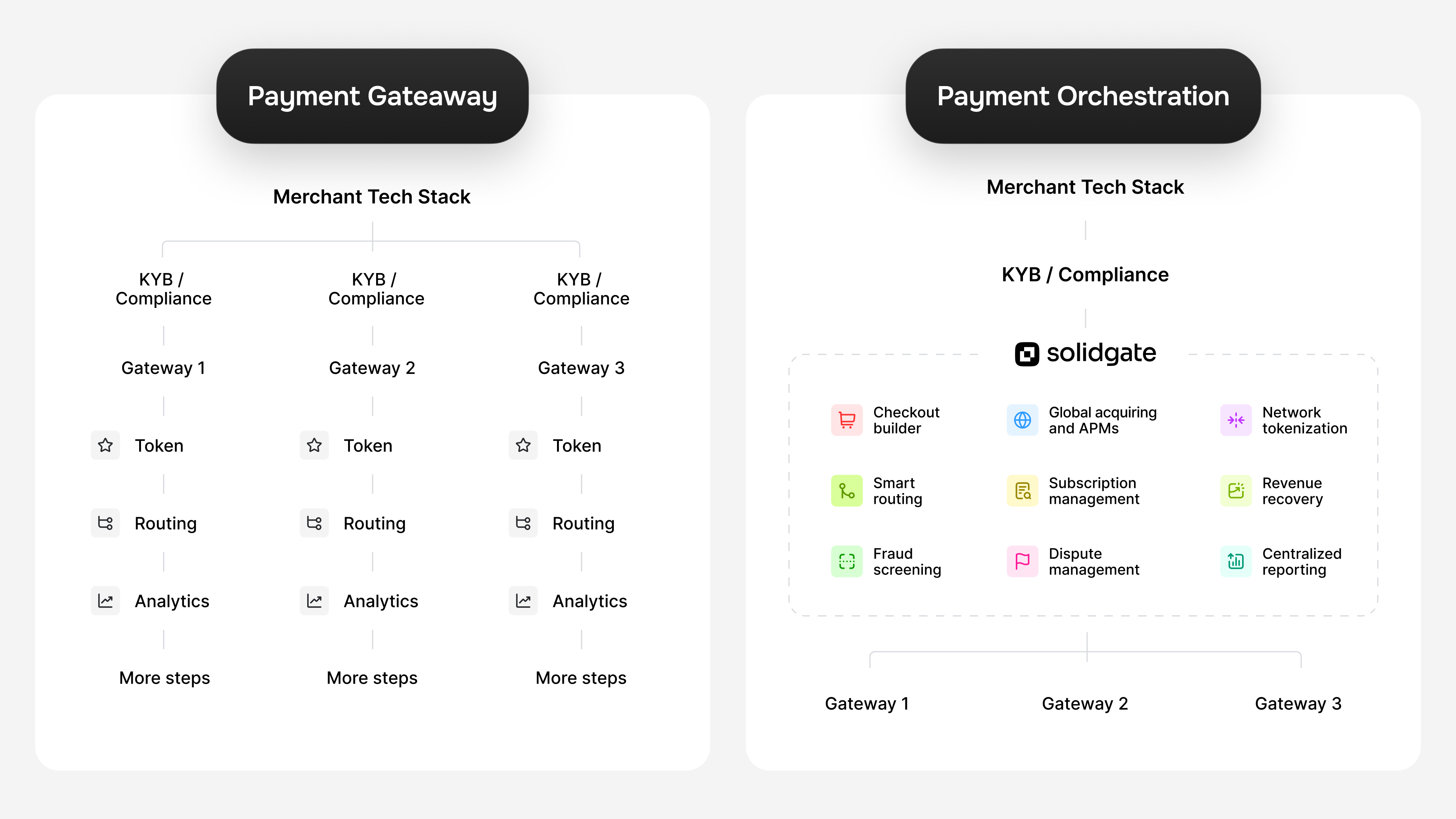
These platforms optimize transaction routing and ensure payments are processed along the best available path, based on factors such as cost, success rates, and geographic location.
Orchestration platforms go beyond basic transaction processing:
- Multi-gateway management: Connect to various payment providers simultaneously, enabling flexible payment acceptance across regions.
- Intelligent routing: Automatically chooses the most efficient path for each transaction, based on dynamic factors.
- Failover protection: Ensures payments are processed even if one provider fails.
- Advanced analytics: Provides actionable insights into transaction performance to optimize payment strategies.
- Compliance automation: Simplifies managing regulatory requirements across multiple payment channels.
Payment orchestration vs payment gateway: Key differences
Who does what in your payment stack
Payment gateways are specialized tools that process payments and handle basic fraud prevention.
Payment orchestration platforms, on the other hand, serve as comprehensive payment management systems that connect multiple payment technologies and optimize payment flows across regions and providers.
Smart routing vs static payment paths
Payment gateways route transactions through predefined paths, typically using a single processor. This works for businesses with simple needs, but it becomes limiting as your operations become more complex.
Orchestration platforms offer , analyzing multiple factors such as:
- Cost optimization: Choosing the most cost-effective payment path
- Success rate maximization: Directing payments through gateways with higher approval rates for specific transaction types
- Geographic optimization: Routing payments through locally preferred providers
- Load balancing: Distributing transactions across multiple providers to prevent bottlenecks
- Risk management: Sending high-risk transactions through specialized fraud prevention channels
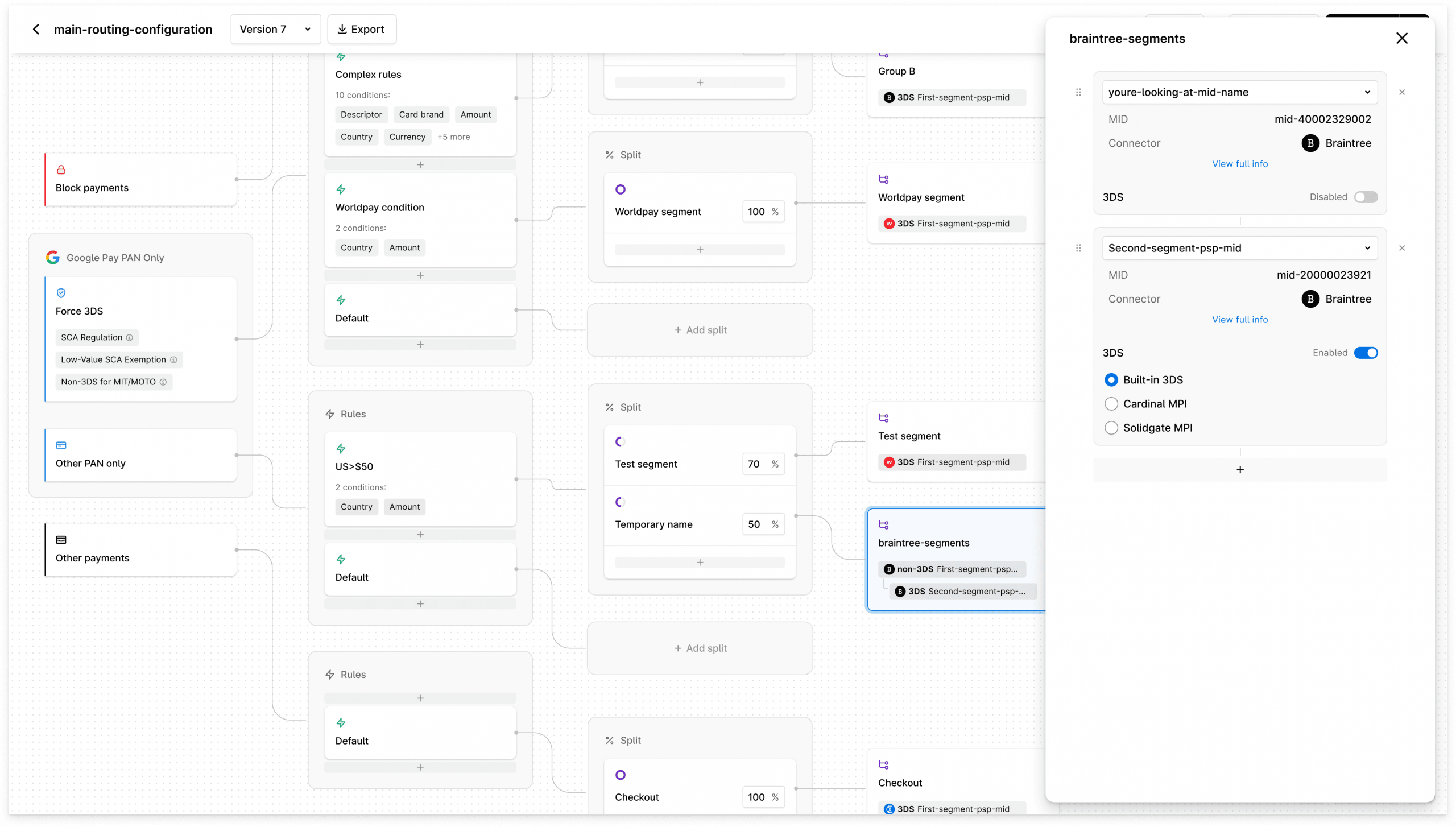
in Solidgate Hub.
Scalable vs fixed payment stack
If you use a single gateway, adding new payment methods, entering new markets, or building backup processing capabilities requires significant effort and resources.
Each new integration is treated as a separate project, often taking months. Reconciling payments data across providers often complicates your operations by 10x.
In contrast, orchestration platforms offer built-in stack scalability. They allow businesses to add new gateways, payment methods, and regions within days or weeks. Solidgate's platform provides businesses with over 110 payment connectors and tools to expand their payment infrastructure quickly.
Relevant read:
Checklist: Do you need a payment gateway or payment orchestration?
Choosing between a payment gateway and payment orchestration depends on your business's growth strategy, transaction volume, and operational complexity.
You might need a payment gateway if:
- Your business operates in one market or region.
- You process a low volume of transactions (up to $200k a month) with minimal billing complexity.
- You only require support for standard payment methods (credit/debit cards, PayPal).
- Your growth plans don’t involve international expansion or adding new payment methods in the near future.
- You are looking for a simple solution with easy integration and minimal setup.
You might need payment orchestration if:
- You are expanding into new regions and need support for local payment methods, currencies, and languages.
- Your business is processing over $300k a month, especially across multiple markets.
- You require multi‑gateway/PSP management to ensure transaction success rates, reduce processing costs, and enhance fraud prevention.
- You want to optimize payment routing to select the best provider based on cost, approval rates, and geographic considerations.
- Your team needs to simplify operations by integrating and managing multiple payment providers through one platform.
- You need advanced analytics and insights to track performance across channels and identify opportunities for improvement.
- Your business requires failover protection to ensure uninterrupted transactions during outages or peak traffic.
Get payment orchestration and more with Solidgate
If a single-gateway setup doesn't work for you, Solidgate offers a payment orchestration platform that centralizes your payment operations. Our platform is designed for online businesses focused on global growth, cost reduction, and operational efficiency.
Our solution is built around three layers:
- Orchestration suite: Payment form, payment link, smart routing, reconciliation, and token vault.
- Payment infrastructure: Connecting you to acquiring, APMs, and a wide range of .
- Value-added services: Subscription billing, fraud prevention, chargeback management, and global tax compliance.
Whether you're expanding globally or optimizing your current payment stack, Solidgate simplifies your payment infrastructure to support growth. With one unified platform, we help you reduce complexity, improve payment success rates, and scale your operations.
Considering payment orchestration? Read more about Solidgate, or with our team to learn how we can help you.
Considering payment orchestration? Read more about Solidgate, or with our team to learn how we can help you.
Frequently asked questions
A payment gateway processes transactions through a single payment path, while payment orchestration manages multiple gateways and payment methods through intelligent routing. Orchestration platforms provide strategic payment management across multiple providers, whereas gateways focus on reliable processing through one channel.
Businesses should choose payment gateways when they have simple payment needs, process moderate transaction volumes in single markets, prefer straightforward implementation, and don't require advanced routing or analytics capabilities. Gateways work well for companies focused on core business activities rather than payment optimization.
Payment orchestration benefits businesses of various sizes, though the value proposition increases with complexity and scale. Small businesses with international customers, multiple payment method requirements, or growth ambitions can benefit from orchestration platforms. However, very small businesses with basic local payment needs may find gateways a better fit.