SWIFT banking system: How SWIFT payments work
Payments 101
Updated 22 Sept 2026
11 min

Andrii Stoikov
Head of Support, Integration, Billing Operations, Solidgate
Secure messaging, efficient payments, and reliable transfers - SWIFT makes international finance simple.
More than 53 million FIN messages travel through SWIFT every day on average. Behind every international wire transfer, securities settlement, and treasury instruction sits the same network – the Society for Worldwide Interbank Financial Telecommunication – connecting over 11,500 institutions across more than 200 countries and territories.
Most businesses interact with SWIFT through their bank, without visibility into what happens between instruction and settlement.
This guide covers the SWIFT banking system end to end – how SWIFT payments work step by step, what identifiers you need and why, which additional services SWIFT offers beyond core messaging, how the network handles security, and what alternatives exist for specific use cases.
TL;DR
- SWIFT is a global messaging network – not a payment system. It transmits payment instructions between banks; the actual movement of funds happens through correspondent banking relationships.
- A typical SWIFT payment follows nine steps, from initiation through reconciliation. Where intermediary banks are involved, settlement takes one to five business days.
- SWIFT codes (BICs) identify the receiving bank; IBANs identify the specific account. Most international transfers require both.
- Beyond messaging, SWIFT offers compliance tools, reference data, connectivity services, and GPI – a real-time payment tracking layer where 75% of Swift payments reach destination banks within 10 minutes.
- Alternatives like Wise, CIPS, and crypto networks exist, but none fully replaces SWIFT at institutional scale.
What is the SWIFT system?
The SWIFT banking system – Society for Worldwide Interbank Financial Telecommunication – is a global messaging network and financial communication platform used by banks and financial institutions worldwide. It provides a secure, standardized way to exchange information and instructions relating to cross-border payments, treasury operations, securities transactions, and other financial transactions.
SWIFT enables banks to communicate and settle transactions efficiently, ensuring the secure and reliable transfer of funds across borders. It serves as a crucial infrastructure for international banking, promoting standardization, transparency, and efficiency in global financial transactions.
Who uses SWIFT and its services
SWIFT's services benefit a wide range of stakeholders involved in international financial transactions.
Banks and financial institutions are the primary users. SWIFT provides a secure and standardized platform to exchange financial messages and facilitate cross-border transactions. It enables them to streamline payment processes, reduce operational costs, and handle international payments more efficiently.
Corporations and businesses benefit from SWIFT by using its network for secure and efficient treasury operations, cash management, and international trade finance. SWIFT enables them to pay suppliers, receive funds from customers, and manage global financial transactions.
International employees benefit because SWIFT enables their employers to securely transfer salaries and other financial benefits to their bank accounts in their home countries, ensuring timely and reliable fund transfers.
Remittance service providers use SWIFT's infrastructure to transfer funds globally, enabling individuals to send money to their home countries.
Regulatory authorities benefit from SWIFT's compliance and security measures, which help combat financial crimes such as money laundering and terrorist financing. SWIFT's messaging standards and transparency contribute to the effectiveness of regulatory oversight.
Core insight: SWIFT's network serves institutions, businesses, employees, and regulators – each relying on a different layer of the same infrastructure. The common thread is secure, standardized cross-border financial communication.
How SWIFT payments work: Step-by-step
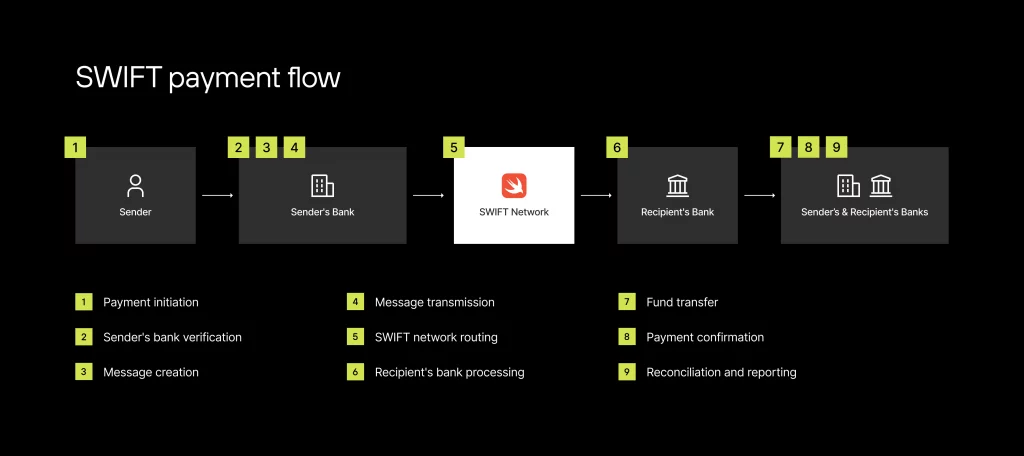
1. Payment initiation
The sender instructs their bank to initiate a payment. This instruction includes the beneficiary's account information, the amount to be transferred, and any additional payment details.
2. Sender's bank verification
The sender's bank verifies the payment instruction, ensuring it meets all necessary regulatory requirements and that sufficient funds are available.
3. Message creation
The sender's bank creates a payment message using SWIFT's standardized messaging format – now ISO 20022 (MX format) following the from the legacy MT standard. This message contains the necessary details of the payment, including the sender's information, beneficiary information, and payment instructions.
4. Message transmission
The sender's bank securely transmits the payment message through the SWIFT network to the recipient's bank. The system encrypts the message to ensure data confidentiality and integrity during transmission.
5. SWIFT network routing
The system routes the payment message through the SWIFT network, directing it to the appropriate recipient bank based on the unique SWIFT code assigned to each financial institution.
Where the sender's bank has no direct correspondent relationship with the recipient's bank, the message routes through one or more intermediary banks, each of which may deduct a handling fee.
6. Recipient's bank processing
The recipient's bank processes the payment instruction, verifies the beneficiary information, checks for any sanctions or compliance issues, and ensures the funds are credited to the correct beneficiary account.
7. Fund transfer
Once the recipient's bank completes the necessary validations, it initiates the transfer of funds from the sender's bank to the recipient's bank through correspondent banking relationships and settlement systems.
8. Payment confirmation
After the funds have been successfully transferred, both the sender's and recipient's banks generate confirmation messages. These include details such as transaction reference numbers and information.
9. Reconciliation and reporting
Both banks their accounts and update their records to reflect the payment transaction. They generate reports and provide necessary information to their customers regarding the payment status, fees, and other relevant details.
Core insight: SWIFT's messaging network ensures secure and reliable communication between financial institutions throughout this process – facilitating cross-border payments while adhering to international standards and regulations.
SWIFT code and IBAN: What you need to know
SWIFT codes and IBANs are two distinct identifiers used in international banking to ensure accurate routing and identification of bank accounts during cross-border transactions.
SWIFT code (BIC – ) is a unique alphanumeric code assigned to each financial institution participating in the SWIFT network. It consists of either 8 or 11 characters and provides information about the bank, its country, city, and branch. When sending a cross-border payment, the SWIFT code identifies the recipient's bank and ensures the payment message is routed to the correct institution.
IBAN (International Bank Account Number) is a standardized international numbering system used to identify bank accounts in specific countries. It includes a country code, two check digits for data integrity verification, and a series of alphanumeric characters representing the country-specific bank account number. European countries and some countries outside Europe primarily use IBAN. When making a payment, the sender must provide the recipient's IBAN to ensure accurate routing and crediting of funds.
In practice, the sender's bank uses the SWIFT code to route the payment message to the correct institution. The recipient's bank then uses the IBAN to identify the specific account where funds should be credited. Both work together to make safe and accurate international payments.
Core insight: The SWIFT code tells you which bank to pay; the IBAN tells you which account to pay. Most international transfers require both.
SWIFT's additional services
In addition to its core messaging services, SWIFT offers a range of services that enhance its value as a financial infrastructure provider.
Compliance services
Compliance services provide a suite of compliance-related solutions to assist financial institutions in meeting regulatory requirements and combating financial crime. These include financial crime compliance solutions, sanctions screening tools, AML controls, and tools for managing counterparty risk.
Connectivity services
Connectivity services offer various options for financial institutions to connect to the SWIFT network securely. These include dedicated leased lines, VPN connections, and cloud-based solutions via SWIFT Alliance Messaging Hub (AMH), SWIFTNet Link, and access solutions including the Shared Infrastructure Program (SIP).
Global Payments Innovation (GPI)
GPI enhances the speed, transparency, and end-to-end tracking of cross-border payments. With GPI, financial institutions can offer faster and more transparent payment services, including same-day value, real-time tracking, and confirmation of payment delivery. SWIFT reports that 75% of Swift payments reach destination banks within 10 minutes.
SWIFTRef
SWIFTRef is a comprehensive reference data platform providing accurate, up-to-date information on financial institutions, codes, and other essential reference data. It helps financial institutions ensure the accuracy of payment instructions, improve straight-through processing, and minimize errors.
MyStandards
MyStandards is a collaborative platform that enables financial institutions to streamline and standardize their message standards and implementation processes. It offers tools for message validation, testing, and documentation – promoting interoperability and reducing implementation time.
SWIFT Integration Platform (SIP)
The SWIFT Integration Platform helps financial institutions integrate their internal systems and applications with the SWIFT network. It provides a standardized interface and tools to enable data exchange between internal systems and the SWIFT messaging infrastructure.
Core insight: SWIFT's additional services extend well beyond messaging – covering compliance, connectivity, payment tracking, and reference data. Together they form a suite of SWIFT payment solutions that financial institutions use to address specific operational needs in cross-border transactions.
How SWIFT protects transactions
SWIFT secures its network and transactions through several layers of control.
Closed network: the network operates separately from the public internet, reducing exposure to external threats and preventing unauthorized access by design.
Message encryption: all messages are encrypted using industry-standard algorithms, ensuring contents remain confidential and can only be deciphered by the intended recipient.
Digital signatures: cryptographic signatures verify the authenticity and integrity of each message, confirming it has not been tampered with during transmission.
Strong authentication: access requires multi-factor , typically combining a secure token with a digital certificate.
Customer Security Program (CSP): a mandatory set of security controls that all member institutions must implement and maintain, covering endpoint security, access management, and anomaly monitoring within each institution's own infrastructure.
Cybersecurity audits: periodic assessments of member institutions verify compliance with security requirements, identify vulnerabilities, and provide recommendations for remediation.
tools: behavioral analysis and anomaly detection flag suspicious or fraudulent activity within transaction flows before messages are delivered.
Incident response and support: a 24/7 security operations center (SOC) monitors the network and coordinates response to security incidents.
Compliance with regulatory standards: the network aligns with international regulatory standards including GDPR, AML, and KYC.
Core insight: SWIFT's security model combines network-level controls – encryption, closed architecture, digital signatures – with member-level requirements through the CSP. Security is a shared responsibility between the network and each participating institution.
Alternatives to SWIFT
Several SWIFT alternatives have emerged in recent years, each offering a different approach to cross-border payments and financial services.
Blockchain-based solutions offer decentralized and transparent that enable peer-to-peer transactions without the need for intermediaries.
National payment systems: some countries have developed their own interbank payment systems for cross-border transactions. China's Cross-Border Interbank Payment System (CIPS), established by the People's Bank of China, facilitates RMB-denominated cross-border payments directly without routing through SWIFT.
Correspondent banking networks: financial institutions can establish direct bilateral relationships with partner banks globally, allowing cross-border payment instructions without routing through a centralized messaging network. This reduces dependency on SWIFT for specific corridors where direct relationships exist.
Wise (formerly TransferWise): a money transfer platform that uses local bank accounts in each country to settle transfers domestically, bypassing correspondent banking networks. It offers transparent fees, mid-market exchange rates, and multi-currency accounts for individuals and businesses.
NIUM (formerly InstaReM): a global payments infrastructure platform that provides APIs for cross-border payments, real-time payouts, card issuance, and FX to enterprises, fintechs, and financial institutions across payroll, marketplaces, and travel.
Airwallex: a global financial platform for businesses that combines multi-currency accounts, international transfers, FX at interbank rates, corporate cards, expense management, and payment acceptance across multiple local payment methods.
Core insight: These SWIFT alternatives differentiate through cost-effectiveness, speed, transparency, and ease of use. Evaluating each option's specific features, limitations, and regulatory considerations is essential when choosing the most suitable alternative for specific cross-border payment needs.
SWIFT pros and cons
Pros:
- Global reach: SWIFT provides a vast network connecting financial institutions worldwide, enabling efficient and secure communication for cross-border transactions.
- Standardization: SWIFT enforces strict messaging standards. The network completed its migration to ISO 20022 in November 2025, enabling richer, structured data exchange that improves straight-through processing and compliance screening.
- Security: SWIFT employs robust security measures to protect the confidentiality and integrity of transmitted data, including encryption, authentication protocols, and secure messaging infrastructure.
- Established infrastructure: SWIFT has been a dominant player in the financial industry for decades, with a mature and reliable infrastructure trusted by banks and financial institutions globally.
- Regulatory compliance: SWIFT helps financial institutions meet regulatory requirements by providing messaging services that facilitate compliance with AML and KYC guidelines.
Cons:
- Cost: SWIFT's services come with associated fees, including messaging fees and connectivity costs, which can be significant, especially for smaller financial institutions and organizations with high message volumes.
- Processing time: cross-border transactions through SWIFT can take several days to settle due to the multi-step process involving correspondent banks and intermediaries.
- Lack of transparency: SWIFT messages may not provide real-time visibility into transaction status or detailed information on fees and foreign exchange rates, making it challenging to track and reconcile transactions.
- Limited innovation: SWIFT's legacy infrastructure and standardized messaging formats may be perceived as less agile compared to emerging technologies and fintech solutions.
- Dependency on correspondent banks: SWIFT transactions often involve multiple correspondent banks, leading to increased complexity and potential delays or errors in the settlement process.
| Pros | Cons |
| Global reach | Cost |
| Standardization | Processing time |
| Security | Limited transparency |
| Established infrastructure | Innovation pace |
| Regulatory compliance | Correspondent dependency |
Core insight: SWIFT's strengths – global reach, standardization, and regulatory compliance – come with trade-offs in cost, speed, and transparency. The right choice depends on whether institutional-grade reliability or operational simplicity matters more for the specific use case.
Best practices for optimizing SWIFT payments
SWIFT involves multiple parties, formats, and compliance checkpoints. By following these best practices, institutions and businesses can optimize their payments via SWIFT, reducing errors and ensuring smooth and secure cross-border transactions.
→ Use correct message formats. SWIFT completed its migration to ISO 20022 MX format in November 2025 – legacy MT payment instructions between financial institutions are no longer accepted over FIN. Institutions still relying on MT formats for any remaining traffic should prioritize completing migration to avoid rejections.
→ Implement straight-through processing (STP). Automating payment processing reduces manual intervention, minimizes errors, and expedites payment settlements.
→ Maintain reliable connectivity and infrastructure. Ensure that hardware, software, and network components supporting SWIFT connectivity are robust and properly maintained to avoid disruptions.
→ Validate messages before transmission. Check SWIFT messages for format, content, and compliance with regulatory requirements before sending, reducing the chances of rejections or delays.
→ Reconcile payment data promptly. Regularly reconcile payment data with internal systems to identify discrepancies or exceptions early, ensuring accurate financial reporting.
→ Implement robust security measures. Protect SWIFT transactions and related data through secure user authentication, encryption, and monitoring tools – in line with CSP requirements.
→ Manage correspondent bank relationships actively. Strong working relationships with correspondent banks help resolve issues efficiently and support smoother payment processing.
→ Monitor payment status and performance. Use comprehensive monitoring and reporting mechanisms to track payment status, detect anomalies, and measure payment performance.
→ Review and improve payment processes continuously. Regularly evaluate payment workflows to identify areas for improvement and engage with SWIFT resources, industry peers, and service providers to explore optimization opportunities.
Core insight: Most SWIFT payment delays and failures trace to two sources – incorrect identifier data and long correspondent bank chains. Addressing both delivers more improvement than any change to how SWIFT itself is configured.
Getting more from cross-border payments
SWIFT is the infrastructure behind most international wire transfers – but cross-border payment performance depends on more than one piece of that infrastructure. Scaling globally also means offering , optimizing routing across providers, and reducing friction at every step of the transaction.
The businesses that convert and retain more customers internationally are typically those with a well-configured .
If you want to see where your current stack holds up and where it can improve,.
Frequently asked questions
Member financial institutions, including banks, broker-dealers, and other financial entities, govern and control SWIFT. The Board of Directors supervises the organization, with representatives from member institutions – ensuring decisions are made collectively.
The financial institutions using SWIFT's services pay its charges. These costs are typically passed on, in full or in part, to the end customer initiating the international payment.
To receive a SWIFT payment, you need to provide the sender with your bank's SWIFT code (BIC) and your account's IBAN. The sender initiates the transfer through their bank, which routes the payment message through the SWIFT network to your bank.
Yes. Alternatives include Wise (formerly TransferWise), CIPS (China's Cross-Border Interbank Payment System), blockchain-based solutions, and global fintech platforms such as NIUM and Airwallex. Each has different trade-offs in cost, speed, and regulatory coverage.
Yes. SWIFT uses a closed private network, message encryption, digital signatures, and strong authentication. Its Customer Security Program (CSP) also mandates security controls that all member institutions must implement and maintain.
Cross-border transactions through SWIFT can take one to several business days to settle, depending on the corridor and the number of intermediary banks involved. SWIFT's GPI initiative has improved speed – 75% of Swift payments reach destination banks within 10 minutes.