8 Best payment orchestration platforms compared: 2026 merchant's guide
Industry
11 Feb 2026
14 min

Anton Tsyslytskyi
Product Manager, Solidgate
We analyzed 8 payment orchestration platforms to help you cut processing costs, launch in new markets faster, and consolidate vendors. See which fits your stack.
Payment orchestration market has matured past "connect to multiple PSPs and route transactions." The platforms winning mid-market buyers in 2026 are the ones that solve the adjacent problems payments teams actually lose sleep over:
- Why did our auth rate drop 3% last week?
- Why does reconciliation take 6 days every month?
- How do we launch in Brazil without a 4-month integration project?
- How can we reduce fees to improve margins?
As a result, the orchestration market has bifurcated. Some platforms are pure connectivity layers that act as advanced routing engines. Others bundle orchestration with direct financial infrastructure and value-added services.
Neither approach is inherently better. The right choice depends entirely on your specific bottlenecks, goals, and setup.
We've analyzed public data across eight leading orchestration platforms – starting with our own solution, as we know it best – to help you match platform architecture to your actual problems, not just compare feature lists.
TL;DR: Overview of the 8 best payment orchestration platforms in 2026
- Solidgate: Unified platform combining advanced payment orchestration, global card acquiring, coverage of 100+ markets, and value-added services like billing, dispute representment, prevention alerts, and tax. Best fit for mid-market consumer subscription and e-commerce businesses scaling across multiple markets.
- Norbr: A platform with a wide connector network. Strongest fit for businesses needing deep payment localization across diverse global markets.
- ProcessOut: AI-driven routing with real-time performance benchmarking. Best for fast-growing businesses that need granular payment flow optimization and advanced analytics.
- Spreedly: Payments platform designed for SaaS, travel, and marketplaces that prioritize API-first orchestration and PSP flexibility.
- Yuno: A platform with a breadth of payment methods and a comprehensive toolkit (fraud, disputes, subscriptions). Optimized for businesses expanding into LATAM and APAC with deep localization needs.
- Primer: Drag-and-drop workflow builder with ML-based routing. Suited for businesses of all sizes needing highly customizable payment automation without engineering resources.
- BlueSnap: Hybrid gateway and orchestration with embedded payments, fraud prevention, and subscription billing. Designed for large international businesses needing an all-in-one solution.
- PayU: Global acquiring and orchestration with strong APM coverage in CEE, LATAM, and Africa. Best for enterprises and SMBs in hospitality and marketplaces targeting emerging markets.
8 leading payment orchestration platforms in 2026
For this comparison, we evaluated eight platforms based on how they handle payment orchestration, infrastructure management, and operational complexity.
But instead of ranking them purely by feature count – which tells you nothing about whether they'll actually solve your problem – we grouped them by architectural approach and what that means for implementation speed, vendor consolidation, and team workload.
Category A: Unified payment platforms (orchestration + infrastructure + services)
New type of platforms that combine payment orchestration with direct financial infrastructure / acquiring and value-added operational services. These solutions let you manage your entire payment stack – from routing and connectivity to acquiring, fraud prevention, and financial operations – in a single platform.
Because they provide both orchestration and financial infrastructure, you can launch faster without negotiating separate contracts.
Good fit for: Businesses that want to consolidate vendors and launch quickly without managing multiple payment processor relationships. You get faster implementation and simplified operations, with the option to add and switch external PSPs as you scale.
Category B: Pure-play orchestration layers
Purpose-built orchestration layers that sit between your business and multiple payment service providers. These platforms focus on connectivity, routing control, operational visibility, and maximum PSP flexibility.
Good fit for: Businesses that maintain direct PSP relationships and want full control over PSP selection and routing optimization between them.
Category C: Infrastructure-first orchestration platforms
Those platforms are primarily built to provide payment infrastructure connectivity at scale, with orchestration capabilities layered on top. They emphasize breadth of payment method coverage and provider connectivity, often serving as white-label infrastructure for platforms, PayFacs, and ISVs.
Good fit for: PayFacs, ISVs, and platforms building white-label payment infrastructure, or businesses expanding into diverse global markets where breadth of payment method coverage is the primary requirement.
1. Solidgate - Payment orchestration with built-in infrastructure and growth toolkit
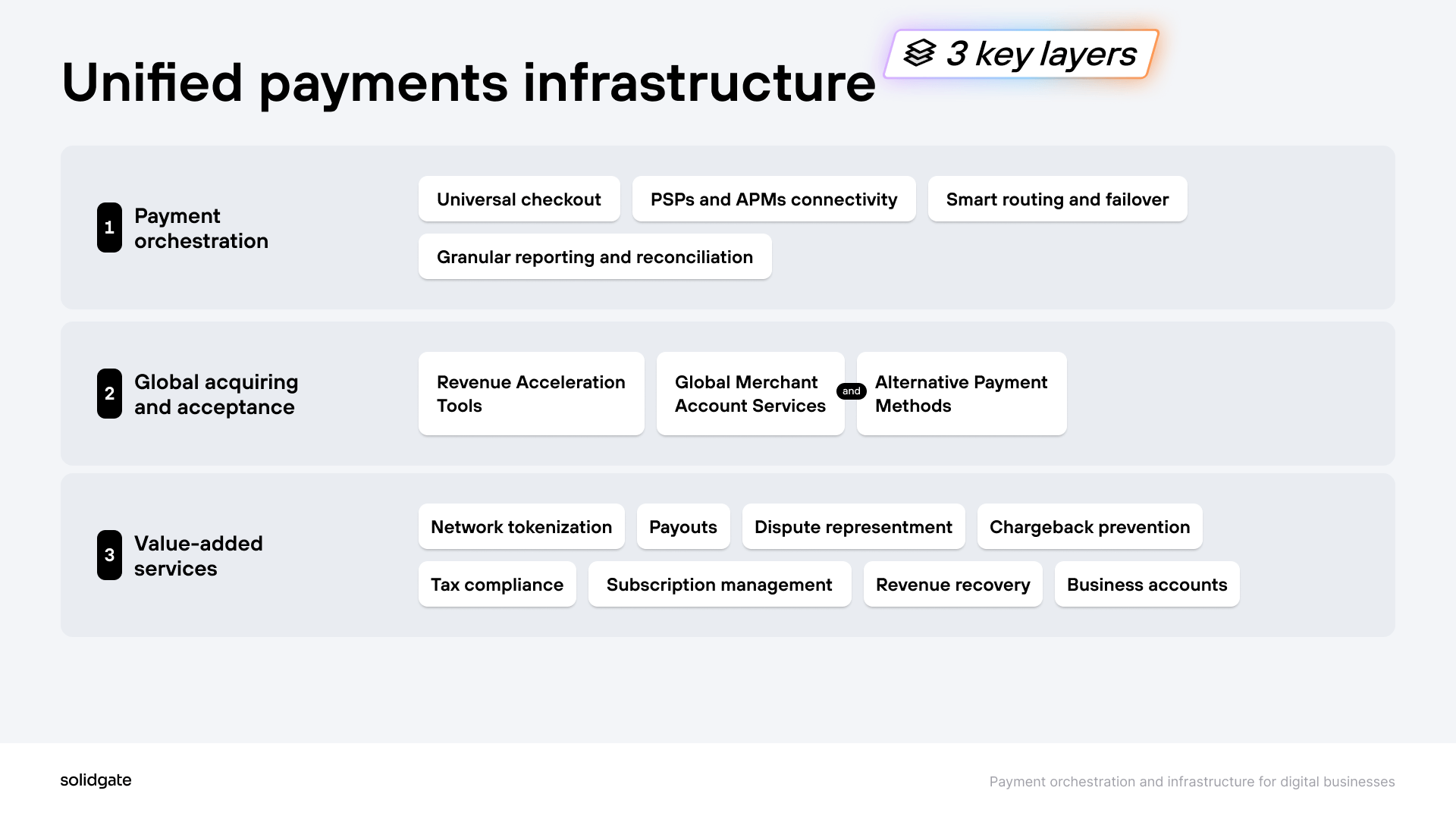
Solidgate combines payment orchestration with direct acquiring and value-added services – all in one platform. Unlike pure orchestration layers that only connect you to PSPs, we provide the infrastructure to process payments directly.
Founded over 9 years ago, we've helped hundreds of European digital businesses expand internationally, maximize revenue, and reduce payment costs and operational overhead.
We're one of the few global payment orchestration platforms with direct payment infrastructure and operational tools – reducing the vendors you need to manage while giving you full control over your payment stack.
Orchestration suite
1. Checkout and acceptance:
- Customizable Payment Forms that integrate directly into your site
- Add or remove payment methods in minutes
- Provider-agnostic 3D Secure to balance security and conversion
- Full control over checkout UX and branding
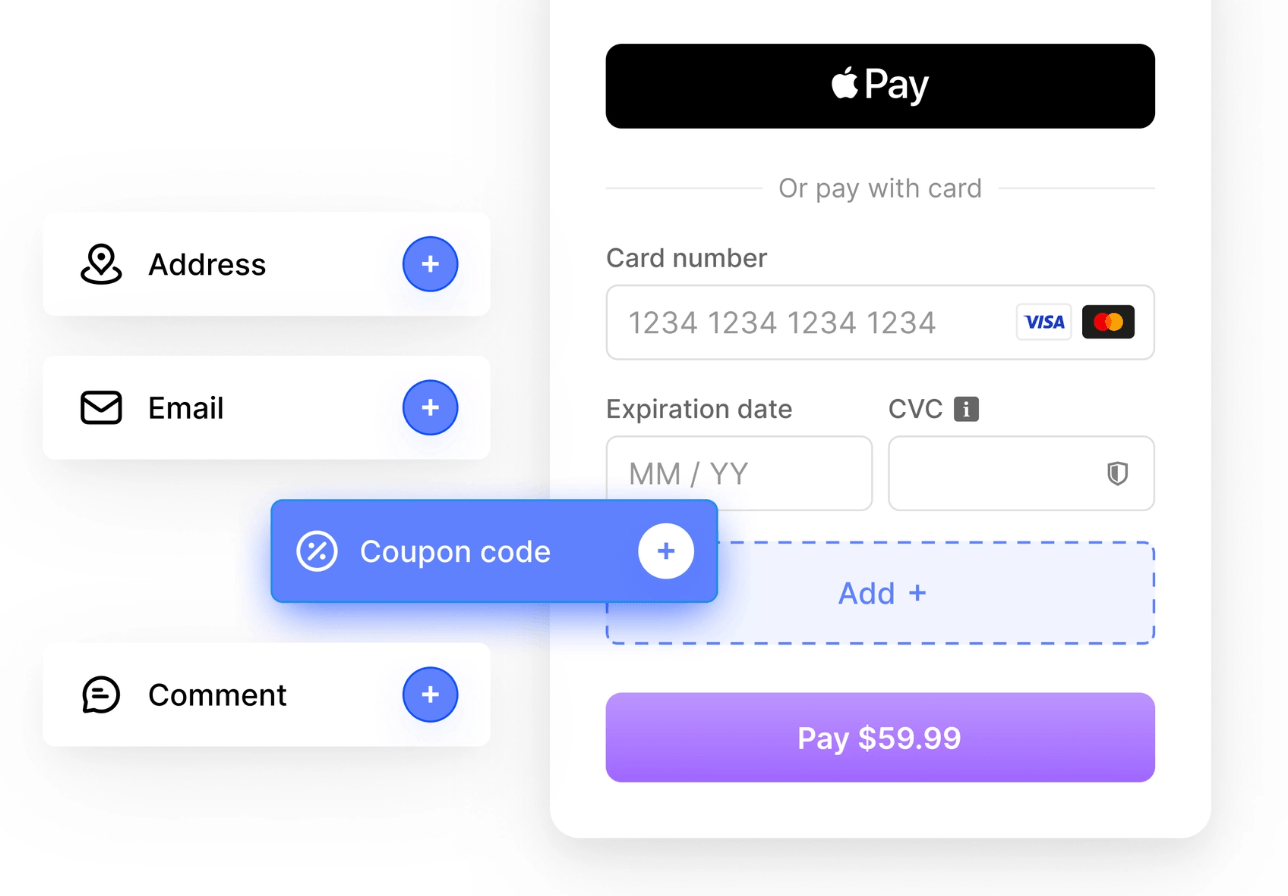
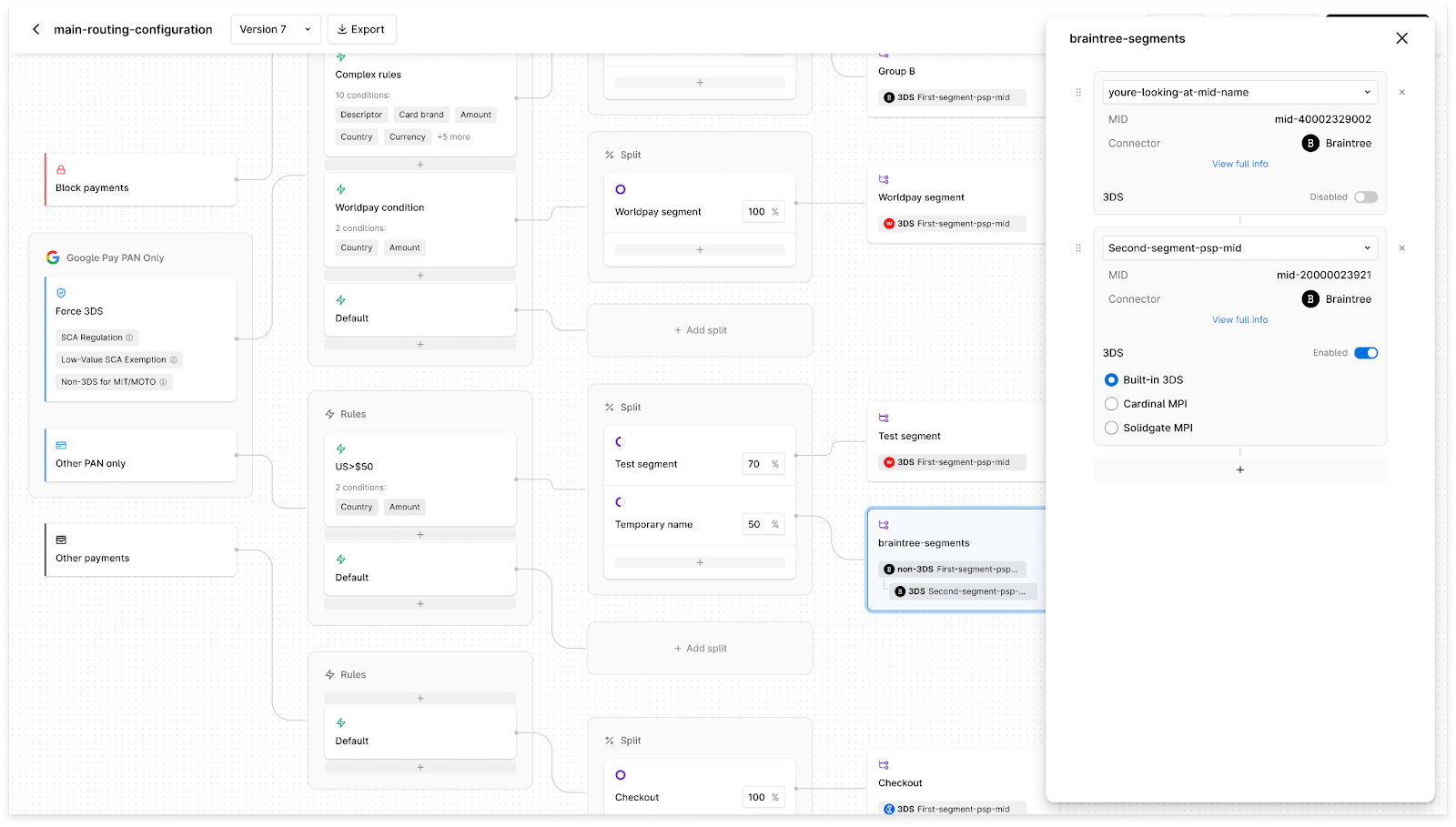
2. Payment routing and cost optimization:
- Self-service smart payment routing with no-code configuration for non-technical teams for cost and performance optimization
- Automatic failover and smart retries to maximize payment success
- A/B testing capabilities for routing strategies
3. Unified data management:
- Provider-agnostic Token Vault for customer, card, and payment method data
- Automated financial reconciliation across all providers
- Payment analytics dashboard with detailed real-time insights
Global payment infrastructure
- Direct acquiring without lengthy bank negotiations – launch in days, not months
- 100+ payment provider connections and payment methods with deep coverage across Europe, North America, LATAM, and Asia Pacific
- Network tokenization, level 2/3 data support, and Click to Pay to boost acceptance rates
Value-added services
Modular, on-demand tools that solve specific operational problems as you scale:
- Subscription billing and recurring payment management
- Fraud management with customizable rules
- Chargeback prevention alerts and automated representment
- Tax compliance automation
- Global business accounts
Integration options
- Unified API: Use server-to-server integration built for complete control and flexible payment flows.
- : Customizable, securely embedded form without PCI DSS complexity.
- : A fully hosted, PCI-compliant, no-code checkout.
- : Pre-built integrations for Shopify, WooCommerce, Magento, OpenCart, PrestaShop, and more.
What businesses should consider Solidgate?
This setup works best for:
- Mid-market B2C and B2B subscription software and digital goods businesses
- Fast-growing global e-commerce brands
- Cross-border marketplaces
Key challenges Solidgate solves:
- Fast market expansion: Launch in new markets without negotiating separate acquiring contracts or building new PSP integrations.
- Payment optimization: Reduce cross-border processing costs and improve authorization rates through intelligent routing and network tokenization.
- Revenue recovery: Minimize failed recurring payments with provider-agnostic tokenization, smart retry logic, and account updater.
- Operations consolidation: Manage routing, billing, fraud prevention, disputes, tax compliance, and reconciliation from one platform instead of stitching together 5+ vendors.
That said, Solidgate might not fit every use case. Here are a few notable alternatives.
2. BlueSnap – Hybrid gateway and orchestration for B2B payments
BlueSnap combines payment gateway functionality with orchestration features and embedded payments, offering an integrated approach that includes processing, fraud prevention, and billing in one package. They have particular strength in B2B payments with Level 2/3 data processing. Below are some of their notable solutions.
Acceptance:
- Local card acquiring in 50 countries
- Payment coverage across 200+ regions
- Checkout builder for customized payment experiences
Optimization:
- Smart payment routing
- Network tokenization and account updater
- 3D Secure authentication
- Level 2 and 3 data processing for B2B transactions
Management:
- Unified analytics and reporting across all payment channels
- Transaction monitoring and reconciliation
Value-added services:
- Subscription lifecycle management
- Global payouts
- Built-in fraud prevention
- Chargeback management
We think it’s a good fit for: Education, healthcare, and business management platforms with significant B2B transaction volume that need embedded payment solutions and prefer an all-in-one approach combining gateway processing and orchestration. Below are some of their notable solutions.
3. PayU – Gateway and orchestration with emerging market expertise
PayU operates as both a payment gateway and orchestration layer, with particular strength in emerging markets. They offer direct acquiring combined with orchestration capabilities, with deep expertise in Central and Eastern Europe, Latin America, and Africa. Below are some of their notable solutions.
Acceptance:
- Direct global card acquiring with local presence
- APM coverage across 50+ countries with focus on CEE, LATAM, and Africa
- Strong local payment method expertise in emerging markets
Optimization:
- AI-driven routing with instant retry logic
- 3D Secure and comprehensive compliance suite
Management:
- Payment management dashboard with analytics
- Transaction monitoring and reporting
Value-added services:
- Built-in antifraud system
We think it’s a good fit for: Enterprises and SMBs in hospitality and e-commerce marketplaces targeting Central and Eastern Europe, Latin America, or Africa, where local payment expertise, direct acquiring relationships, and APM coverage are critical for success.
4. ProcessOut – Advanced routing with real-time performance analytics
ProcessOut (owned by Checkout.com) focuses on payment intelligence – using AI-driven routing combined with granular performance monitoring through their Telescope analytics system. They emphasize data transparency and real-time optimization. Below are some of their notable solutions.
Acceptance:
- Payment coverage across 190+ countries
- Provider-agnostic Token Vault with network tokenization
Optimization:
- AI-driven smart routing with dynamic, real-time optimization
- Network tokenization to reduce declines
- Automatic retry logic across multiple providers
Management:
- Telescope monitoring system that analyzes transactions across all providers with performance benchmarking
- Financial reconciliation and unified reporting
We think it’s a good fit for: Fast-growing e-commerce, SaaS, and delivery businesses in Europe and North America that need to optimize every percentage point of their payment acceptance rates and want detailed, data-driven visibility into performance.
5. Spreedly – API-first orchestration for maximum PSP flexibility
Spreedly has been in the open payments space since 2007, building a reputation as a reliable connectivity layer. They prioritize API-first architecture and PSP flexibility, offering cross-border payment tools and intelligent data. Below are some of their notable solutions.
Acceptance:
- Connection to over 140 payment gateways
- Token Vault with secure payment credential storage
Optimization:
- Network tokenization and account updater
- Cascading and automatic fallbacks
- Smart payment retries for declined transactions
Management:
- End-to-end reporting and reconciliation
- Dashboard with alerting functionality
- Transaction monitoring and performance tracking
Value-added services:
- Risk management and fraud prevention integrations
- Recurring billing support
We think it’s a good fit for: SaaS platforms, travel companies, and marketplaces that value engineering control and API-first architecture, particularly those wanting the flexibility to easily switch or add PSPs without vendor lock-in.
6. Primer – No-code workflows with drag-and-drop customization
Primer differentiates through its visual workflow builder. It allows non-technical teams to design and optimize complex payment flows and create bespoke solutions for unique payment workflows without engineering resources. They emphasize automation and customization through an intuitive interface. Below are some of their notable solutions.
Acceptance:
- Customizable checkout with full UX control
- Centralized Vault for payment credential storage
- Multi-PSP connectivity
Optimization:
- Drag-and-drop workflow builder for non-technical teams to create custom payment logic
- No-code smart routing configuration
- Provider-agnostic 3D Secure
- Network tokenization
- Automatic fallbacks and retry mechanisms
Management:
- Unified reconciliation
- Performance monitoring dashboards with configurable alerts
- Real-time visibility into payment operations
We think it’s a good fit for: Small businesses with simple workflows across retail, travel, fintech, and entertainment that need control over payment workflows without engineering support or technical resources.
7. Norbr – White-label infrastructure with extensive connector marketplace
Norbr offers white-label payment infrastructure designed for PayFacs, ISOs, and ISVs. Their standout feature is one of the market's most extensive connector directories. Below are some of their notable solutions.
Acceptance:
- Payment coverage across 100+ countries
- Unified dynamic checkout with customizable payment flows
- Universal tokenization for provider-agnostic payment data storage
Optimization:
- No-code, AI-based automated routing
- SCA rule manager with AI-powered recovery
- Automatic fallback and retry logic
Management:
- No-code dashboard for customized payment workflows and insights
- Automated payment reconciliation across payment service providers
- 180+ currency support, including cryptocurrency
We think it’s a good fit for: PayFacs, ISVs, and platforms building white-label payment infrastructure for their end customers, particularly those needing extensive global payment method coverage and customizable workflows.
8. Yuno – Orchestration platform with strong presence in LATAM and APAC
Yuno positions itself as an all-in-one orchestration solution that goes beyond basic routing. They emphasize AI-first architecture and deep localization, particularly in emerging markets. Below are some of their notable solutions.
Acceptance:
- Payment coverage in 200+ countries, with a focus on LATAM, EMEA, APAC, and North America
- Checkout builder for customized payment experiences
- Extensive local payment method support, including emerging markets
Optimization:
- Self-serve, customizable smart routing
- Provider-agnostic 3D Secure
- Network tokenization and account updater
- Split payments for complex transaction flows
- Automatic fallbacks and retry logic
Management:
- Centralized reconciliation across providers
- Payment analytics dashboards
- Real-time transaction monitoring
Value-added services:
- Pre-chargeback alerts and automated chargeback resolution system
- Subscription lifecycle management
- Global payouts
- Risk management and fraud prevention
We think it’s a good fit for: Established e-commerce businesses and digital brands expanding into emerging markets (especially LATAM and APAC) that need both sophisticated orchestration and a comprehensive operational toolkit for managing the full payment lifecycle.
Buying guide: 5 Steps to choose the right payment orchestrator
1. Identify what payment problems you need to solve
Before you get lost in feature matrices and vendor demos, write down the specific payment challenges you're trying to fix.
For example: your business is expanding into three new European markets, but your current PSP doesn't support the alternative payment methods customers expect (iDEAL in the Netherlands, BLIK in Poland).
Setting up separate PSP contracts for each market means juggling multiple integrations, reconciling across different dashboards, and training your ops team on three new systems.
To solve this, you'd look for a platform that offers pre-built connections to PSPs covering these markets, unified reconciliation across all providers, and a single interface for your team to manage everything.
You'd also need migration support to move your existing payment stack without disrupting current operations.
2. Find the platforms that match your criteria
If you're not the primary user of the platform, involve your payments team, finance team, and engineers in this research. They'll help you identify requirements you might have missed and avoid choosing a platform that creates more problems than it solves.
3. Evaluate orchestrators based on these critical elements
Not every platform will fit your needs. Here are the essential capabilities the best orchestration platforms offer:
1. Payment method and geographic coverage
Your orchestration platform is only useful if it supports multiple payment methods that your customers actually use.
Things to consider:
- Does it support the specific local payment methods you need (e.g., PIX for Brazil, Bizum for Spain, Swish for Sweden)?
- How many PSP connections does it offer in your target markets?
- Can you access these payment methods through direct integrations?
- How quickly can they add new payment methods when you expand into additional markets?
- Do they have experience with your industry's payment patterns (e.g., high-value B2B transactions vs. micropayments)?
2. Routing control and optimization
Some platforms give you pre-built routing templates ("route by geography," "route by card type") that work fine until you need something custom. Others let you build complex logic ("if transaction > $500 AND customer is in Germany AND it's a recurring charge, route to Provider A; otherwise, fallback to Provider B").
Things to consider:
- Can you configure routing rules yourself through a no-code interface, or do you need to open a support ticket every time you want to test a new strategy?
- Is there automatic failover when a provider goes down?
- Can you A/B test different routing strategies?
3. Data visibility and reconciliation
Managing payments across multiple PSPs creates a data nightmare if you don't have unified visibility.
Things to consider:
- Can you see all transactions across all payment methods in a single dashboard?
- Does it provide automated reconciliation between transaction records and settlement reports?
- Can you track every transaction's routing path (which provider processed it and why)?
- Are transaction logs detailed enough for debugging issues?
- Can you export data for your own analysis?
- Does it show real-time payment performance metrics by provider, geography, and payment method?
4. Self-service capabilities
The more you can do without contacting support, the faster you can move.
Things to consider:
- Can you activate new PSPs yourself, or does it require vendor assistance?
- Can you onboard new MIDs (Merchant IDs) through the admin panel without support tickets?
- Can you customize your checkout experience independently?
- Is there a testing environment (sandbox) where you can validate changes before going live?
- Can you configure monitoring and alerts with different delivery channels (email, Slack, webhooks)?
5. Integration ease and flexibility
You need the platform to work with your existing tech stack, not force you to rebuild everything.
Things to consider:
- What integration methods are available (hosted checkout pages, JavaScript SDKs, REST APIs)?
- How much engineering time is required for initial implementation?
- Does it integrate with your e-commerce platform (Shopify, Magento, WooCommerce, Salesforce Commerce Cloud)?
- Is there API access for building custom integrations?
- Do they provide migration support from your current setup?
6. Operational toolkit beyond basic routing
Look for platforms that solve adjacent payment problems, not just connectivity.
For subscription businesses:
- Does it support recurring billing and automated retries?
- Can it handle dunning management for failed recurring payments?
- Does it offer an account updater to automatically update expired card details?
For fraud and risk management:
- Is there built-in fraud screening, or does it integrate with fraud tools?
- Can you create custom fraud rules without engineering resources?
- Does it provide chargeback prevention alerts?
- Can you automate dispute management and representment?
For financial operations:
- Does it handle multi-currency settlement?
- Are FX rates transparent and competitive?
- Can you track processing fees by provider to optimize costs?
- Does it support tax calculation and reporting for different jurisdictions?
- Can you manage treasury and cash flow visibility?
7. Performance and reliability
Downtime or slow processing directly impacts revenue.
Things to consider:
- What uptime SLA do they offer (look for 99.99%)?
- Do they have redundancy built in (multiple data centers, automatic failover)?
- How do they handle provider outages (automatic routing to backup providers)?
- What's their average API response time?
- Can they handle your transaction volume during peak periods like Black Friday?
- Do they provide real-time status monitoring?
- How quickly do they detect and respond to provider issues?
8. Vendor support and expertise
Payment operations are too critical to be left without proper support.
Things to consider:
- What level of technical support is included in the base price?
- Do they offer 24/7 support or only business hours?
- What's their average response time for critical issues?
- Do you get a dedicated account manager or customer success contact?
- Can they provide payment strategy consulting (not just technical support)?
- Do they offer migration assistance from your current setup?
- How transparent is their product roadmap?
- Do they actively develop new features based on customer feedback?
- Can you access a knowledge base and documentation for self-service?
4. Evaluate your shortlist thoroughly
Before committing, validate that the platform actually delivers what it promises:
- Request detailed proposals: Send an RFP to each finalist asking specific questions about pricing, implementation timelines, and feature availability for your use case. Compare responses side by side.
- Take the demo seriously: Don't just watch a canned presentation. Bring your payments team, come with a list of specific scenarios you need to handle, and ask the vendor to show you how their platform would solve them. Ask about edge cases and limitations.
- Insist on a sandbox trial: Get hands-on access to test the platform yourself. Have your engineers evaluate the API documentation and integration process. Have your ops team test the dashboard to see if it's actually intuitive. Try configuring routing rules, running test transactions, and generating reports.
- Talk to reference customers: Ask the vendor for references from companies with similar business models and payment challenges. Ask these customers about implementation challenges, support quality, and whether they'd choose the platform again.
5. Build your internal business case
You've done the research and found the right platform. To get budget approval, you must lead with business impact:
- "Reducing involuntary churn from 8% to 4% would recover $240K in annual recurring revenue"
- "Optimizing routing could reduce our cross-border processing costs by 1%, saving $180K annually"
- "Consolidating three PSP dashboards into one platform would save our ops team 15 hours per week"
- "Launching in Brazil three months faster means capturing $500K in additional revenue this fiscal year"
Choosing the best payment orchestrator that works for you
Modern payment orchestrators are evolving from pure payment control systems into the drivers for margin and operational efficiency. The real value of the platform now lies in maximizing conversion rates, minimizing costs, simplifying operations, and shortening time-to-market.
When evaluating platforms, focus on what matters:
- The architecture that works for your setup
- Breadth of payment methods and connectors in your markets
- Automations that eliminate manual work, not create new dashboards to monitor
- Reliability that doesn't require a dedicated on-call engineer
- Modular services that solve your specific problems as you scale
At Solidgate, we provide global merchants with the payment infrastructure they need to compete across borders. to see how it works for your specific setup and goals.
Disclaimer: This comparison is based on publicly available information and is for illustrative purposes only. Features, benefits, and performance may vary depending on individual circumstances, market conditions, or changes in competitor offerings. All trademarks, logos, and product names are the property of their respective owners. Solidgate makes no representations regarding the accuracy or completeness of the information provided here.
Frequently asked questions
If your business is expanding internationally, managing multiple PSPs, or dealing with complex payment flows, a payment orchestration platform is essential. It can help cut payment costs, improve acceptance rates across regions, speed up time to market, and reduce operational overhead by centralizing PSP management, routing, and reconciliation.
A payment gateway is a technology that facilitates transactions between the customer, merchant, and financial institutions. In contrast, a payment orchestration platform manages multiple gateways and PSPs, optimizing payment routing, managing fraud prevention, and handling reconciliation. The orchestration platform provides broader functionality, helping businesses connect and control multiple payment processors efficiently.
Key features to look for in a payment orchestration platform include:
- Payment method and geographic coverage: Support for a wide variety of payment methods and global markets.
- Smart payment routing and optimization: No-code or AI-based routing to maximize transaction success.
- Data visibility and reconciliation: A unified dashboard for tracking transactions, automatic reconciliation, and performance analytics.
- Security and compliance: PCI DSS compliance, 3D Secure support, fraud prevention, and network tokenization.
- Self-service and integration: Easy onboarding of new PSPs, customizable checkout forms, and robust API options for integration with existing tech stacks.
Look for platforms that provide:
- Recurring billing management: Built-in subscription management, dunning, and payment recovery tools like smart retries and network tokenization.
- Flexibility: API-first architecture to flexible management of payment methods and gateways.
- Performance optimization: Self-service payment routing to improve authorization rates and minimize transaction declines.
- Integration with SaaS platforms: Ensure the platform integrates easily with your current billing or CRM system for a unified management.