
Payment orchestration vs. payment gateway: Which one do you need?
Payments 101
Updated 8 Oct 2026
8 min

Andrii Kononenko
Head of Merchant Operations, Solidgate
Deciding between a payment gateway and an orchestration platform is key to scaling your business. Learn the differences and find out which solution best fits your growth and operational needs.
Payment orchestration is at nearly 25% annually. The businesses driving that number have all hit the same wall: a single gateway that couldn't scale with them.
Both orchestration and gateway process payments, but they operate at different levels of complexity and control. For scaling digital businesses processing over $300k monthly across 2+ markets, that gap is material. It determines whether you can optimize your across regions, reduce operational overhead, and enter new markets without rebuilding your infrastructure.
In this article, we'll explain the difference between payment orchestration and payment gateway to help you decide which option suits your needs more.
TL;DR
- A payment gateway routes transactions through one provider. A manages multiple gateways, acquirers, and payment methods through a single integration.
- Orchestration doesn't replace your existing gateway – it sits above it as a management layer.
- The switch makes sense when you process $300k+ monthly, operate across multiple markets, or run subscription billing.
- Migration is incremental: connect your current PSP first, then add acquirers and routing logic over time.
What is a payment gateway?
A payment gateway acts as the digital equivalent of a point-of-sale terminal. It securely connects your website or application to payment processors, encrypting and transmitting customer payment data for authorization.
How payment gateways work
Payment gateways handle:
- Data encryption to protect sensitive information during transmission
- Authorization requests to verify the availability of funds or credit
- Transaction routing to direct the data to the appropriate financial institution
- Response handling to communicate the result to merchants
- Settlement coordination to transfer funds between accounts
While gateways like PayPal, Stripe, and Square simplify online , their limited flexibility and cross-border scalability make them less suited for businesses with complex needs or high transaction volumes.
When single gateways hit the wall
Payment gateways work well for businesses with simple payment requirements, but they have limitations that can hinder growth:
Capacity constraints: As transaction volumes increase, gateways may struggle with delays or failures due to limited capacity.
Geographic restrictions: Expanding into new regions can be difficult if the gateway does not support local payment methods and multi-acquirer setup.
Single points of failure: Relying on one provider creates vulnerability during maintenance or system outages.
If you're looking to expand globally or processing higher transaction volumes, these limitations can become significant growth obstacles. By contrast, enable businesses to manage payment flows across multiple providers and markets, reducing risk and increasing reliability.
What is payment orchestration?
is a middleware layer that connects your business to multiple payment processors, gateways, and alternative payment methods (APMs) through a single API. Instead of being locked to one provider's routing logic, you control how transactions are distributed, retried, and recovered across your full provider mix.
See how businesses at different growth stages with orchestration.
Payment orchestration vs payment gateway: Key differences
Who does what in your payment stack
With a gateway, you configure once and accept whatever performance that provider delivers. With an , you set rules that continuously direct transactions to the highest-performing, lowest-cost path available.
Smart routing vs static payment paths
Payment gateways route transactions through predefined paths, typically using a single processor. This works for businesses with simple needs, but it becomes limiting as your operations become more complex.
Orchestration platforms offer, analyzing multiple factors such as:
- Cost optimization: Choosing the most cost-effective payment path
- Success rate maximization: Directing payments through gateways with higher approval rates for specific transaction types
- Geographic optimization: Routing payments through locally preferred providers
- Load balancing: Distributing transactions across multiple providers to prevent bottlenecks
- Risk management: Sending high-risk transactions through specialized fraud prevention channels
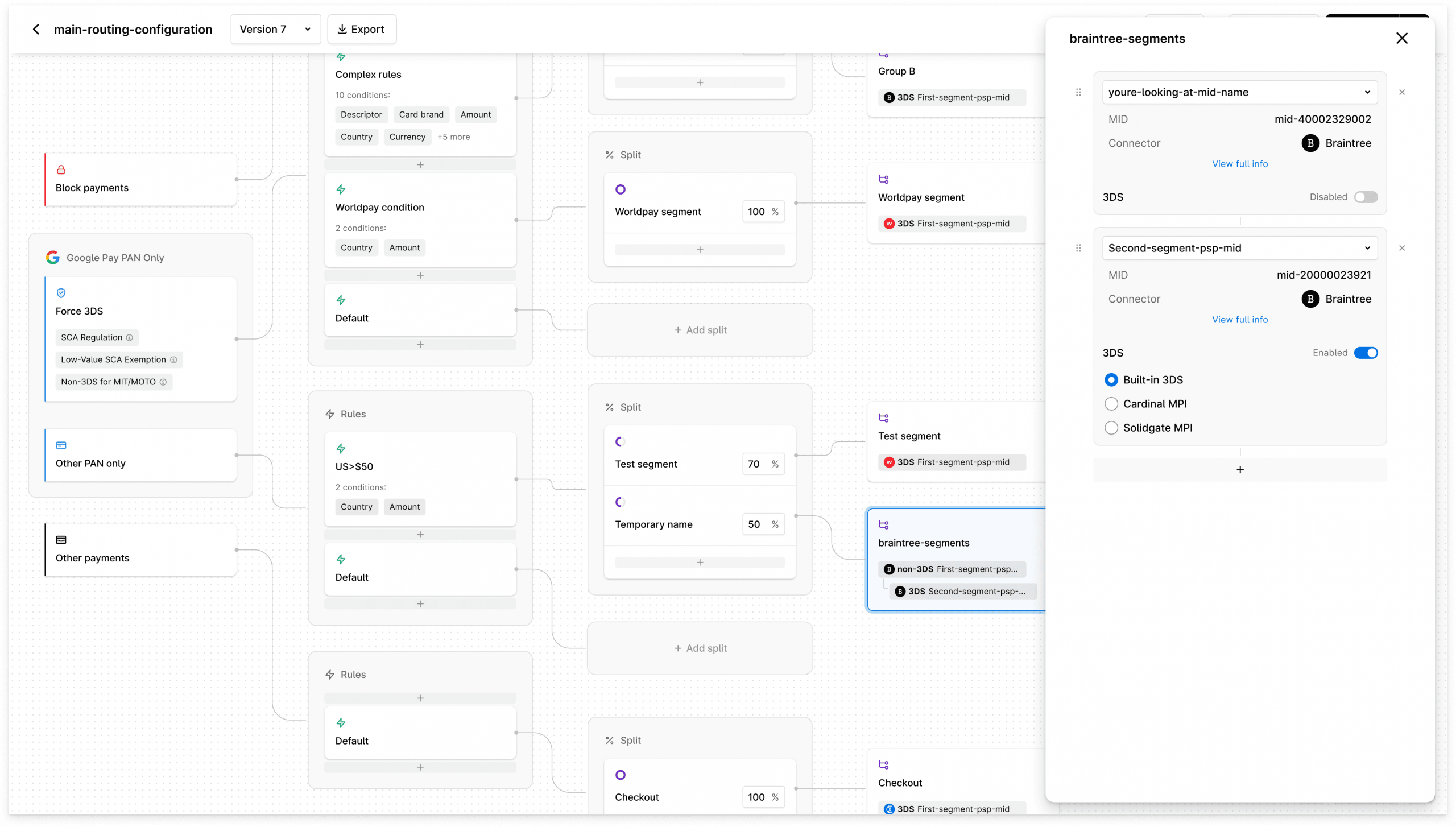
in Solidgate Hub.
Scalable vs fixed payment stack
Each new gateway integration is a project in isolation: scoping, development, testing, and compliance review. A team adding two new PSPs in sequence can spend months on payment plumbing that generates no new revenue. Reconciling data across providers then multiplies the operational overhead.
Orchestration inverts this dynamic. You integrate once – to a single payment orchestration platform – and add new providers through configuration. Solidgate connects to 100+ global and local acquirers and APMs, meaning a business expanding into Southeast Asia can add GoPay, ShopeePay, and GrabPay without a separate engineering sprint for each.
Read more:
From one gateway to orchestration: the migration path
The most common misconception about moving to orchestration is that it means replacing your current gateway. It doesn't. Orchestration sits above your existing stack – whatever PSP you run today – as a routing and management layer. Those providers stay connected underneath as processors.
A practical migration follows three phases.
Phase 1: Single integration
Connect your current PSP to the orchestration platform, and route all traffic through it. Nothing changes operationally at this stage – you're establishing the layer and validating performance data before adding complexity.
Phase 2: Add a second acquirer
Once the initial integration is stable, connect a second provider. Configure basic routing rules: primary acquirer for your core market, secondary for failover or specific regions. This is where cascading starts recovering declined transactions that would previously have reached the cardholder as a .
Phase 3: Expand methods and routing logic
Add local APMs for new markets, configure cost-based routing between acquirers, and build retry logic for subscription renewals. By this stage, the are doing the routing work that previously required custom development per provider.
Token portability deserves specific attention. Stored card credentials are typically bound to a specific PSP. When you migrate or add an acquirer, those tokens don't automatically travel with you – which means existing subscribers may face failed renewals or re-entry prompts. Acquirer-agnostic tokenization, where tokens are tied to the card network (Visa, Mastercard) rather than a specific processor, solves this. Existing subscribers keep their stored payment method working across any acquirer you route through.
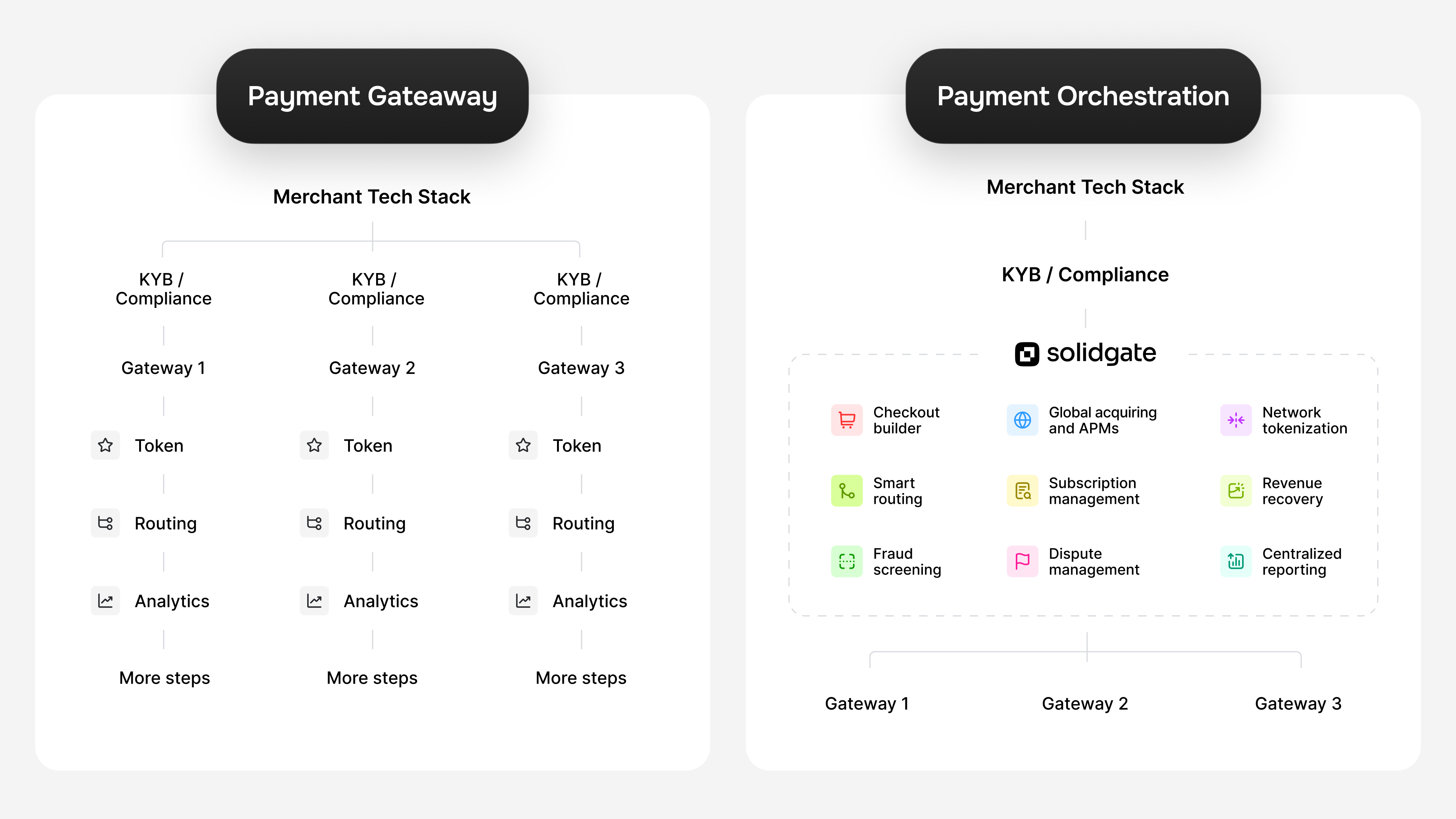
Core insight: Migrating from a standalone payment gateway to an all-in-one payment solution doesn't require a payment stack rebuild. Most businesses integrate the orchestration layer first, validate with existing volume, then add providers and complexity incrementally.
Gateway vs orchestration: cost math
Gateways and orchestration sit at different positions in the cost structure, so comparing them requires looking at more than the platform fee.
With a single gateway, costs are predictable: a percentage per transaction plus fixed fees. The hidden cost is what never completes – declined transactions, card-on-file customers lost to when cards expire, and cross-border fees you can't negotiate from a single-provider position.
With an orchestration platform, you add a coordination layer – but you gain cost levers in return:
- Least-cost routing directs each transaction to the cheapest eligible acquirer, reducing your blended processing rate.
- Local acquiring lowers interchange versus cross-border processing. Across our merchant base, it delivers up to 17.9% LTV improvement on average.
- Cascading and failover convert transactions that would otherwise decline into completed revenue. Payment cascades can produce a 14.8% LTV lift.
- Smart retries reduce involuntary churn for subscription businesses. On average, 7.2% of subscribers are at risk of being lost each month to payment failures alone.
For instance, saved €100K annually and cut subscription churn by 5% after adding a payment orchestration layer to their single-provider setup.
Core insight: The cost comparison only makes sense when you put both sides on the table: the platform fee on one side, and what single-gateway limitations cost you today on the other.
Checklist: Do you need a payment gateway or payment orchestration?
Your current payment setup maps to one of these two profiles.
You might need a payment gateway if:
- Your business operates in one market or region
- You process under $200k monthly with minimal billing complexity
- You only require standard payment methods – credit and debit cards, PayPal
- International expansion isn't on the roadmap for the near term
- You want simple implementation with minimal technical overhead
You might need payment orchestration if:
- You're expanding into new markets and need local payment methods, currencies, and acquirers
- Your business processes $300k+ monthly, especially across multiple markets
- You run subscription billing – and involuntary churn from failed renewals is a measurable problem
- You want routing control: directing transactions by cost, approval rate, or geography
- You need unified reporting across providers rather than reconciling separate dashboards
- Your engineering team spends time on payment plumbing that should be configuration
- You need failover so that a single PSP outage doesn't take down your checkout
If most of your answers land in the second column, the choice between payment orchestration and payment gateway becomes obvious.
Get payment orchestration and more with Solidgate
If a single-gateway setup doesn't work for you, Solidgate offers a that centralizes your payment operations. Our platform is designed for online businesses focused on global growth, cost reduction, and operational efficiency.
Our solution is built around three layers:
- Orchestration suite: Payment form, payment link, smart routing, reconciliation, and token vault.
- Payment infrastructure: Connecting you to acquiring, APMs, and a wide range of payment connectors.
- Value-added services: Subscription billing, fraud prevention, chargeback management, and global tax compliance.
Whether you're expanding globally or optimizing your current payment stack, Solidgate simplifies your payment infrastructure to support growth. With one unified platform, we help you reduce complexity, improve payment success rates, and scale your operations.
Considering payment orchestration? Read more about Solidgate, or with our team to learn how we can help you.
Considering payment orchestration? Read more about Solidgate, or with our team to learn how we can help you.
Frequently asked questions
A payment gateway processes transactions through a single payment path, while payment orchestration manages multiple gateways and payment methods through intelligent routing. Orchestration platforms provide strategic payment management across multiple providers, whereas gateways focus on reliable processing through one channel.
Businesses should choose payment gateways when they have simple payment needs, process moderate transaction volumes in single markets, prefer straightforward implementation, and don't require advanced routing or analytics capabilities. Gateways work well for companies focused on core business activities rather than payment optimization.
Standalone gateways handle one function well – secure transaction processing through a single provider. All-in-one payment platforms combine routing, analytics, subscription billing, and multi-provider management in a single integration. For businesses with simple, single-market payment needs, a gateway is sufficient. For those managing multiple markets or billing models, an all-in-one approach reduces overhead and improves acceptance rates.
Three factors determine the right fit: transaction volume, market scope, and billing complexity. Volume tells you whether a single provider can handle your load reliably. Market scope tells you whether you need local acquirers and payment methods that a single gateway may not support. Billing complexity tells you whether you need retry logic, token portability, and subscription management or whether basic recurring charges are sufficient.