What is Payment Orchestration, and why scaling businesses shouldn't ignore it
Payments 101
Updated 14 Aug 2026
10 min

Anton Tsyslytskyi
Product Manager, Solidgate
Your PSPs work in silos. Payment orchestration connects them – routing every transaction to the right provider, recovering declines, and giving you one view of your entire stack.
Scaling used to mean building integrations one by one.
Today, it means coordinating dozens of variables – from provider performance and fraud rules to checkout UX and cost per transaction.
Payment orchestration is a technology layer that connects multiple payment service providers (PSPs), acquirers, and payment methods into one centralized platform – managing how transactions are routed, retried, and reconciled across your entire stack.
The market for this category of platform is expanding at , and for good reason. More scaling businesses are exploring what orchestration can do for them – particularly when they're expanding into new markets, adding providers, or watching approval rates vary across corridors.
This guide is payment orchestration explained – covering the meaning, how it works under the hood, its advantages and limitations, who should consider it, and how to evaluate whether it fits your stack.
TL;DR
- Payment orchestration connects multiple PSPs, acquirers, and payment methods through one integration – routing, retrying, and reconciling every transaction centrally.
- It helps increase approval rates, reduce payment processing costs, speed up market expansion, and consolidate reporting across providers.
- Orchestration pays for itself once you're processing $400k+/month across multiple markets or providers.
- There are trade-offs – migration effort, added architectural complexity, and the need for internal ownership – but they're manageable with the right approach.
- Solidgate combines payment orchestration with its own acquiring and value-added services in a single platform.
What is payment orchestration?
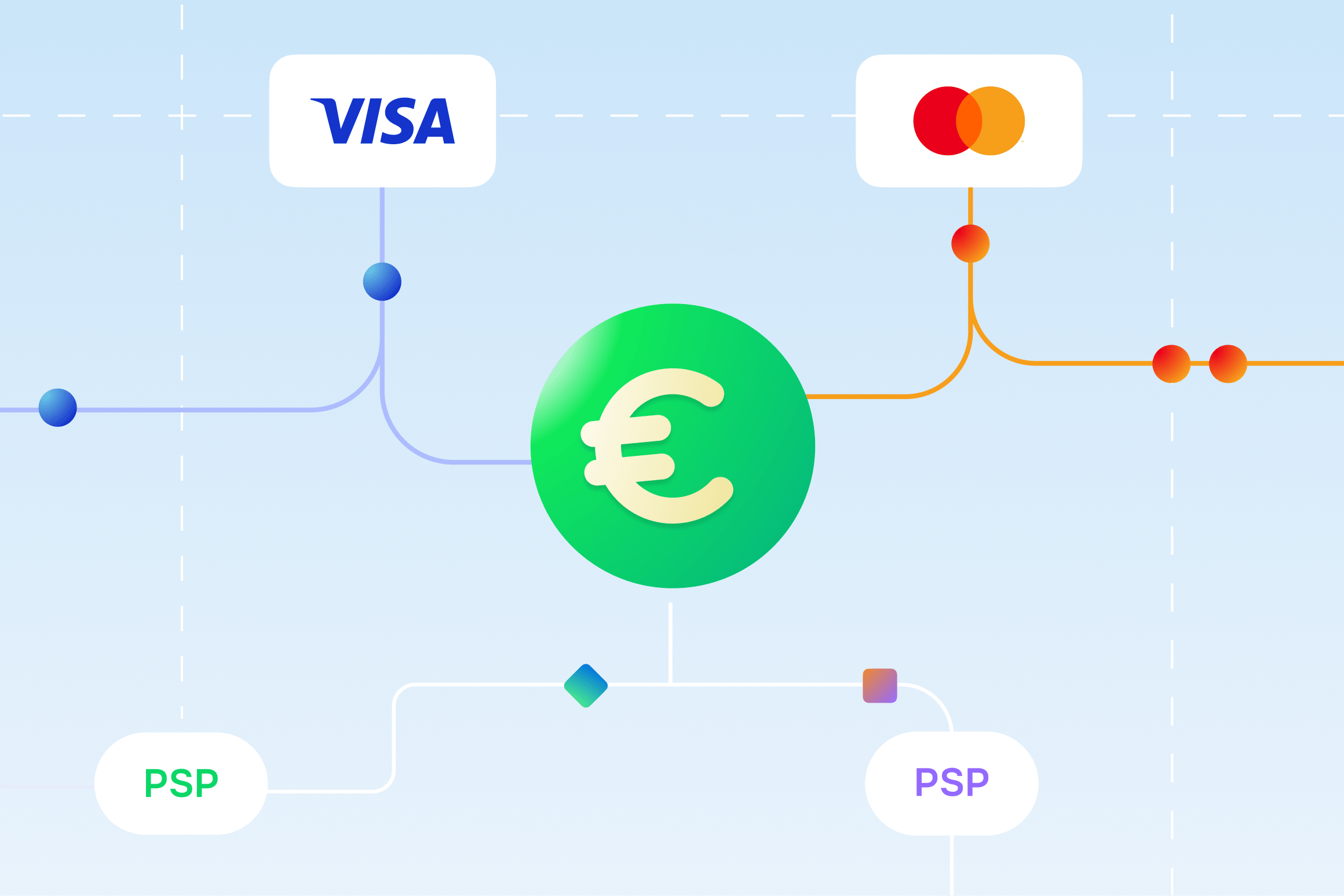
A payment orchestration platform connects all the payment flows from multiple PSPs, , and alternative payment methods (APMs) into a single system. Instead of integrating each provider individually, you integrate once – with the orchestrator – and then add new providers without additional development work.
It acts as the above PSPs and acquirers: the control plane that decides how every transaction is routed, retried, and reported.
The payment orchestration definition is straightforward. What makes it valuable is what it enables: your payment stack becomes more scalable, adaptable, and cost-efficient. You gain the ability to integrate and manage all payment aspects through a single system: reducing declines, consolidating data, and expanding into new markets without rebuilding your infrastructure.
Core insight: Payment orchestration doesn't replace your existing PSPs – it sits on top of them, giving you control over how transactions flow across your entire provider network.
How payment orchestration works
When a customer clicks "Buy" on your website or app, a lot happens behind the scenes. With payment orchestration, the process works like this:
Step 1: Payment acceptance
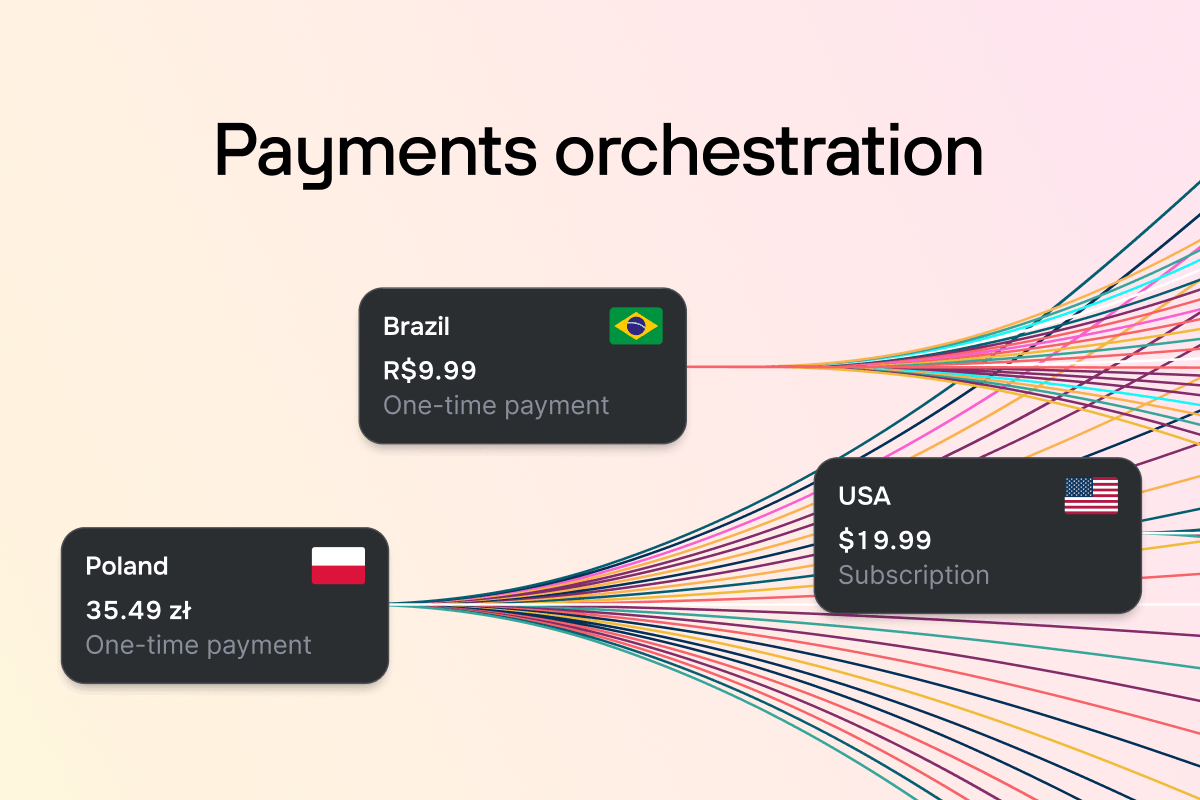
The customer sees a checkout that offers all relevant payment options for their location – credit card, digital wallets, or local methods like in Poland or in Brazil.
The orchestration platform dynamically displays the appropriate payment methods for each market, driving conversion by matching local preferences. Your customers get a unified, relevant frontend experience, regardless of the underlying processor.
Step 2: Smart transaction routing
Once the customer submits their payment details, the orchestration engine routes the transaction to the best available provider (processor or) using real-time logic.
This logic can consider factors like the customer’s location, card type, transaction amount, and historical provider performance. For example, a US transaction might be routed to Chase or Stripe, while EU transactions are routed to Checkout or Adyen.
The goal is to send the payment through the provider most likely to approve it (and even the one with the lowest fees in that scenario).
Step 3: Automatic failovers
If the chosen provider to process the transaction, the orchestration platform automatically reroutes the payment to an alternative provider. This happens in milliseconds and stays invisible to the customer.
Instead of losing a sale because of one gateway's outage or overly strict rules, the payment tries again through another path.
Step 4: Authorization and reconciliation
Once the payment clears through one of the providers, the transaction proceeds to authorization and as usual. All transaction data – settlements, fees, chargebacks, and refunds across providers – feeds back into a unified dashboard.
Data is reconciled in real time and on an hourly basis to prevent any drift between the provider and the orchestrator.
Core insight: The four-step flow – accept, route, failover, reconcile – runs automatically for every transaction. Your team configures the rules; the platform executes them at scale.
Want to understand how orchestration could work in your stack?.
Benefits of payment orchestration
The benefits of payment orchestration come down to four areas: faster market entry, higher acceptance, flexible operational control, and cost efficiency.
Speed up time to market by connecting to new PSPs and APMs
Each market has its preferred acquirers,, and payment methods. Without orchestration, adding each new payment method or PSP requires months of development work to build and maintain new integrations.
Direct connections with alternative and local payment methods also often require a local legal entity, which adds time and cost. The more providers you work with, the more you invest in building and maintaining those connections.
An orchestration platform gives you instant access to dozens of payment connectors in each market, saving months of development and reducing long-term cost.
| Without orchestration | With orchestration | |
|---|---|---|
| Adding a new PSP | Months of dev work per provider | Configuration change, no code |
| Local payment methods | Requires local legal entity + integration | Enabled via existing connector |
| Reconciliation | Manual, per-provider | Automated, centralized |
| Failovers | Custom-built or nonexistent | Built-in, real-time |
Increase payment acceptance with smarter routing
Across our merchant base, businesses processing in five or more markets see authorization rates vary by up to 12 points between their best and worst corridors. Orchestration closes that gap by matching each transaction with the provider most likely to approve it.
For example, a merchant in Southeast Asia using the Solidgate saw a 5% increase in approval rates after using to distribute payment flows across multiple APMs like Alipay, WeChat Pay, and credit cards.
This kind of uplift isn't a one-off – we've seen similar results across various markets when businesses add an orchestration layer.
Explore more from Solidgate merchants.
Centralize reporting and reconciliation
When payment data is spread across multiple PSP dashboards, finance, ops, and product teams all waste time stitching together fragmented reports. Orchestration solves this by pulling settlements, fees, decline reasons, and chargebacks from every provider into a single view.
This means your teams can automate reconciliation, run A/B tests on logic, identify underperforming providers, and track how changes – like enabling 3DS, adding a new PSP, or adjusting retry logic – affect outcomes.
Scale without the growing pains
Traditional payment setups often don't scale gracefully. Different gateways have different UX flows, redirect requirements, or performance limits. If you've ever had a traffic spike, you know the risk of one provider throttling under load.
Orchestration lets you grow payment capacity by load-balancing across multiple processors. If your volumes double overnight, a well-architected platform distributes the transactions and avoids any single point of failure.
Core insight: Each of these advantages compounds the others. Smarter routing lifts approval rates, centralized data reveals where to route next, and fewer manual integrations free your team to act on those insights instead of maintaining plumbing.
Reduce fraud without compromising approval rates
Many orchestration providers integrate fraud detection engines, adaptive 3-D Secure (3DS) authentication flows, chargeback prevention, and risk scoring. This lets you protect revenue while still approving as many legitimate transactions as possible.
The platform can apply 3DS verification when required, route exemptions when allowed, and flag suspicious orders for review. By tokenizing card data and using secure vaults, it also reduces your scope: sensitive data stays with the platform, not scattered across your systems.
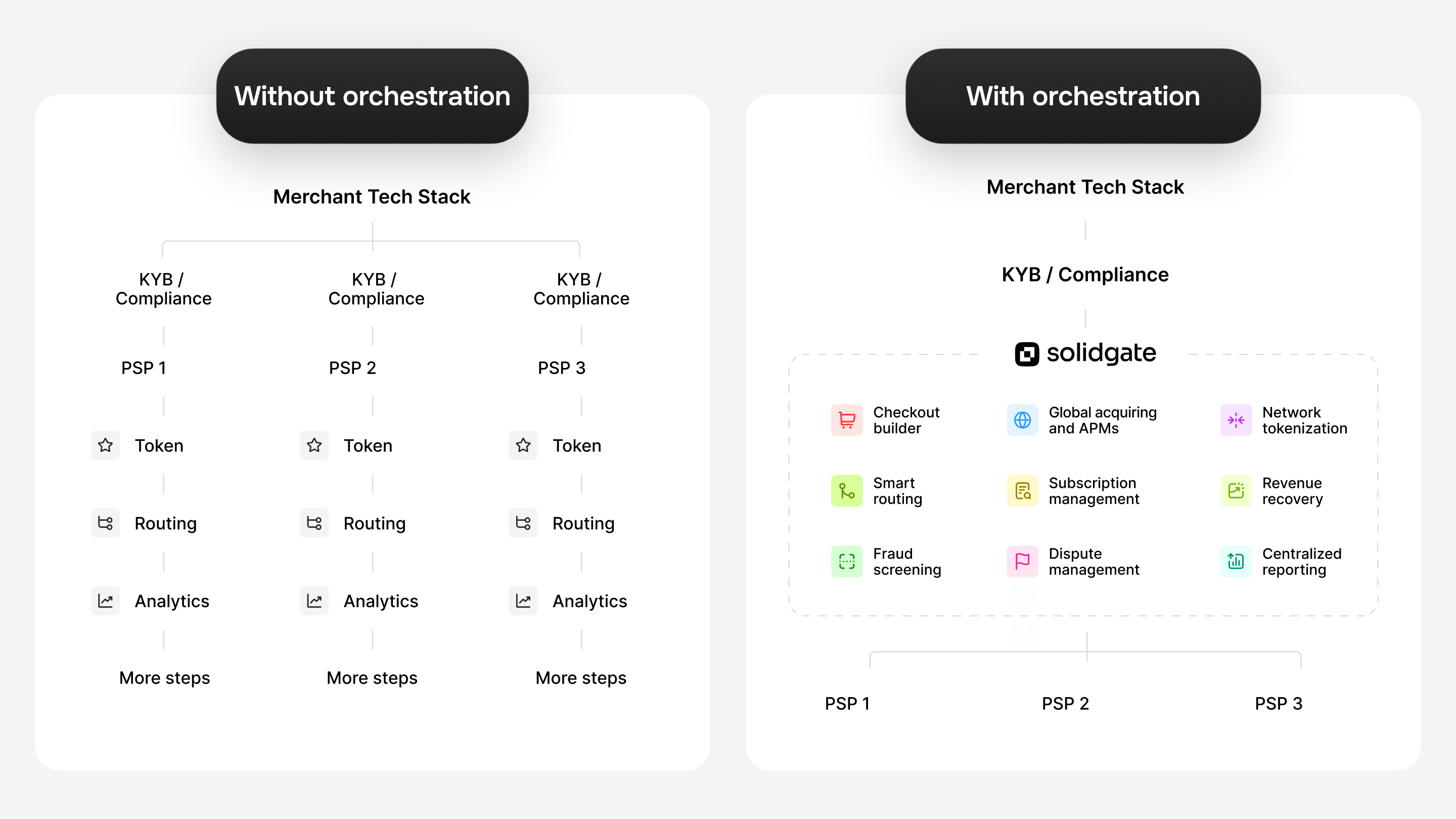
Core insight: Payment orchestration benefits extend beyond routing. Fraud screening, 3DS management, and tokenization all become easier to manage when they run through one layer.
Challenges and limitations of payment orchestration
Orchestration solves real problems, but it's not without trade-offs. Here's what to consider before adding an orchestration layer to your.
Migration and integration effort
Connecting an orchestration platform isn't a weekend project. You'll need to map your existing PSP integrations, configure routing rules, and test failover logic before going live. For businesses with complex payment setups, initial migration can take weeks.
That said, most orchestration platforms are designed to make this easier than building from scratch. You're integrating once instead of maintaining parallel connections to each provider. The upfront effort pays back in reduced long-term maintenance.
Added architectural complexity
Adding a layer between your application and your PSPs introduces another dependency. If the orchestration platform experiences downtime, it can affect all your payment routes – not just one.
Look for providers with strong uptime guarantees (99.99%+), real-time monitoring, and transparent incident communication. The best orchestration platforms reduce single-provider risk by design, but you should evaluate the orchestrator's own reliability just as carefully.
Requires internal ownership
Orchestration gives you more control – but someone on your team needs to own that control. Routing rules, failover logic, and provider performance reviews don't manage themselves. Without someone (even part-time) overseeing your orchestration setup, you won't capture its full value.
For most mid-market businesses, this isn't a new hire. It's adding orchestration oversight to the scope of your existing payments or ops lead.
Cost justification at lower volumes
At lower transaction volumes, the ROI of orchestration can be harder to justify. The platform fee, plus the effort to configure and maintain routing logic, may outweigh the gains from smarter routing or failovers.
Orchestration starts delivering measurable returns once you're processing roughly $400k+/month, operating in multiple markets, or working with two or more providers. Below that threshold, a single well-chosen PSP may be the better fit.
Core insight: The challenges of payment orchestration are real but manageable. Most come down to upfront investment, and the payoff scales with your transaction volume and geographic complexity.
Who needs payment orchestration (and who doesn't)?
Orchestration isn't for everyone. Understanding who uses payment orchestration – and who doesn't need it yet – helps you avoid both over-investing and under-investing. Here's how to tell whether it fits your business.
You likely need orchestration if:
✅ You process $400k+/month and are growing. At this volume, the difference between a 2–3% approval rate improvement and the status quo is measurable revenue.
✅ You sell across multiple markets. Cross-border transactions introduce provider-specific performance gaps, local APM requirements, and currency complexity that a single PSP can't always handle well.
✅ You work with (or plan to add) two or more PSPs or acquirers. Managing multiple providers without a centralized layer means duplicated integrations, siloed data, and manual reconciliation.
✅ Your approval rates vary significantly by corridor. Across our merchant base, businesses processing in five or more markets see authorization rates vary by up to 12 points between their best and worst corridors. Orchestration helps close that gap through routing, failovers, and local acquiring.
✅ You're a or losing revenue to involuntary churn. Smart retry logic, network tokenization, and card updater services – all manageable through an orchestration platform – directly recover failed recurring payments.
You probably don't need orchestration (yet) if:
❌ You process under $400k/month through one PSP in one market. Your current setup likely handles your needs. Focus on growth first.
❌ You don't have (and don't plan) multi-provider complexity. If a single PSP covers your markets, methods, and performance targets, orchestration adds cost without proportional benefit.
❌ You don't have anyone to own the payments function. Orchestration gives you powerful controls, but those controls need someone behind them.
Core insight: Payment orchestration fits businesses at the point where payment complexity becomes a blocker to revenue – typically $400k+/month, 2+ markets, or 2+ providers. Below that, it's likely premature.
Why choose Solidgate for payment orchestration?
At Solidgate, we operate as a Unified Payment Infrastructure with three key layers: payment orchestration, global acquiring and acceptance, and value-added services, with orchestration being our primary focus.
Here's why hundreds of online businesses scale with us:
100+ connectors, one API
Solidgate provides access to more than 100 acquirers and local payment methods through a single API – a payment ecosystem your team configures from the dashboard. This allows you to add new providers and regional methods without code changes.
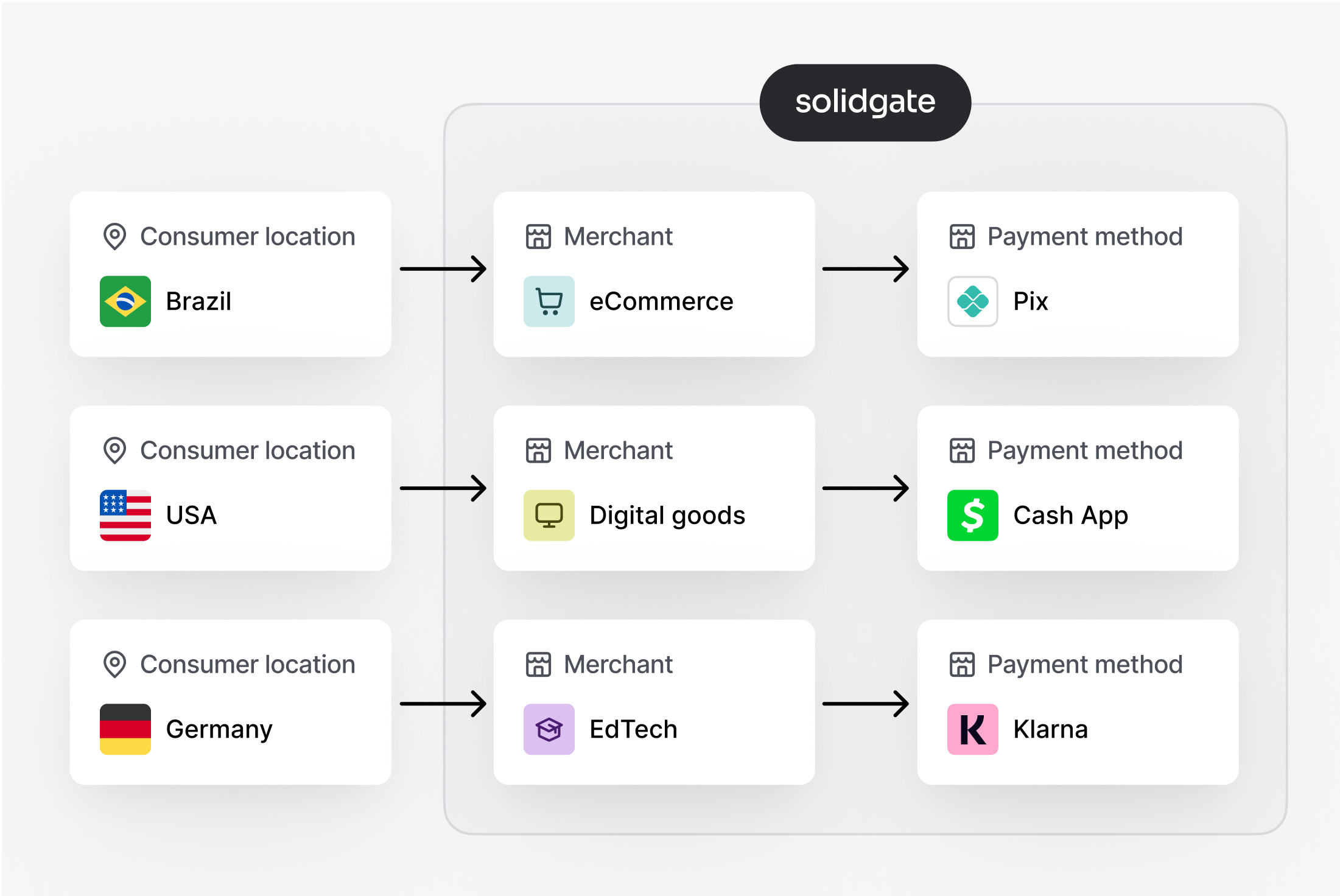
This expertise in cross-border payment flows means compliance checks, formatting, and localization are handled per-provider behind the scenes. The result: you roll out in a new market in days, not months.
Routing based on 20+ transaction parameters
Where most orchestration platforms route on basic criteria like geography or card brand, Solidgate evaluates each transaction against more than 20 parameters:
- BIN number
- Issuer response patterns
- Historical approval rates
- Transaction amount, and more
If a transaction fails, the platform cascades it to the next-best provider automatically. Your team can also build and test custom routing flows from the dashboard, then analyze performance and iterate.
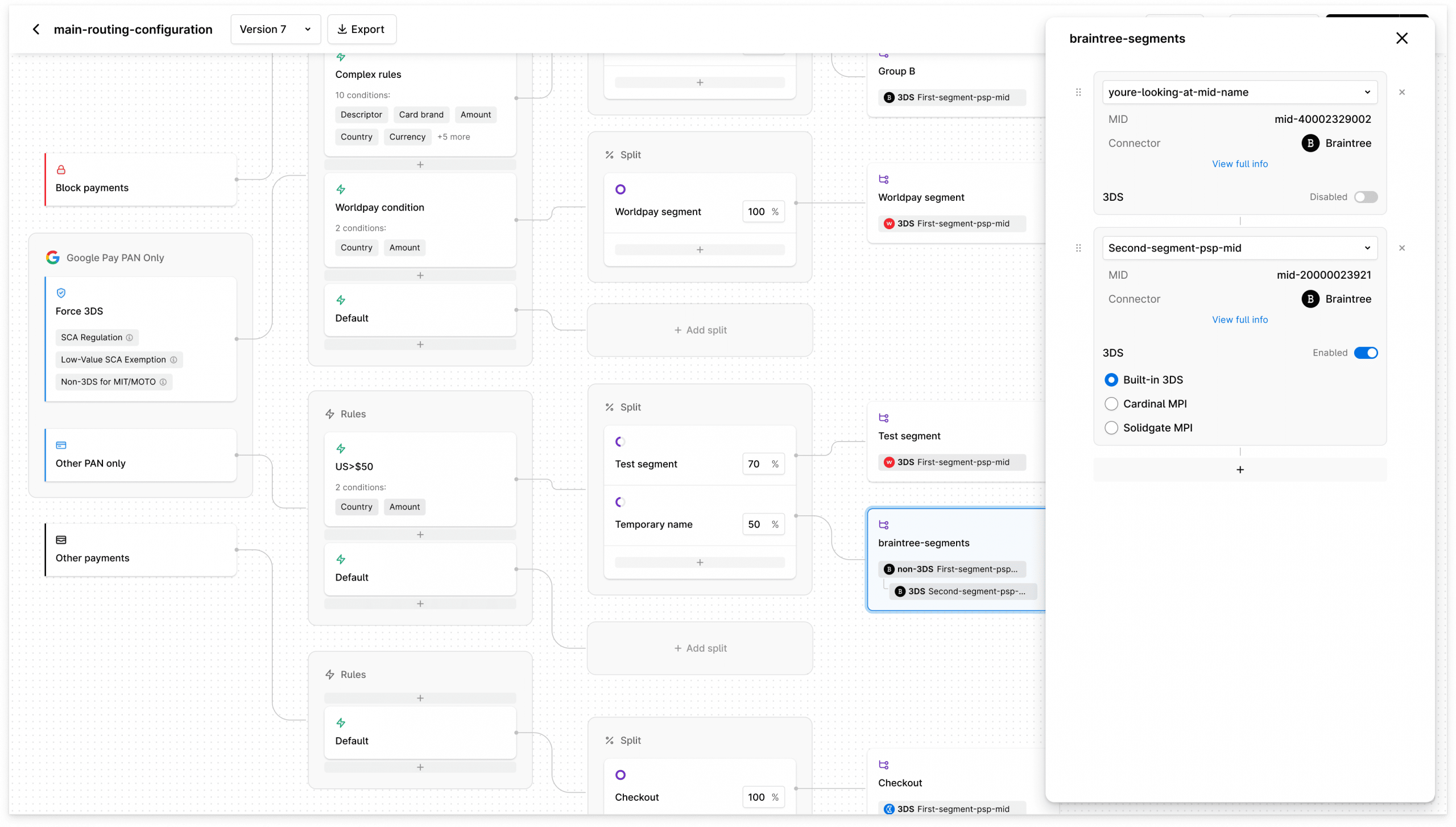
Compare to see how this stacks up.
Provider-level analytics and automated reconciliation
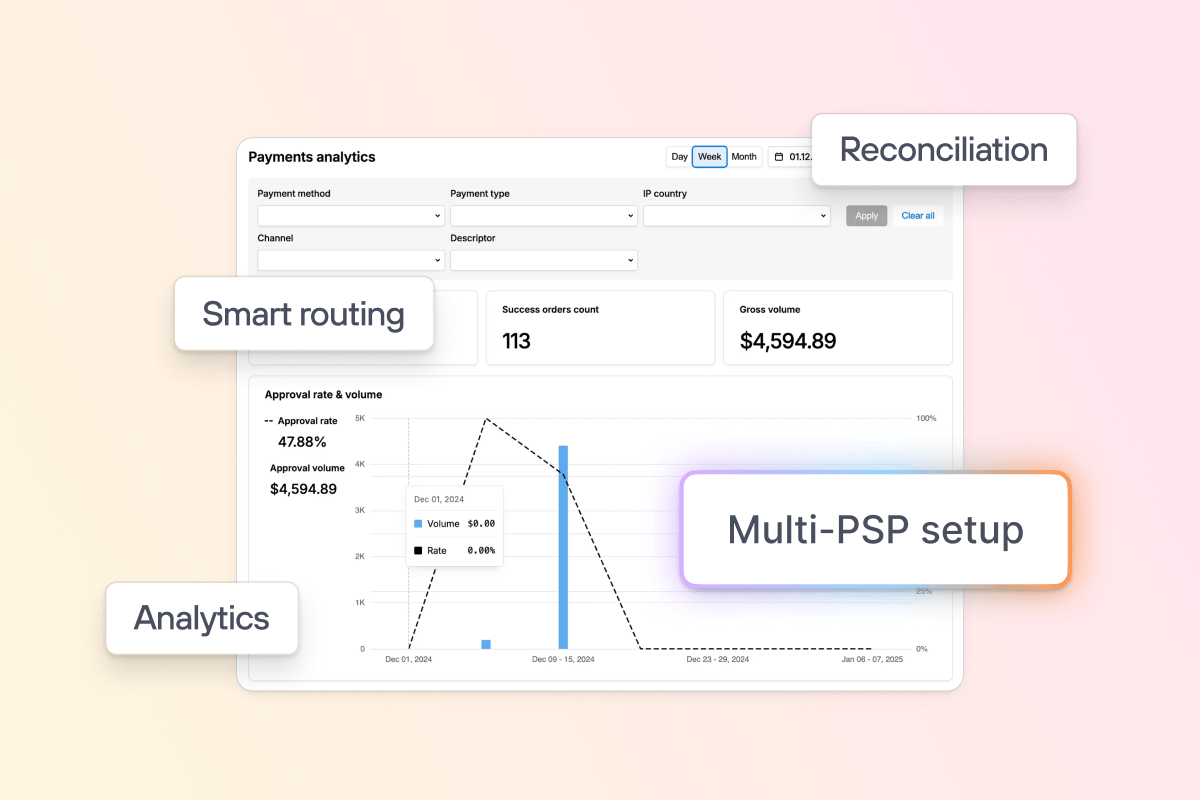
Solidgate's dashboard breaks down authorization rates and decline reasons by provider, country, payment method, channel, and descriptor – all updated continuously. This is the level of granularity you'd need to export and stitch together manually from individual PSP portals.
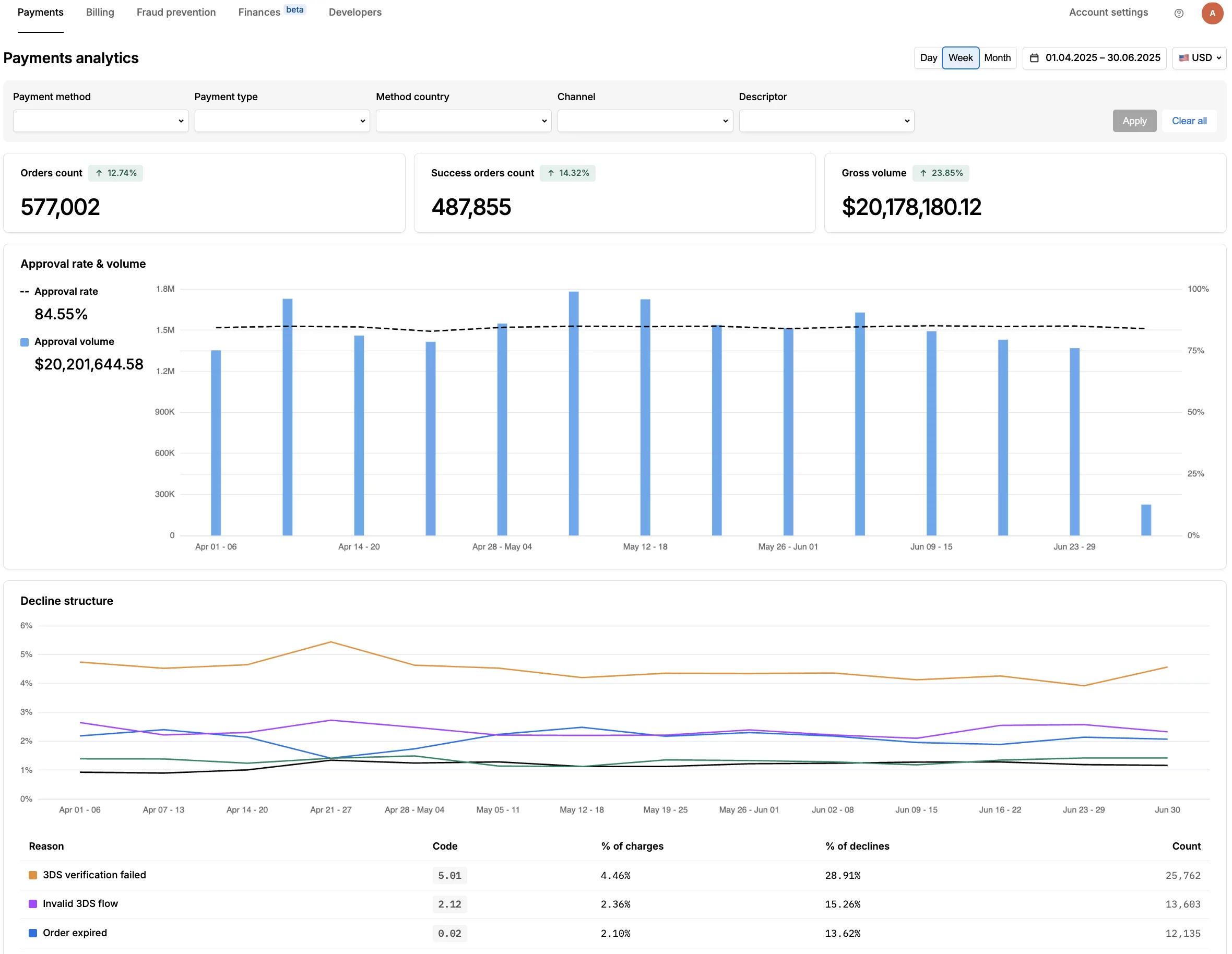
Reconciliation runs automatically: settlements, chargebacks, and payouts from all your providers are matched and tracked in one place. Your finance team gets a complete cash flow picture without switching between tools.

Built-in revenue recovery and acceptance tools
Beyond routing, the platform includes features designed to recover payments that would otherwise be lost:
- Adaptive 3DS and support for balancing security with checkout experience
- (VTS/MDES) to improve issuer recognition and reduce declines
- Account updater and smart retry logic to recover payments after soft declines or card expiration
These are configurable per region and run automatically – your team sets the rules, the platform executes.
Value-add tools that scale with you
As your business grows, Solidgate offers a range of built-in features you can use without adding external vendors or integrations:
- that includes trials, renewals, billing calendars, smart retries, and more
- with evidence scoring and submission
- Early and logic for proactive resolution
- A that calculates and reports based on location and transaction type
- A fraud detection engine that enables secure transactions while detecting and preventing fraud threats across multiple acquiring channels
Each of these is available within the same platform and dashboard.
to discover how Solidgate can assist you with payment orchestration.
Your payments scale as far as your stack allows
If you're processing across multiple markets, working with more than one provider, or watching approval rates fluctuate across corridors – the problem isn't your PSPs. It's how they're connected.
Payment orchestration gives you the control layer to route transactions intelligently, failover automatically, reconcile in one place, and scale without adding proportional complexity. It doesn't replace your providers; it makes them work together.
The businesses that get the most from orchestration are the ones that treat payments as a revenue lever, not just a cost center. If that sounds like your team, it's worth evaluating what a payments orchestration layer could do for your numbers.

$0 → $10M monthly GMV
How HOLYWATER built a global payment stack with Solidgate
Frequently asked questions
Payment orchestration refers to the strategic management and optimization of various payment methods, providers, and channels within a unified framework. It involves dynamically selecting the most suitable payment methods and providers based on factors such as transaction type, customer preferences, and regional considerations.
Payment orchestration is particularly relevant in omnichannel environments, where customers interact through various touchpoints. Payment orchestration ensures a cohesive payment process that aligns with both business needs and customer expectations.
Businesses need orchestration when their payment complexity outgrows what a single PSP can handle. That typically means processing in multiple markets, managing two or more providers, or dealing with fluctuating approval rates. Orchestration centralizes control, increases acceptance, and reduces operational overhead.
A payment gateway connects a merchant to a single acquirer or processor to authorize transactions. A payment orchestrator sits above one or more gateways and PSPs, managing routing logic, failovers, and data across all of them. For a deeper comparison, read .
Yes. A well-designed orchestration platform doesn’t require you to rip out existing PSPs. It builds a logic layer around them by using smart payment routing, failover rules, and performance data to automatically send each transaction through the best available provider. This can lead to measurable approval rate gains (often 10–30%) using the same providers.
ROI depends on your volume, market spread, and current approval rates. Common gains include 2-10% higher authorization rates through smarter routing and failovers, lower processing costs through least-cost routing, reduced engineering time from maintaining a single integration, and faster market expansion. The ROI compounds as transaction volume grows.
Payment orchestration addresses five core challenges: fragmented payment infrastructure across multiple providers, declining authorization rates in specific markets or corridors, high payment processing costs from suboptimal routing, operational overhead from manual reconciliation and siloed dashboards, and difficulty scaling into new markets that require local payment methods or acquirers.