Payment optimization vs. payment orchestration: What's the difference and why it matters
Payments 101
Updated 27 May 2026
5 min

Andrii Kononenko
Head of Merchant Operations, Solidgate
Payment optimization is the goal. Orchestration is how you get there. Learn the key differences, how they work together, and which one your business needs first.
Payment optimization and payment orchestration show up in the same conversations, the same vendor pitches, and often the same strategy decks. If you're managing payment performance across multiple markets or providers, it's hard to tell which concept applies to the problem you're trying to solve right now.
That ambiguity has a cost.
Across the businesses we work with, subscription cancellations stems from payment or billing failures. Whether that revenue gets recovered often comes down to a single question: can your current stack execute the fix, or is the stack itself the constraint?
This article draws the line between optimization vs. orchestration and shows how the two work together.
TL;DR
- Payment optimization is the goal: higher authorization rates, stronger decline recovery, lower processing costs.
- Payment orchestration is the infrastructure layer that makes those goals achievable at scale.
- You can run some optimization tactics on a single provider but the ceiling arrives fast.
- Orchestration without a clear optimization strategy is infrastructure with no direction.
Payment optimization vs. payment orchestration
Payment optimization is the ongoing process of improving payment performance across the full transaction lifecycle – increasing the share of transactions that succeed, recovering those that fail, and reducing the cost of each one that completes.
For a deeper look, check out our .
Payment orchestration is the infrastructure layer that sits above your PSPs (payment service providers) and acquirers.
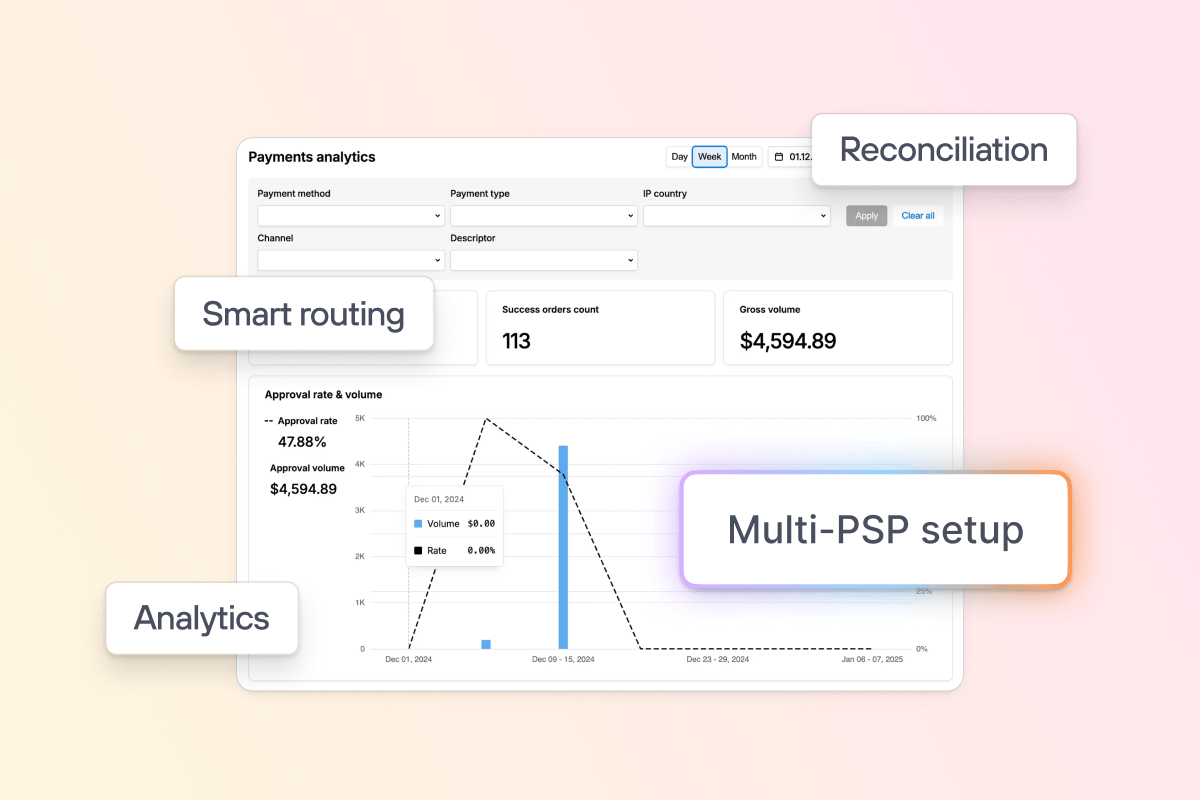
It connects you to multiple payment providers and coordinates how transactions flow between them – routing each payment to the best-performing acquirer, failing over to a backup when one declines, and centralizing data across your entire provider mix into a single view.
For a deeper look, check out our.
| Payment optimization | Payment orchestration | |
| What it is | A set of tactics and outcomes | A technical infrastructure layer |
| Primary goal | Improve transaction success rate, recover failed payments, and reduce processing cost | Connect providers through a unified API, control how every transaction is routed, and centralize payment data across your provider mix |
| Measured by | Auth rate, decline recovery rate, cost per transaction | Failover success rate, auth rate by route, time to add a new provider |
| Works alone? | Partially – limited to single-provider tactics | Yes, but misses the point without optimization targets |
| When it matters most | When transaction success rate is underperforming | When a single-PSP setup becomes a growth constraint |
Worth remembering: Optimization tells you what to fix. Orchestration determines whether your payment stack can fix it.
Key differences between payment optimization and orchestration
The core distinction becomes clear when you look at the specific failure mode you're dealing with.
Payment optimization targets a specific, diagnosable failure mode – a payment method missing in a key market, a retry window mistimed to issuer behavior, or a 3DS (3D Secure) threshold set too aggressively.
Let’s say your conversion rate in Germany drops because your 3DS threshold is blocking low-risk transactions. You adjust the exemption logic, apply frictionless 3DS2 flows to eligible transactions, and conversion recovers because everything you needed to solve it was already in your stack.
Payment orchestration addresses systemic gaps that no single tactic can fix – fragmented decline data across providers, routing logic owned by your PSP, or tokens locked to a single acquirer.
A common scenario: your authorization rate is declining across three markets but you can't isolate why, because each provider dashboard uses different decline code formats and there's no unified view.
You know something is wrong, but you don't know where to act. What you need is a layer above your PSPs that centralizes the data, surfaces where is underperforming, and gives your team somewhere to act on what they find.
Worth remembering: If you can identify the failure mode and your current infrastructure can execute the fix, it's an optimization problem. If the infrastructure itself is preventing you from diagnosing or acting on the problem, it's an orchestration problem.
How payment optimization and orchestration work together
Payment orchestration removes the ceiling that prevents optimization from scaling. The tactics don't change – the infrastructure underneath them does. Here's how that plays out in practice.
Phase 1: Optimize within your current setup
Most businesses start here – a single PSP, or maybe two, running retry logic, checkout improvements, and local payment method additions. The ceiling appears when your PSP's routing logic is built around its own acquirer relationships, not yours – and the more markets you enter, the faster you hit it.
Phase 2: Hit the orchestration threshold
The signals are recognizable:
- No local acquiring in a market you're expanding into
- Subscription renewal rates dragging net revenue retention
- One provider outage costing you a day of revenue
- Engineering is spending more cycles on payment plumbing than on product
At this point, the layer underneath the tactics needs to change.
Phase 3: Orchestration enables a new optimization surface
With the in place, your team can:
- Connect to multiple PSPs;
- Test and tweak routing rules;
- Measure authorization rate by market, card type, and acquirer;
- Act on what the data tells you without waiting on a dev cycle.
Solidgate, for example, connects to dozens of , hundreds of connectors through a single unified API, with routing rules your payment team configures directly in the Hub.
, a streaming service operating across Eastern Europe and Central Asia, worked with Solidgate to combine both layers – routing transactions to the highest-performing acquirers, applying SCA (Strong Customer Authentication) exemptions to reduce authentication friction, and strengthening renewal resilience through network tokenization.
The result is a 3.5% boost in payment conversion, a 5% reduction in churn, and €100K saved annually.
Worth remembering: When payment optimization and payment orchestration work in sequence – infrastructure first, optimization on top – the results compound across conversion, retention, and cost.
Build on the right foundation
At some point, every payment stack outgrows the infrastructure it was built on. That point arrives faster as your payment volume grows and you scale across markets and billing models.
The businesses that keep improving past it have both layers aligned – orchestration giving the payment team routing control and provider redundancy, and optimization giving that infrastructure a clear performance target.
Merchants we work with have seen a 14.8% lift in transaction success from acquirer cascading, 5% from local acquiring, and 11.6% from .
to map your current payment setup and identify where the gap is.

How Nova Post scaled payments
with 95%+ approval rates
Frequently asked questions
Payment optimization covers the tactics and decisions that improve how transactions perform – more approvals, faster decline recovery, and lower cost per transaction. Payment orchestration sits above your PSPs and acquirers, coordinating how transactions flow between them and giving your team control over routing, failover, and reconciliation from a single point.
Yes – and most businesses do early on. Checkout improvements, 3DS tuning, and local payment method additions all deliver real gains on a single-provider setup. The limitation appears when your transaction mix outgrows one provider's routing logic. Expanding across markets or billing models is where single-provider optimization runs out of range.
Payment orchestration provides the execution layer that makes optimization tactics scalable. Smart routing directs each transaction to the highest-performing acquirer for that market and card type. Acquirer cascading automatically recovers soft declines. Network tokenization improves authorization rates on recurring charges. Without the routing infrastructure underneath, each of these tactics hits the same single-provider ceiling.