Payment orchestration or vault: Which comes first, and when you need both
Payments 101
Updated 26 Nov 2026
10 min

Andrii Kononenko
Head of Merchant Operations, Solidgate
Payment orchestration or a vault – or both? This guide shows which one your stack needs first and when running them together pays off.
Payment orchestration or vault – vendors often pitch the two as alternatives, so the decision looks like a straight choice between products.
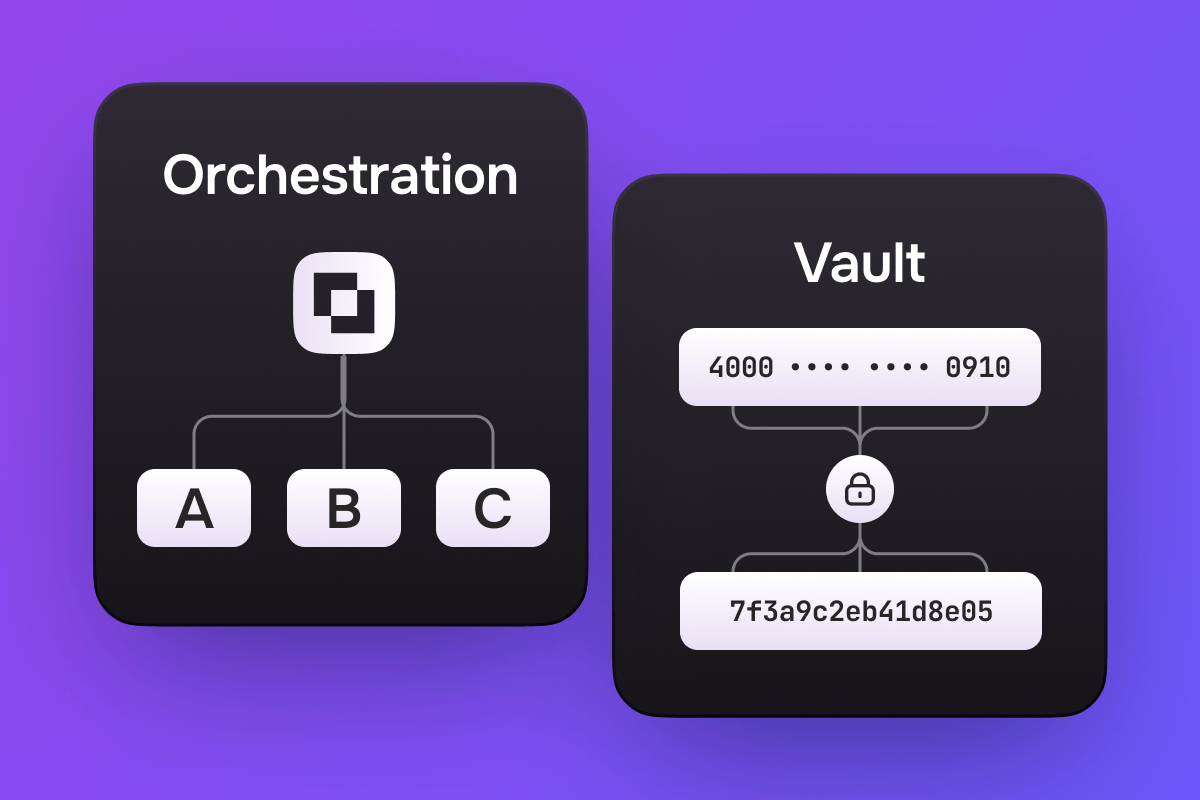
Orchestration improves where payments go: higher approval rates, a backup route when a provider goes down, and one view across payment service providers (PSPs). A vault controls what's already stored: saved cards that work with any provider and fewer systems in PCI scope.
Which one comes first depends on the problem that costs you money today. Once you run several PSPs and charge saved cards on repeat, you'll likely need both.
This guide helps you spot which problem you have, see how the two layers combine, match a setup to your stage, and vet vendors before you sign.
TL;DR
- Payment orchestration and a token vault solve different problems: orchestration picks the route for each payment, and a vault controls where saved cards live and who can charge them.
- Orchestration comes first when approval rates vary by market, one PSP carries every payment, fees differ by route, or ops work grows with each new provider.
- A vault comes first when recurring revenue sits on one PSP's tokens, a provider change is planned, PCI scope keeps growing, or saved cards go stale.
- Merchants with several PSPs and recurring revenue usually need both, and the setup decides who owns the tokens – each PSP, an independent vault, or a platform with a built-in vault.
Payment orchestration or vault: What each one solves
is a control layer that connects a merchant to several PSPs, acquirers, and payment methods through one integration and picks the route for each transaction.
A is a PCI-compliant environment that stores card data and returns a token the merchant's systems keep and charge in place of the card number.
| Payment orchestration | Token vault | |
| Problem it solves | Which provider processes each payment | Where card data lives and who can use it |
| Who holds card data | Depends on setup – the PSPs, a separate vault, or a vault inside the platform | The vault operator – a PSP or an independent provider |
| Effect on PCI scope | Depends on integration type | Can reduce the systems in scope; the vault stays in scope for its operator |
| What breaks without it | Approval gaps by market, a full stop when one PSP goes down, manual work across providers | Saved cards stay with the PSP that vaulted them |
Core insight: Orchestration answers where a payment goes, with rules for market, card type, cost, or performance, while the token vault answers where the card behind that payment is stored, and who gets to use it.
Signs you need payment orchestration first
Orchestration comes first when the loss happens at the routing stage. Four signals point there.
Approval rates differ by market. Issuers tend to approve transactions from acquirers in their own country more readily, so a provider that converts well at home can lag on foreign cards. With one PSP, every payment takes that same route, wherever the card comes from.
Everything runs through one provider. If that PSP has an outage or pauses the account for a review, payments can stop in every market until the issue is resolved.
Fees vary by route. Processing costs differ by provider, card type, and region. With one PSP, every payment pays that provider's price, even where another provider would process it for less.
Ops work grows with every PSP. Each provider adds its own dashboard, decline codes, and settlement files, which turns reconciliation into manual stitching.
Orchestration fixes all four from one layer, mainly through and cascading. Smart routing sends each payment to the best-performing provider for its corridor, weighing approval odds against cost. When a payment fails at one provider – a soft decline or an outage – cascading retries it through the next provider in the sequence. The ops load shrinks too: every provider connects through one integration, so the team tracks all payments, declines, and settlements in one dashboard.
According to the , merchants usually use three to four payment gateways and acquirers, which suggests a multi-provider setup – the kind orchestration is built to manage – is common among online merchants.
Core insight: Orchestration comes first when approval rates vary by market, one provider carries every payment, fees differ by route, or each new PSP adds ops work.
Signs you need a vault first
A vault comes first when the risk sits in how saved cards are stored and who can use them. Four signals point there.
Recurring revenue depends on one provider's tokens. Subscriptions, renewals, and one-click repeat purchases run on credentials, charged as merchant-initiated transactions (MIT). When a PSP vaults those cards, it keeps the card numbers and gives the merchant tokens that typically work only inside its own vault.
A provider change is on the roadmap. Adding a second PSP or moving away from the current one means migrating the card data or asking customers to enter their cards again.
PCI scope keeps growing. Every system that touches raw card numbers falls under . Host-to-host integrations, where card data passes through the merchant's own servers, fall under Self-Assessment Questionnaire D (SAQ D), the most extensive one.
Stored cards go stale. A saved card number stops working when the card expires or is reissued, and each failed renewal puts recurring revenue at risk.
A provider-agnostic, PCI-compliant token vault addresses all four. It stores each card once and charges it through any connected provider, so recurring revenue and provider changes stop depending on a single PSP. Raw card data stays in the vault and off the merchant's servers, which shrinks PCI scope. from Visa Token Service (VTS) and Mastercard MDES keep stored cards current, since the scheme updates the credential when a card is reissued.
Issuers tend to trust network tokens more: tokenization can reduce fraud by up to 60%, and deliver a 6 basis point approval rate increase globally in 2024.
Core insight: A vault comes first when recurring revenue sits on one provider's tokens, a provider change is planned, PCI scope keeps growing, or stored cards go stale.
When you need both: Payment orchestration and token vault
Both layers usually become necessary when a merchant processes payments through more than one provider and recurring revenue depends on stored cards. This typically happens in three situations:
- Recurring revenue across several PSPs. Renewals and repeat purchases on saved cards run through two or more providers.
- Multiple PSPs. Payments run through two or more providers to lift approval rates or stay live during outages, and saved cards need to work on every route.
- Selling cross-border. New markets go live through local providers, and existing customers' saved cards have to work there too.
In each case, the next decision is how to combine the two layers. Three setups are common, and they differ most in who owns the tokens.
PSP vaults with routing on top
Each PSP keeps vaulting the cards it processes, and an orchestration layer routes new payments across providers. It's the quickest setup to launch, since no new vendor joins the stack. The limits appear on repeat charges. Each saved card stays tied to the PSP that vaulted it, so a renewal typically can't be cascaded to another provider. Exit terms then come down to each PSP's export policy. Some PSPs export card data only to another PCI DSS Level 1 compliant processor, and payment history and subscriptions can stay behind.
Independent vault plus a separate orchestrator
An independent, PSP-agnostic vault stores each card once and forwards it to whichever PSP the orchestrator picks, with a separate running the routing. Token portability is the main gain: saved cards stay usable as processors come and go. The price is two vendors, two contracts, and two integrations that have to stay in sync. Passing card data between two systems can add a step to each charge, and troubleshooting a failed payment may involve both vendors.
Orchestration platform with a built-in vault
A with a , like Solidgate, stores the cards and routes the payments in one place, so the same token works on every connected provider. A saved card can be retried or cascaded to another provider without re-tokenizing it, network tokens from VTS and MDES update automatically, and existing cards can be migrated in from other vaults or PSPs – all through one integration.
One of our merchants, , a US dating app with a subscription model, launched direct billing with Solidgate and made it available to all its US iOS subscribers. The result: a ~20% ARPU lift on the iOS US segment.
This setup fits merchants building or consolidating their stack, since getting there usually means moving existing cards and routing rules in one project.
Core insight: Merchants need both layers when saved cards have to work across several providers and markets. A saved card follows a payment to any provider when the vault sits outside a single PSP, and a platform with a built-in vault delivers that through one integration.
Which setup fits your stage
The right setup depends on two things: how many providers a merchant runs and how much revenue comes from charging saved cards, such as renewals and repeat purchases.
| Stage | Setup that fits | Why it fits | What to watch |
| One PSP | The PSP's own vault | One provider stores and processes every card, so there's nothing to route yet | Recurring revenue growing or a second PSP on the roadmap – cards stored with one PSP need a migration to move later |
| Two or more PSPs, mostly one-off payments | PSP vaults with routing on top | New payments get routed across providers without adding a vendor, and few saved cards need to move between them | The share of repeat charges – saved cards stay tied to the PSP that vaulted them, so renewals can't be cascaded |
| Two or more PSPs with recurring revenue, an orchestrator already in place | An independent vault plus a separate orchestrator | Adds card storage that works on every PSP without replacing the current routing layer | Keeping two vendors in sync – an extra step on each charge, and failed payments that may need both vendors to troubleshoot |
| Two or more PSPs with recurring revenue, building or scaling the stack | An orchestration platform with a built-in vault | One integration covers routing, retries, cascading, network tokens, and card migration | Migration scope – which cards and network tokens move in, and how subscriptions are recreated on the new tokens |
At every stage, the vault decision sets how far the stack can grow. Cards stored with one PSP stay usable only through that PSP, which is where around stored cards begins.
Core insight: The right setup follows your stage. One PSP runs on its own vault, and several PSPs with mostly one-off payments can route on top of PSP vaults. Once recurring revenue runs across PSPs, add an independent vault to an existing orchestrator, or move to a platform with a built-in vault when building or scaling the stack.
What to ask before you commit
These seven questions help you vet a vendor before signing, whether you're adding a second PSP or choosing between .
- Can I bring my saved cards in? A card migration usually means the current processor exports encrypted card data and the new provider issues fresh tokens for each card. Ask which export formats it accepts and how existing subscriptions are recreated on the new tokens.
- What happens to my network tokens? Network tokens are typically re-provisioned when a merchant changes provider. Ask how the provider handles re-provisioning during a token migration, and how long it takes.
- Which PSPs and acquirers are already connected? Every connection a provider still has to build delays routing in that market. Check its against the markets and payment methods you sell in today and plan to add.
- Who controls routing, and what can I see? Ask whether your team can set and change rules by market, card type, or cost, and whether approval rates and declines show up per provider in one report.
- Which SAQ will my integration put me on? Your Self-Assessment Questionnaire (SAQ) type depends on the exact integration. Integrations that keep card data off your servers can qualify for a shorter questionnaire, such as SAQ A. Ask which options the vendor offers, and confirm the final SAQ type with a Qualified Security Assessor (QSA).
- Do 3D Secure results and MIT flags follow the card? A merchant-initiated charge links back to the original customer-initiated payment where the cardholder gave consent. Ask whether that link, and the Strong Customer Authentication (SCA) result, reach a new acquirer when a stored card is routed or cascaded.
- How are the vault and routing priced? Fees can be charged per transaction, per stored token, per network token request, or bundled into processing. The gap between those models widens as volume and the saved-card base grow.
Core insight: Before signing, check four things: whether saved cards and network tokens can move in, whether the provider connects to the PSPs you need and lets you control routing, which SAQ and authentication data you end up with, and what the vault and routing cost as volume grows.
How Solidgate brings orchestration and vaulting together
Solidgate is a with a built-in, provider-agnostic, PCI-compliant . For merchants, that means a declined renewal gets a second chance on another provider, and saved cards keep working when a provider is added or dropped. Stored credentials stay current as cards are reissued, and moving over is simpler, since existing cards can be migrated in from another vault or PSP.
When one of acquiring banks closed, every token stayed on the Solidgate side, and the recurring base moved to new acquirers with near-zero loss. lifted payment conversion by 3.5% with orchestration across multiple acquirers. Network tokens and smart retries helped cut its subscription churn by about 5%.
Want to check whether orchestration with a built-in vault is the right setup for you? to see how Solidgate can support your payment stack.
Frequently asked questions
They're closely related. Tokenization replaces a card number with a token, and a vault is the secure system that stores the real card number and issues those tokens. Every vault tokenizes, but tokens can also come from elsewhere, such as network tokens issued by Visa and Mastercard.
Yes, it's a common setup. An independent vault stores each card once and passes it to whichever provider the orchestrator selects. The trade-off is two vendors and two integrations to keep in sync. A payment orchestration platform with a built-in vault covers both through one integration.
No. A vault can shrink your PCI DSS scope by keeping raw card numbers off your systems, and you still have to validate compliance. The vault itself stays in scope for whoever runs it. Your SAQ type depends on your integration, so confirm it with a QSA.
Usually, yes. Your current PSP exports encrypted card data, and the new provider issues fresh tokens, and subscriptions are recreated on those tokens. Terms vary: some PSPs export only to a PCI DSS Level 1 compliant processor and don't include payment history or subscriptions. Solidgate, for example, supports card-on-file migration from other vaults and PSPs.
Network tokens are typically re-provisioned with the new provider once the underlying cards are migrated, since public scheme documentation doesn't describe a direct transfer. Ask your new provider how it handles re-provisioning and how long it takes, so renewals keep running through the switch.
Usually not yet. With one PSP, its own vault stores your cards, and there's no second route to orchestrate. Plan ahead if recurring revenue is growing or a second PSP is on the roadmap, since cards stored with one PSP typically need a migration to move later.