ProcessOut alternatives: 6 payment orchestration platforms compared
Industry
Updated 12 Nov 2026
9 min

Anton Tsyslytskyi
Product Manager, Solidgate
ProcessOut is a strong orchestration option for merchants, but not the only one. See which alternatives exist.
Merchants may look for ProcessOut alternatives for the same reasons they review any . Some of the common triggers include entering new markets, adding new payment methods, changing the business model, growing transaction volumes, and reviewing the vendor setup.
Platforms vary and many options exist, so merchants can compare them to see which one fits best. To support that comparison, we reviewed six ProcessOut alternatives, including Solidgate, on five criteria based on the information each company publishes on its website.
TL;DR: A snapshot
- Solidgate: A full-stack payment platform with orchestration at its core, extended by platform products and card acquiring for eligible merchants (additional compliance checks apply).
- Spreedly: Positions itself as a payment orchestration platform built around vault, connect, protect, and optimize, with an integration for agentic commerce.
- Gr4vy: Describes itself as a no-code, cloud-based payment orchestration platform for merchants and platforms.
- Payrails: Presents itself as a modular payment platform that works as an operating system for payments.
- IXOPAY: Positions itself as a payment orchestration platform with tokenization and payment optimization modules.
- Yuno: Describes itself as an AI-native payments platform with a single API for pay-ins, payouts, and fraud prevention.
What is ProcessOut and why look for alternatives?
ProcessOut is a payment orchestration platform that connects merchants to multiple payment providers through one API. Its website lists orchestration, smart routing, monitoring, a vault, and an operations suite for reconciliation and accounting.
Checkout.com ProcessOut in 2020, and ProcessOut states on its website that it runs as a standalone unit.
Reasons to look for ProcessOut alternatives vary. But typically merchants may need other capabilities, additional payment methods or markets, or a different mix of products from one vendor.
How we chose these ProcessOut alternatives
We compared six platforms that offer payment orchestration, using the information each company publishes on its website. Each platform was evaluated on five criteria:
- Coverage. The providers, acquirers, and payment methods a platform connects to through one integration.
- Routing and recovery. Routing rules decide which provider handles each payment, and retry logic decides what happens after a decline.
- Vault and tokens. A vault stores payment credentials, and tokenization replaces card numbers with tokens.
- Risk and disputes. Fraud tools screen payments, and chargeback tools help manage disputes.
- Finance and operations. Reporting, reconciliation, and adjacent modules such as billing or payouts.
The 6 best ProcessOut alternatives: A comparison table
| Solidgate | Spreedly | Gr4vy | Payrails | IXOPAY | Yuno | |
| Core offering | Payment orchestration combined with payment infrastructure and platform products (billing, antifraud, disputes, tax) | Payment orchestration platform with vault, connect, protect, and optimize modular products + agentic commerce | No-code, cloud-based payment orchestration | Modular payment platform with orchestration, tokenization, chargebacks, and analytics | Payment orchestration with tokenization and payment optimization modules | AI-native payments platform with no-code orchestration |
| Provider and payment method coverage | 100+ providers, acquirers, and payment methods across 100+ markets, including EMEA, US, LATAM, APAC | Gateway integrations across 100+ countries | 400+ payment methods and anti-fraud providers | 100+ integrations | 500+ pre-built payment adapters | 1,000+ payment methods, PSPs, and fraud solutions |
| Routing and recovery | Intelligent routing rules, cascading, and fallback; Smart retries for subscription renewals | Routing on cost and approval data; retries and re-routing to a secondary gateway | Routing and retry workflows | Routing rules and retries | Intelligent routing; retries not listed | AI routing agent; automatic retries |
| Vault and tokens | Provider-agnostic vault, network tokens, and account updater | Provider-agnostic vault, card updater, and network token lifecycle | Vault; network tokens; account updater | Token vault; network tokenization | Universal and network tokens; account updater; vaulting | Vault; network tokens; account updater |
| Risk and disputes | Built-in antifraud, 3DS management, prevention alerts, and automated representment | Fraud, identity, and 3DS providers | Multiple fraud prevention services | Chargebacks module | Risk and fraud services; 3DS | Risk conditions; 3DS; chargeback management |
| Finance and operations | Billing, tax, business accounts with mass payouts (additional compliance checks apply), and reconciliation | Settlement rules | Reporting metrics | Unified analytics; reconciliation; payouts; fee monitoring | Reconciliation and settlement | Payouts, reconciliations, subscriptions |
| Best for | Scaling businesses across e-commerce, subscription software, and mobility that need full-stack infrastructure for accepting payments, recovering lost revenue, and entering new markets | Businesses that want a portable credential vault while using existing providers | Businesses and platforms with sub-merchants or dedicated cloud requirements | Businesses that want orchestration, analytics, and financial operations in modular form | Platforms, PSPs, and merchants that need tokenization, PCI tooling, or white-label orchestration | Businesses expanding across many markets that need local payment method coverage |
Disclaimer: This comparison is based on publicly available information from each company's website and reflects Solidgate's independent view of their core features. It is not intended to be exhaustive. Features and offerings may change, so confirm current details with each provider. Solidgate is listed first because it is the platform we know best. The order of the other platforms does not imply any ranking, endorsement, or preference.
Best ProcessOut alternatives: A deep dive
1. Solidgate
is a platform built for businesses scaling globally. Founded in 2016, it connects merchants to 100+ providers, acquirers, and payment methods through one . Orchestration is the core layer, and rules send each payment to the provider suited to its card brand, country, and amount.
Merchants add layers around that core as they need them. Platform products cover billing, fraud and dispute management, and tax. Options to set up PayFac capabilities, card acquiring, and business accounts are available for eligible merchants (additional compliance checks apply).
Everything runs on that is PCI DSS 4.0 certified and backed by a 99.99% uptime SLA.
Key capabilities:
Routing and cascading. A no-code sends each payment to the provider you choose for it and retries declines through fallback routes. Fewer payments are lost to a single provider's decline. Headway, a subscription app, saw up to a with Solidgate.
Network tokenization and vault. Solidgate enables Visa Token Service and Mastercard Digital Enablement Service network tokenization, account updater, and a provider-agnostic token vault. reports a 4.6% authorization lift for tokenized card-not-present transactions. Network tokens replace card numbers, which can reduce exposure of card data.
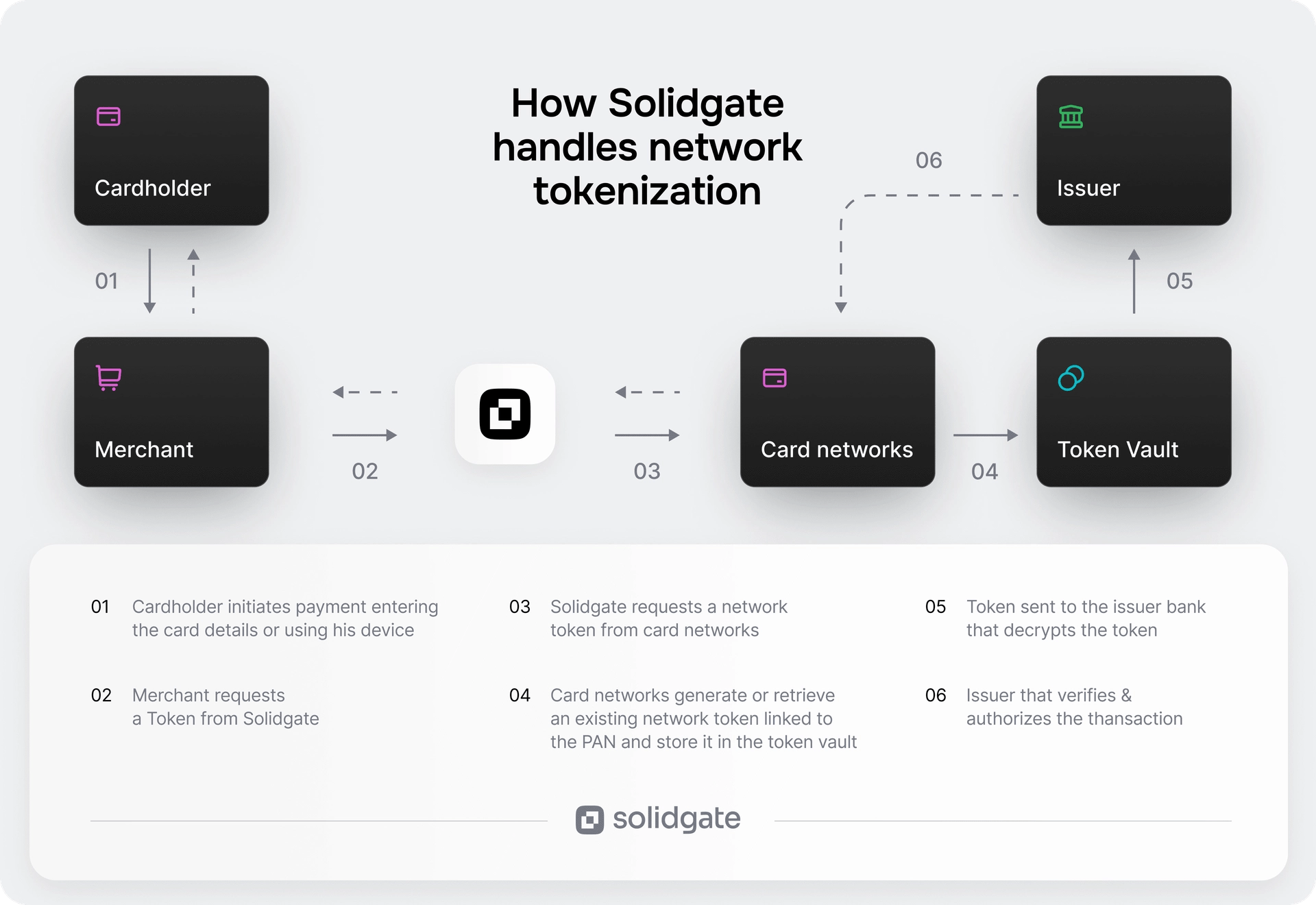
The vault keeps payment credentials on Solidgate's side, so they stay portable when a merchant changes or adds providers. When a tier-2 acquirer closed, , a subscription marketing platform, kept its tokens on Solidgate and moved its recurring payments to new acquirers with near-zero loss.
Connectors and payment methods. Solidgate connects merchants to 100+ providers, acquirers, and through a single integration. Merchants can use additional providers and local payment methods as they expand into new markets or verticals, without rebuilding the integration.
Payment Form and Payment Link. Payment Form embeds a customizable checkout on the merchant's own page. Payment Link collects payments through a shareable URL, with no website needed. Both support one-time and subscription payments across cards, wallets, and local methods.
Fraud and dispute management. Built-in antifraud screens each payment before authorization, and customizable rules let merchants tune it to their business. Verifi and Ethoca Prevention Alerts flag disputes before they become chargebacks.
Once enabled, automated representment compiles and submits evidence for Visa, Mastercard, PayPal, and APM disputes when they are filed. Together, these can reduce chargebacks and manual dispute work.
Billing and subscriptions. Billing covers customer management, subscription updates, prorations, and coupons. Teams manage the subscription lifecycle in one place. Smart retries time each failed-renewal retry by decline reason and payment history. , a streaming service, saw a 5% lower subscription churn and a 3.5% higher payment conversion rate with Solidgate.
Tax. Tax is calculated automatically per invoice and shown in tax reports, which helps finance teams handle tax across regions.
Business accounts. EUR, USD, and GBP business accounts support SEPA and SWIFT payments, FX, and mass payouts. Finance teams can collect, convert, and pay out from one place. Eligible merchants can open them (additional compliance checks apply).
Best for: Scaling businesses across ecommerce, subscription software, and mobility that need full-stack infrastructure for accepting payments, recovering lost revenue, and entering new markets.
2. Spreedly
Spreedly describes itself as a payment orchestration platform built around four areas: vault, connect, protect, and optimize. Its website says it began in 2007 with secure card storage. It now covers connections to payment and fraud providers, routing, and agentic commerce.
Some of the key capabilities:
- Vault for payment methods
- Connections to gateways, providers, and processors through one integration
- Routing on live cost and approval data per provider
- Retry on the same gateway, re-routing to a secondary gateway, and credential updates for declined payments
- Real-time screening with chained fraud, identity, and 3DS providers
- Composer, a visual canvas for fraud, routing, and settlement rules
- Agentic-commerce integration
We think it fits businesses that want credentials portable across gateways while they keep using existing providers.
3. Gr4vy
Gr4vy describes itself as a no-code, cloud-based payment orchestration platform for merchants and platforms. Its website lists a universal integration to PSPs and anti-fraud providers. Some of its core products include checkout, vault, optimization, and analytics.
Some of the key capabilities:
- PSP and anti-fraud provider activation from the dashboard
- Routing and retry workflows configured without code
- Checkout rules by currency, transaction value, and product, with dynamic display of payment methods
- PCI DSS Level 1 vault, network tokens, and account updater
- Gr4vy for Platforms, with separate sub-merchant workflows and a white-label option
- Single-tenant cloud instances with automatic failover
We think it fits enterprise merchants and platforms with sub-merchants or dedicated cloud requirements.
4. Payrails
Payrails positions itself as a modular payment platform that works as an operating system for payments. Some of its core products include orchestration, token vault, network tokens, chargebacks, analytics, reconciliation, payouts, and payment links.
Some of the key capabilities:
- Orchestration with routing rules, retries, and workflows
- Token vault, network tokens, and 3DS
- Payment links
- Chargebacks module
- Unified analytics, reconciliation, payouts, and fee monitoring
- Integrations with PSPs, alternative payment methods, and anti-fraud providers
- Agentic commerce support
We think it fits enterprises that want orchestration, analytics, and financial operations in a modular form.
5. IXOPAY
IXOPAY describes itself as a payment orchestration platform with tokenization and payment optimization modules. Some of its core products cover orchestration and payment processing, tokenization and card lifecycle, payment intelligence, security and risk, and agentic commerce.
Some of the key capabilities:
- Intelligent routing, risk and fraud services, and reconciliation and settlement
- Pre-built payment adapters
- Universal tokens, with TokenEx vaulting
- Payment modules for network tokens, account updater, 3DS
- Agentic suite and white-label orchestration option
We think it fits platforms, PSPs, and merchants that need tokenization, PCI tooling, or white-label orchestration.
6. Yuno
Yuno positions itself as an AI-native payments platform with a single API for pay-ins, payouts, and fraud prevention. Its website lists payment acceptance, subscriptions, tokenization, insights, and agentic commerce among its solutions.
Some of the key capabilities:
- Single API to multiple integrations with payment methods, PSPs, and fraud solutions across numerous countries
- AI routing agent, smart routing, and automatic retries
- Account updater and network tokenization
- Risk conditions, 3DS, and chargeback management
- Subscriptions and reconciliation
- Payments Concierge and agentic commerce support
We think it fits businesses expanding across many markets that need local payment method coverage.
Check our .
Core insight: All six platforms connect merchants to multiple payment providers through one integration. Each one adds its own set of capabilities around routing, such as billing, fraud tools, vaulting, or deployment options.
How to choose the right ProcessOut alternative
Merchants can consider several common factors when they compare ProcessOut alternatives. The weight of each factor depends on a business's markets, volumes, and team resources.
- Provider and payment method coverage. It can help to check that the platform connects to the acquirers, providers, and local payment methods in your markets.
- Routing and retry controls. Consider how intelligent routing and retry logic are configured, and whether your team can adjust them without engineering work. These settings are among the main levers of .
- Vault and token handling. Merchants may want to know where stored credentials live, whether they can move between providers, and which network tokens the platform supports.
- Fraud and dispute tooling. Some platforms run fraud rules and chargeback handling inside the platform, and others connect third-party providers. Matching the model to the resources your team has today can simplify daily operations.
- Product scope and operations. Consider how much of the surrounding payment infrastructure the platform covers, such as billing, payouts, reconciliation, or card acquiring.
Core insight: Merchants can narrow a shortlist of the by checking five areas: coverage, routing and retries, credential handling, risk tooling, and product scope.
Ensure your ProcessOut alternative matches your payment stack
No universal solution exists. The right ProcessOut alternative depends on the markets, payment methods, and products your business runs today. Spreedly, Gr4vy, Payrails, IXOPAY, Yuno, and Solidgate each fit a different setup. Their solutions range from no-code and modular orchestration platforms to unified, AI-native, and full-stack payment infrastructure.
If you want to see how Solidgate's orchestration, routing, and platform products can match your payment stack, .
Disclaimer: This article is based on publicly available information and is for illustrative purposes only. Features, benefits, and performance may vary depending on individual circumstances, market conditions, or changes in competitor offerings. All trademarks, logos, and product names are the property of their respective owners. This article reflects Solidgate's independent view, and Solidgate makes no representations regarding the accuracy or completeness of the information provided here.
Frequently asked questions
Among the ProcessOut alternatives are Solidgate, Spreedly, Gr4vy, Payrails, IXOPAY, and Yuno. The right solution matches the markets, payment methods, and products a merchant runs today, and platforms differ in scope, from no-code and modular orchestration to full-stack payment infrastructure.
ProcessOut's pricing is best confirmed by contacting ProcessOut directly. Current terms may vary by merchant and change over time.
ProcessOut is owned by Checkout.com, which the ProcessOut company in 2020. According to ProcessOut’s website, it continues to work as a standalone unit. Both points reflect public statements and may change.
When considering alternatives, merchants may look at provider and payment method coverage, routing and retry controls, vault and token handling, fraud and dispute tooling, and finance and operations modules. These can be weighed against the markets, payment methods, and products the business runs today.
Recent articles