5 best Spreedly alternatives to compare in 2026
Industry
Updated 21 Oct 2026
10 min

Anton Tsyslytskyi
Product Manager, Solidgate
Spreedly is a strong option among many payment orchestration platforms. We compared five alternatives, including ours, on what each offers merchants, so you can pick the one that matches your setup.
If you’ve opened this article, chances are you’re comparing payment orchestration platforms and looking for Spreedly alternatives. The reasons vary. Some businesses enter markets that need specific providers or local payment methods. Others want billing, fraud, or finance tools next to orchestration, or a no-code or white label setup.
A sits between a business and its payment service providers (PSPs), and platforms differ in what they add around that core.
This guide compares five Spreedly alternatives – Solidgate, Yuno, Gr4vy, IXOPAY, and Payrails – on coverage, recovery, credentials, risk, and operations.
TL;DR: A snapshot of Spreedly alternatives
- Solidgate: A full-stack payment orchestration platform that combines orchestration with platform services (billing, tax, and fraud and dispute management) and treasury, with access to acquiring available as an option.
- Yuno: A payment orchestration company with a no-code layer, subscription and payout tools, and AI agents.
- Gr4vy: A cloud-based platform for merchants and platforms that manages payment orchestration without code.
- IXOPAY: A payment orchestration platform positioned between merchants and their providers, with rule-based routing and a white label option.
- Payrails: A modular payments platform for businesses with several providers, covering payments, finance, and data tools.
What is Spreedly and why look for alternatives?
Spreedly is a payment orchestration platform that lets businesses use several payment providers through one integration. The Spreedly company, headquartered in Durham, North Carolina, was founded in 2007 as a secure card storage service. According to its website, it serves merchants, platform businesses, and fintech companies.
The following core products make up the Spreedly payment orchestration platform. Connect links payment gateways, processors, and payment methods, Vault stores credentials, Optimize covers routing and retries, and Protect adds fraud and 3DS tools. Spreedly also lists an Agentic product for purchases made through AI shopping assistants.
Teams may compare Spreedly competitors for a few practical reasons:
- They want billing, tax, or treasury tools alongside orchestration.
- They take cross-border payments in markets that need specific providers, acquirers, or payment methods.
- They want to add access to acquiring on local rails to their setup.
- They want a full-stack or white label setup.
Core insight: Teams may look at Spreedly alternatives when their priorities shift toward broader scope, different market coverage, or a different working model.
How we chose these Spreedly alternatives
We included platforms that present themselves as platforms, publish their capabilities on their own websites, and serve merchants directly. Each was compared on five areas:
- Coverage: the providers, acquirers, and payment methods a platform reaches through a unified API or connectors, including multi-acquirer setups and local acquiring. Broad coverage matters when a business adds markets.
- Recovery: , transaction routing rules, failover, and retry logic. These tools support decline recovery when a provider rejects a payment or goes down.
- Credentials: a payment vault, tokenization, and whether network tokens stay usable when providers change. Stored cards that stay usable make provider changes easier.
- Risk: antifraud tools, 3DS, and chargeback handling, which affect both approval rates and dispute losses.
- Operations: billing, reconciliation, settlement, and payout tools around the orchestration layer, which decide how much finance work stays in separate systems.
Core insight: The comparison rests on what each company publishes about coverage, recovery, credentials, risk, and operations.
The 5 best Spreedly alternatives
Solidgate
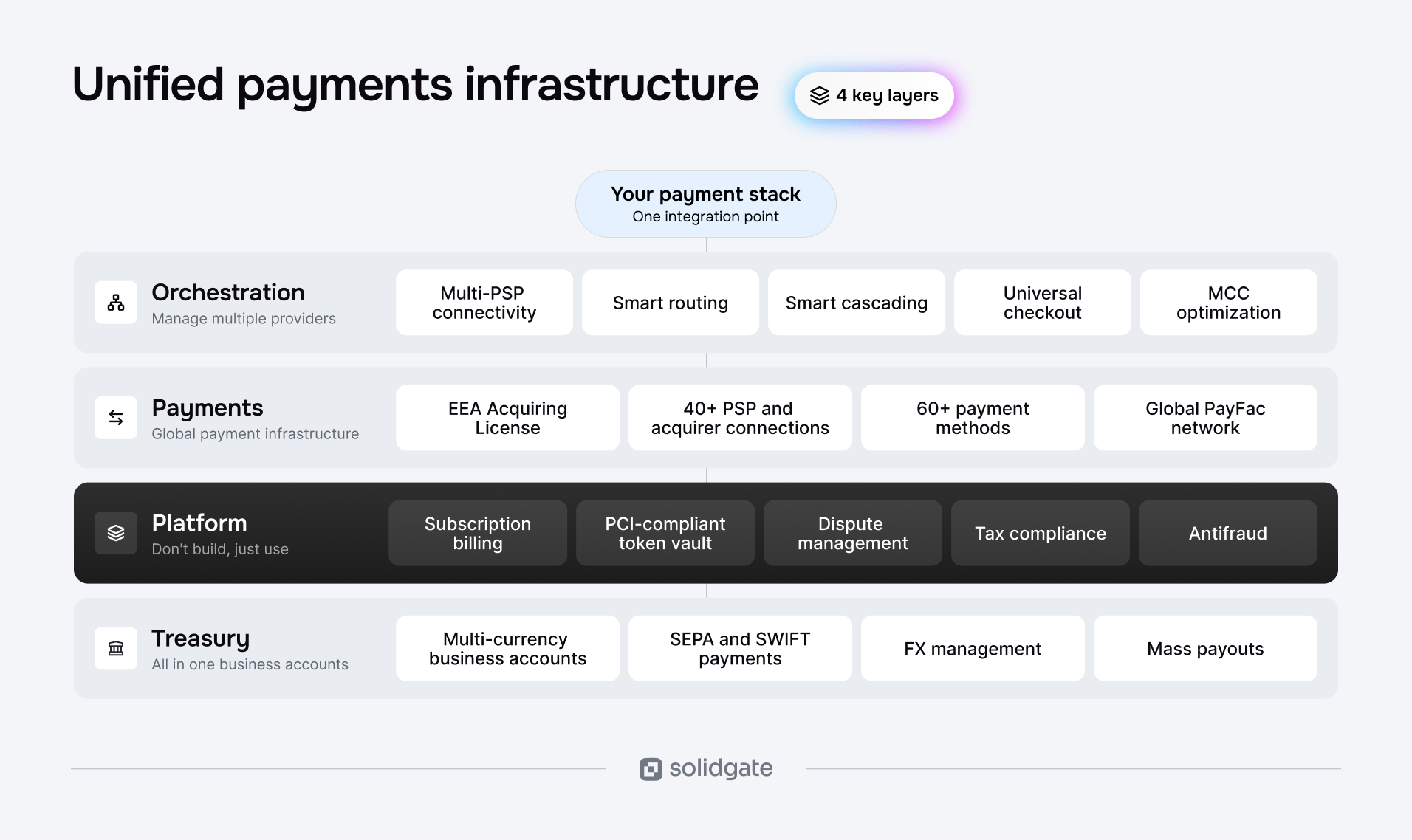
Solidgate is a for businesses scaling globally. Founded in 2016, it connects merchants to 100+ PSPs, acquirers, and payment methods through one integration. Orchestration is the core layer, extended by payment infrastructure (with options to open and manage accounts, add card acquiring, or set up PayFac capabilities), platform services (billing, fraud, and disputes), and treasury. With Solidgate, merchants get full-stack infrastructure for accepting payments, recovering lost revenue, and entering new markets.
Why choose Solidgate
Orchestration gives payments teams one place to run every provider. , failover, and reporting work across all connected providers from the Hub. Solidgate data shows that cascading has added up to 14.8% to subscriber lifetime value (LTV).
Stored credentials stay usable across providers and card reissues. The provider-agnostic vault lets merchants reuse the same card details across providers without re-collecting them. Network tokens and Account Updater keep cards current after reissue. reports a 4.6% authorization lift for tokenized card-not-present transactions compared with card numbers.
More failed renewals get recovered before they turn into churn. Billing, dunning, and smart retries are available on the platform, so a failed renewal gets another attempt timed to issuer behavior and geography. According to early Solidgate data, merchants using smart retries have seen 51–67% better first-retry conversion.
Fraud screening and dispute handling run alongside payments. Built-in antifraud screens each transaction in real time, and customizable rules let merchants tune it to their business. Verifi and Ethoca prevention alerts flag disputes before they become chargebacks, and automated representment submits evidence for Visa, Mastercard, and PayPal disputes.
Key capabilities
Each capability is modular, so merchants can start with orchestration and add layers later.
and cascading: Rules react to card type, issuer, geography, and live provider performance, and payments teams change them in the Hub without engineering. Cascading retries a declined payment through another provider, and failover reroutes traffic when a provider slows down or fails.
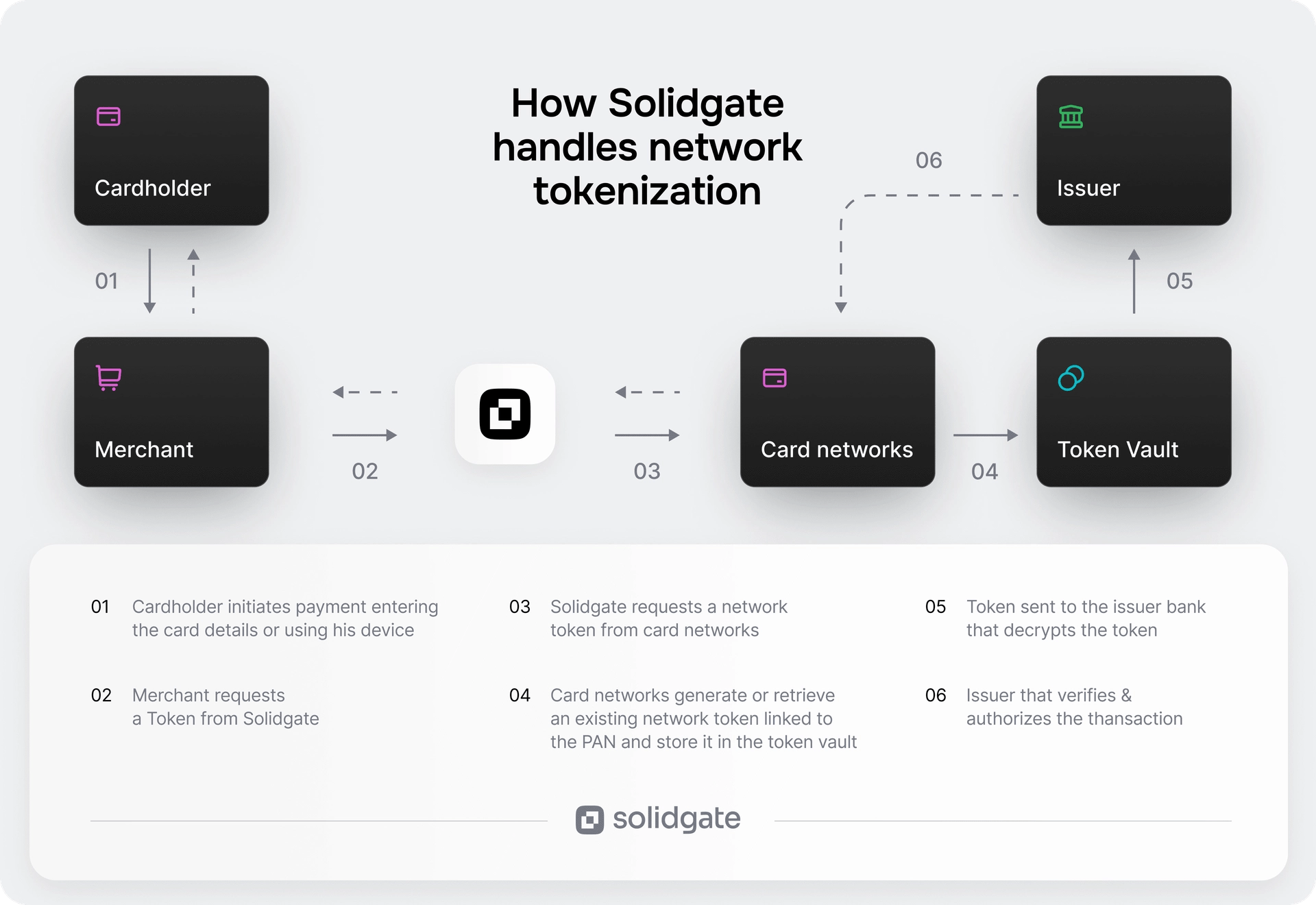
Vault and network tokenization: The provider-agnostic vault stores credentials across providers, so merchants can reuse card details without re-collecting them. Network tokens through Visa Token Service (VTS) and Mastercard Digital Enablement Service (MDES), plus Account Updater, keep cards current after reissue. Existing credentials can be imported.
Payment Form and Payment Link: A customizable embedded Payment Form keeps customers on the merchant’s site. No-code Payment Links collect payments by email, SMS, social channels, or QR code. Both support one-time and recurring payments across cards, wallets, and local methods.
Connectors and payment methods: A reaches 40+ PSP and acquirer connections and 60+ payment methods, covering cards, wallets, and local (APMs). New methods and markets activate from the dashboard without per-country development.
Payment infrastructure: Options to open and manage accounts, add access to acquiring, or set up PayFac capabilities, alongside the existing connector network.
Subscription billing and smart retries: Billing covers trials, prorated upgrades and downgrades, pauses, coupons, and dunning. Merchants get 4 retries within 4 weeks by default, adjustable in Billing settings. Merchants can also choose a third-party billing tool over the native engine.
Antifraud and dispute management: Customizable antifraud rules screen transactions, and Verifi and Ethoca prevention alerts flag disputes before they become chargebacks. Automated representment, once enabled, compiles and submits evidence for Visa, Mastercard, PayPal, and APM disputes.
Tax: Real-time tax calculation covers US and EU jurisdictions, with Avalara and Vertex integrations.
Treasury: EUR, USD, and GBP business accounts support SEPA and SWIFT payments, FX, and mass payouts.
All of this runs on with a 99.99% uptime SLA and PCI DSS 4.0 compliance.
Solidgate in practice
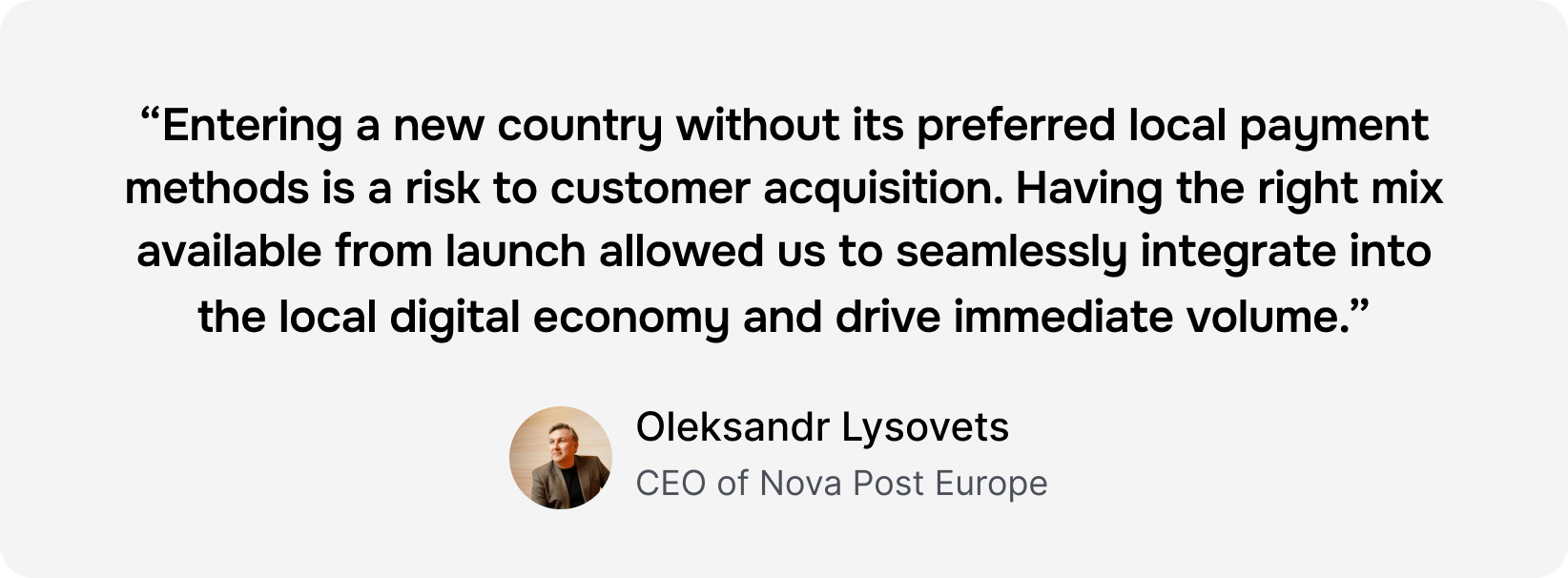
Nova Post is an international logistics operator that expanded payments across Europe, the UK, and the US through one Solidgate integration. Local payment methods – PayPal, BLIK, iDEAL, and Open Banking – were live from launch, and like-for-like settlements arrive in PLN, GBP, USD, and EUR.
- 15+ markets live
- 95%+ approval rates from launch
- Two weeks average onboarding per EU market
See the .
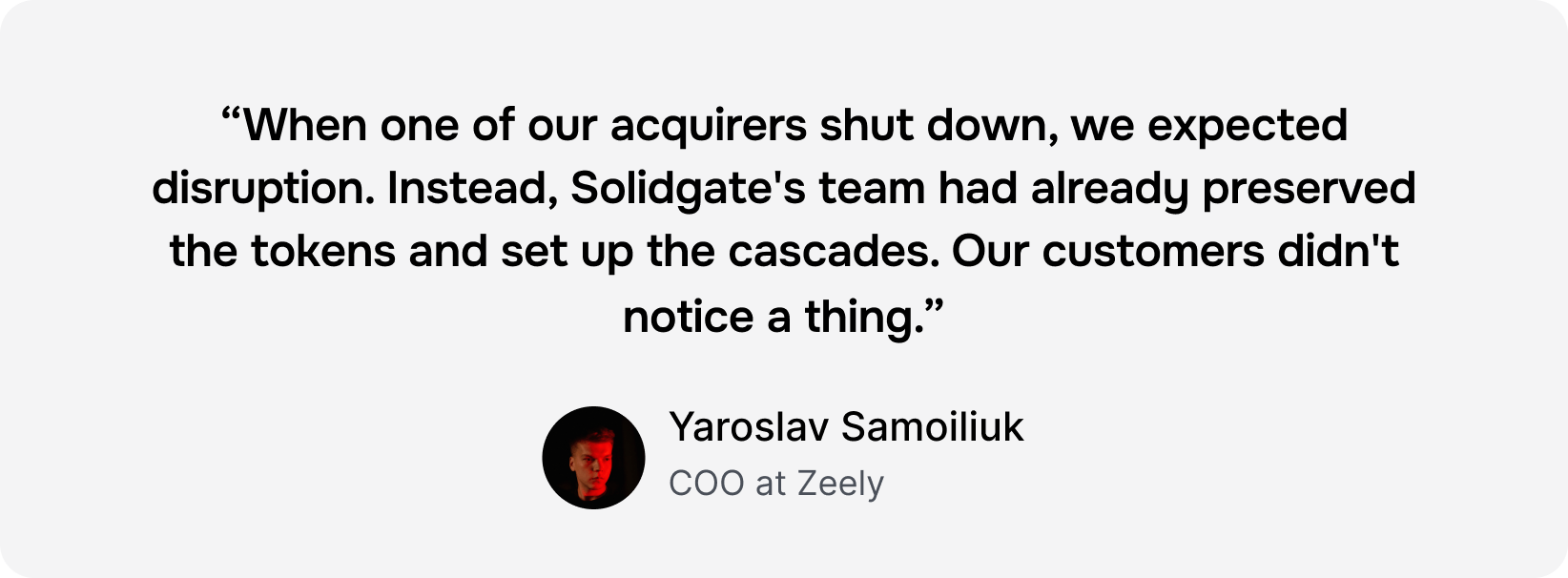
Zeely, an AI-powered marketing platform, partnered with Solidgate in 2022. Over three years, Solidgate helped it move from tier-2 to tier-1 acquirers, add routing and cascading between them, and roll out network tokenization. When one tier-2 bank closed, all tokens stayed on the Solidgate side and Zeely’s recurring payments moved to the new providers with near-zero loss.
- +8 percentage points in approval rate, from tier-1 acquirers, routing, and tokenization combined
- 10x processing growth in three years
- 40% lower risk metrics in three months
See the .
2. Yuno
Yuno is a payment orchestration company founded in 2021. Its no-code layer lets merchants accept payments in many countries without rebuilding the integration each time. Its site positions the platform for merchants, banks, and wallets.
Some of the key capabilities:
- One integration to multiple payment methods, providers, and fraud solutions in 190+ countries
- Smart routing across several providers, with automatic retries and network tokenization
- Subscription management, payouts, and reconciliation
- Risk rules, 3DS, chargeback management, a vault, and account updater
- AI agents, including Payments Concierge, which its site says monitors the payment stack and recommends actions
We think it fits best: large global merchants that want a wide provider catalog and AI-assisted payment tools.
Check our guide to the best alternatives.
3. Gr4vy
Gr4vy is a no-code, cloud-based payment orchestration platform for merchants and payment platforms. Its site frames the platform around merchant control of payment strategy.
Some of the key capabilities:
- One integration to multiple payment methods
- Optimization: routing, no-code workflows, fraud prevention, and unified payment insights
- A vendor-agnostic data vault with tokenization and data portability
- Card processing, alternative methods, recurring payments, and customizable checkout
We think it fits best: merchants and platforms that want a no-code, provider-agnostic setup with their own instance of the platform.
4. IXOPAY
IXOPAY is a payment orchestration platform that sits between merchants and their payment providers. It states that it provides no merchant ID (MID), so merchants keep their own contracts with acquirers or PSPs. The company serves merchants and regulated payment providers, and it offers a white label version that payment providers can brand as their own.
Some of the key capabilities:
- Pre-built adapters to multiple acquirers and payment methods
- Drag-and-drop rules based on card type, location, BIN, amount, and recurring or one-time payments, with fallback providers and load balancing
- A PCI DSS compliant vault with universal and network tokens, account updater, and import of existing cards
- Risk and fraud services, a built-in 3D Secure plug-in, reconciliation, and settlement
We think it fits best: merchants and regulated payment providers that want routing control and a white label option.
5. Payrails
Payrails is a modular payments platform, founded in 2021, for businesses that have outgrown a single provider. Its site describes an operating system that covers accepting payments, optimizing performance, and running financial operations.
Some of the key capabilities:
- 100+ integrations
- Configurable workflows for each payment, and an AI assistant
- A token vault, network tokenization, 3DS, and payment links
- A Merchant of Record product
- Unified analytics, chargeback management, reconciliation, payouts, and fee monitoring
We think it fits best: businesses that run several providers and want payments, finance, and data tools in one modular platform.
Spreedly alternatives compared
| Solidgate | Yuno | Gr4vy | IXOPAY | Payrails | |
| Product scope | Orchestration, payment infrastructure, billing, antifraud, disputes, tax, and treasury | Orchestration with payouts, subscriptions, reconciliation, and AI agents | No-code orchestration with checkout, vault, and analytics | Orchestration, tokenization, and payments intelligence | Modular platform for payments, finance, and data |
| Routing and recovery | Routing rules, cascading, and failover; smart routing; smart retries for renewals | Smart routing and automatic retries | Routing, retries, and workflows | Rule-based routing, fallback providers, and load balancing | Orchestration workflows |
| Vault and tokens | Provider-agnostic vault, network tokens, and Account Updater | Vault, network tokens, and account updater | Vendor-agnostic vault with data portability | Vault with universal and network tokens, and account updater | Token vault and network tokenization |
| Risk and disputes | Built-in antifraud, 3DS management, prevention alerts, and automated representment | Risk rules, 3DS, and chargeback management | Fraud prevention | Risk and fraud services, and 3D Secure | 3DS and chargeback management |
| Finance and operations | Billing, tax, treasury with mass payouts, and reconciliation | Subscriptions, payouts, and reconciliation | Recurring payments, dashboard, and reports | Reconciliation and settlement | Reconciliation, payouts, fee monitoring, and Merchant of Record |
| We think it fits best | Scaling businesses across e-commerce, subscription software, and mobility | Large merchants that want a wide provider catalog and AI tools | Merchants and platforms that want a no-code, provider-agnostic setup | Merchants and payment providers that want routing control | Businesses that have outgrown a single provider |
Disclaimer: This comparison is based on publicly available information from each company’s website and reflects Solidgate’s independent view. Features and offerings may change, so confirm current details with each provider.
Core insight: Solidgate combines orchestration with billing, tax, treasury, and risk tools, with acquiring access available as an option. Gr4vy describes a no-code setup with a dedicated instance, IXOPAY offers routing control and white label, Yuno offers a wide provider catalog with AI tools, and Payrails highlights modular finance and data tools.
How to choose the right Spreedly alternative
The right platform depends on how a business takes payments, so it helps to compare options against the same checklist.
- Map how you take payments: markets, currencies, payment methods, and the mix of one-time and recurring payments.
- Check coverage: whether the platform reaches the providers, acquirers, and payment methods your customers use in those markets.
- Compare approval and recovery tools: routing, failover, retries, and tokenization, the building blocks of .
- Review risk and compliance: fraud screening, 3DS, chargeback handling, and how the platform handles card data and PCI DSS scope.
- Look at the rest of the stack: billing, tax, reconciliation, and payout tools, and how the platform fits the systems you already run.
- Compare commercial terms: pricing model, contract length, support, and whether stored cards can move if you change platforms.
- Verify the details: ask each vendor for current pricing and terms, and read independent Spreedly reviews as well as feedback about the alternatives alongside vendor pages.
Core insight: A good alternative decision rests on market coverage, recovery tools, risk and compliance, the rest of the stack, and current commercial terms.
A good Spreedly alternative is the one that fits your payment stack
When choosing among the , the right choice often starts with analyzing your business needs. That might be broader scope in one platform, specific market coverage, or tighter control over providers and credentials.
Gr4vy and IXOPAY may suit enterprise merchants that want hands-on control of how payments are configured and routed. Yuno and Payrails can fit teams that want many integrations alongside AI, analytics, or finance tooling. Spreedly remains a good choice for teams that want to hold their own credentials and choose each provider.
Some businesses need more than orchestration: they manage multiple providers, tax, and fraud tools while scaling globally.
That’s where Solidgate helps: orchestration organized together with billing, tax, and fraud and dispute management on the same platform, with acquiring access available as an option.
to see how it fits your current setup.
Disclaimer: This article is based on publicly available information and is for illustrative purposes only. Features, benefits, and performance may vary depending on individual circumstances, market conditions, or changes in competitor offerings. All trademarks, logos, and product names are the property of their respective owners. This article reflects Solidgate’s independent view, and Solidgate makes no representations regarding the accuracy or completeness of the information provided here.
Frequently asked questions
Spreedly payment orchestration competitors include Solidgate, Yuno, Gr4vy, IXOPAY, and Payrails, among others. Each connects merchants to multiple payment providers through one integration, and each positions itself differently. The right choice is up to the merchant and depends on its needs, markets, and existing setup.
Spreedly offers modular plans: one for the vault and one for performance optimization, which is quoted through sales. Costs depend on which modules a team uses. Prices and terms change, so confirm current pricing directly with Spreedly and with each alternative before comparing costs.
The best option depends on the business, so start with your markets, payment methods, and payment volume. Then compare each platform’s provider coverage, recovery and risk tools, and fit with your existing systems. Ask vendors for current pricing and terms, and check independent reviews and customer references before deciding.
Recent articles