Interchange
What is interchange?
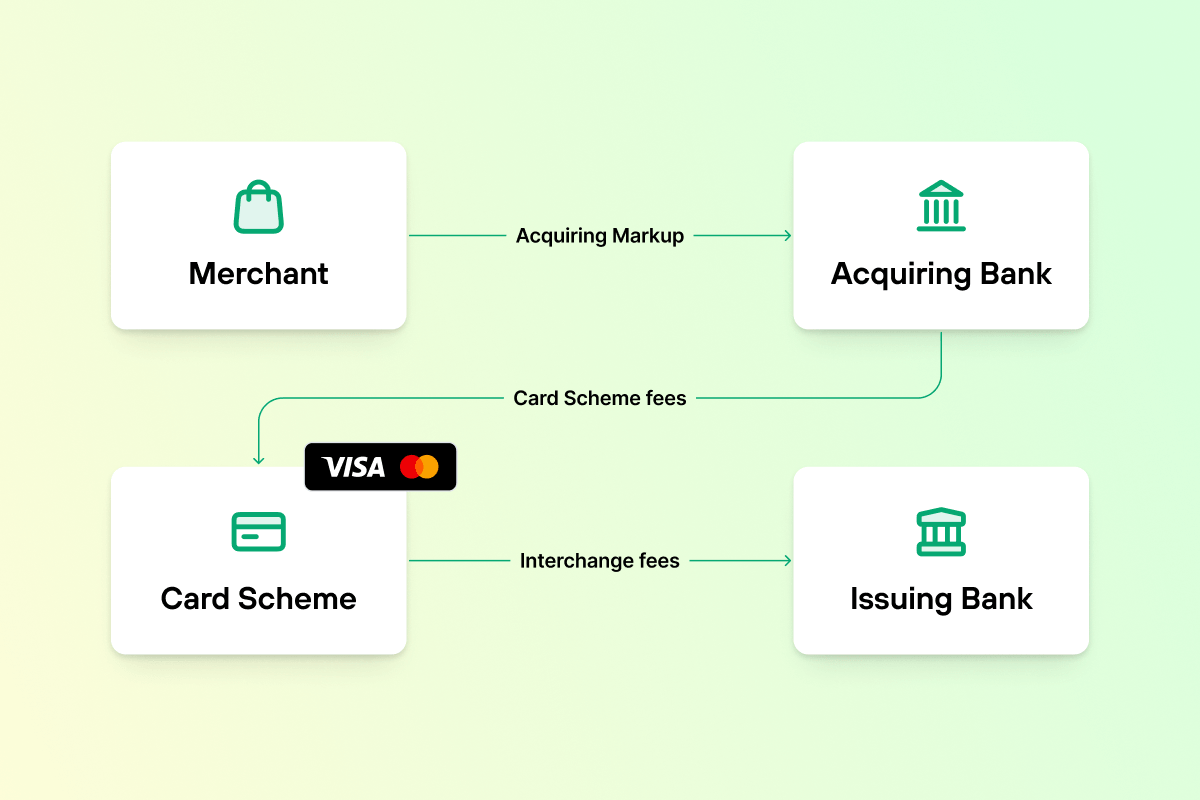
Interchange is a fee the acquiring bank pays to the cardholder's every time someone pays with a card. The , such as Visa and Mastercard, set the rate, and it compensates the issuer for the cost and risk of funding and processing the transaction.
The rate is fixed by the networks, not negotiated between the two banks. It is charged as a percentage of the transaction value, a fixed amount per transaction, or both, and it changes with the card type, the channel, and the merchant's industry. Merchants never pay the issuer directly, but they carry interchange as the largest input into what their charges them to accept cards.
Interchange is not the same as interchange++ (IC++). Interchange is the single network fee inside a transaction; is a pricing model that shows a merchant that fee separately, alongside scheme fees and the processor's markup.
Key facts
- Also known as: interchange fee, interchange reimbursement fee (IRF)
- Paid by: the acquiring bank (the merchant's )
- Paid to: the , the cardholder's bank
- Set by: the , not the banks
- Charged as: a percentage of transaction value, a fixed per-transaction amount, or both
- Varies by: card type, transaction channel, and the (MCC), a four-digit code that groups merchants by industry and helps determine the rate
How interchange works
- Authorization – The cardholder pays, and the transaction routes from the merchant through the acquirer to the card network to the issuer.
- Rate applied – The network applies the interchange rate that matches the card type, channel, and merchant category for that transaction.
- Settlement – The issuer sends the acquirer the transaction amount minus interchange, so the issuer retains interchange as its share.
- Merchant billed – The acquirer recovers interchange from the merchant through its own charges, usually bundled into the .
What affects interchange rates
- Card type – Rewards and commercial credit cards carry higher interchange than standard debit cards, because they cost the issuer more to fund.
- Transaction channel – Card-not-present payments usually price higher than card-present ones, since online transactions carry more fraud risk.
- Merchant category – The MCC groups merchants by industry, and some categories qualify for preferential rates.
- Region and regulation – The EU and UK cap interchange on consumer cards, so the same card pays a different rate depending on where the transaction settles.
Interchange vs interchange++
Interchange is one fee inside a transaction; interchange++ (IC++) is a way of pricing a merchant that exposes that fee on its own line.
| Interchange | ||
| What it is | A network fee | A merchant pricing model |
| Set by | The card networks | The processor or acquirer (the markup) |
| Who pays | The acquiring bank | The merchant |
| Covers | One issuer fee | Interchange, plus scheme fees, plus processor markup |
Why it matters
Because the issuer keeps interchange and the acquirer passes it on, interchange forms the base cost of every card payment a merchant accepts. No party at the point of sale can negotiate it down: the networks publish the rates, so the rate that applies is decided by the transaction mix, which card, which channel, which category.
That is also why the pricing model matters. Under interchange++ the merchant sees the exact interchange charged on each transaction. Under flat-rate pricing the same cost is folded into one blended rate, so the merchant can't see interchange on its own.