Payment service providers: What merchants need to know
Payments 101
Updated 22 Sept 2026
9 min

Andrii Kononenko
Head of Merchant Operations, Solidgate
A payment service provider is the backbone of how online businesses get paid. Here's everything merchants need to know – from how PSPs work to how to choose the right one.
A payment service provider (PSP) lets merchants accept and process transactions across multiple payment methods. For most online businesses, it's the foundation of how they get paid.
But not all PSPs are built the same. Providers differ in which markets they cover, which payment methods they support, how they handle routing, and how much operational control they give merchants over the stack. Those differences are easy to miss at the start – and harder to work around once volume grows and market requirements expand.
This guide covers what PSPs do, how to evaluate them, and when one provider stops being enough.
TL;DR
- PSPs handle the full payment lifecycle: acquiring access, fraud screening, authorization routing, compliance, and settlement reporting.
- Two main PSP types exist: aggregators (fast setup, flat-rate pricing, shared merchant account) and dedicated merchant account providers (deeper underwriting, volume-based pricing, more control).
- Choosing the right PSP comes down to five factors: payment method and market coverage, checkout and integration fit, security and compliance standards, fees, and support quality.
- As payment needs grow, merchants often work with more than one PSP – and managing multiple providers is where payment orchestration becomes relevant.
What is a payment service provider (PSP)?
A payment service provider (PSP) is a third-party organization that enables businesses to accept electronic payments from customers. It includes cards, digital wallets, bank transfers, and local payment methods – all accessible through a single integration. The PSP manages the underlying relationships with acquiring banks, card networks, and compliance frameworks on the merchant's behalf.
Before PSPs became standard, getting started with online payments meant applying directly to acquiring banks, setting up a separate payment gateway, and managing fraud and compliance independently. PSPs replaced that complexity with a single integration and a standardized onboarding process.
For merchants, this means:
- Faster time to market
- Lower operational overhead
- A consistent layer for , settlement, and reporting across every payment method they accept
A separate model worth knowing is the (MoR) – a third party that assumes full legal and financial responsibility for each transaction, including tax collection and compliance. A PSP processes payments on the merchant's behalf; an MoR owns the transaction legally.
Payment service provider vs payment gateway vs payment processor
Here’s how the three concepts differ:
A payment processor handles the technical transfer of funds between the and the card network – transaction execution only. It doesn't provide merchant accounts or bundled services.
A payment gateway is the data transmission layer – it encrypts and routes payment data from the merchant to the acquiring bank.
A payment service provider integrates both – and adds the merchant account, fraud tooling, settlement, compliance, and reporting around them.
See the full breakdown of in our guide.
Types of payment service providers
| Aggregators | Dedicated merchant account providers | |
| Merchant account | Shared master account across many merchants | Unique MID assigned to your business only |
| Onboarding | Fast, minimal paperwork | Deeper underwriting and approval process |
| Pricing | Flat rate per transaction | Volume-based rates, typically lower at scale |
| Control | Limited – account decisions at the aggregator level | Higher – direct relationship with the acquiring bank |
| Best for | Businesses starting out or processing lower volumes | High-volume merchants needing rate optimization and account stability |
Aggregators pool merchants under a single master account – which is what makes onboarding fast and pricing simple.
Dedicated merchant account providers assign a unique merchant ID to each business, requiring more underwriting upfront but offering more control over the long-term acquiring relationship.
Core insight: Aggregators trade control for speed; dedicated account providers trade speed for control. Transaction volume is the most reliable starting point for deciding which trade-off fits your business.
How do payment service providers work?
When a customer clicks "Pay," the PSP coordinates a sequence across six parties – the customer, the merchant, the PSP itself, the acquiring bank, the card network, and the issuing bank.
The full cycle from initiation to settlement typically spans seconds for authorization and one to three business days for funds to reach the merchant's account.
- Payment initiation – The customer enters card or wallet details at checkout.
- Fraud and risk screening – PSPs with built-in fraud screening evaluate the transaction against risk signals.
- Routing – The PSP selects the acquiring bank for the transaction based on cost, approval likelihood, and market. logic applied here determines which path the transaction takes through the.
- Authorization – The acquiring bank forwards the request through the card network to the issuing bank. The issuer may trigger 3D Secure verification, then approves or declines based on available funds and risk assessment.
- Response – The authorization decision returns to the merchant via the PSP. The customer sees an approval or decline at checkout.
- Capture and clearing – Once authorized, the merchant captures the transaction (immediately or deferred, depending on business type). The card network then clears the transaction - confirming the funds transfer between the issuing and acquiring banks.
- Settlement – Funds move from the issuing bank through the acquiring bank to the merchant's account. The PSP handles reconciliation and provides transaction-level reporting for the merchant's finance workflow.
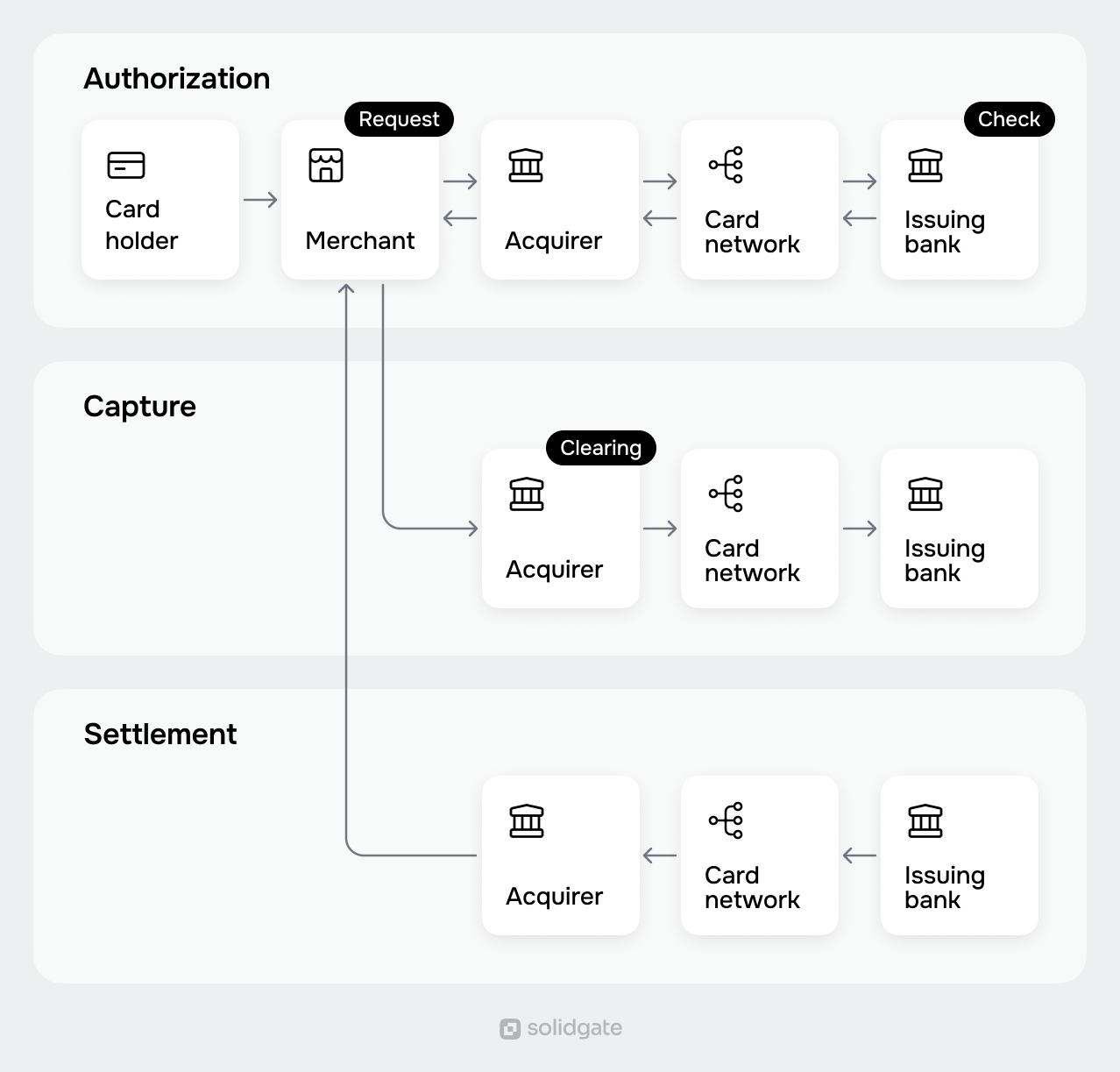
For a deeper look at see our guide.
Core insight: Behind a single customer’s "Pay" sits a seven-step sequence spanning six parties. The PSP coordinates it end to end – the merchant sees one integration and one reporting view.
Core functions of a payment service provider
Payment acceptance
Payment providers give merchants access to cards across Visa, Mastercard, and regional schemes, alongside digital wallets and . The breadth of the PSP's payment method library determines which markets and customer segments you can reach without adding another provider.
Acquiring access
PSPs maintain relationships with acquiring banks so merchants don't have to. When a transaction is authorized, the acquiring bank receives the funds from the card network and settles them to the merchant. The PSP manages that relationship, including the merchant account setup and the acquiring bank's underwriting requirements.
Authorization routing
PSPs apply routing logic to each transaction – selecting the acquiring path most likely to approve it at the lowest cost. More configurable PSPs let merchants set routing rules by card type, country, or transaction value. This is the layer that most directly affects authorization rates.
Security and compliance
PSPs operate under (Payment Card Industry Data Security Standard) certification and handle , tokenization of stored card data, and regional regulatory requirements such as SCA (Strong Customer Authentication) for European transactions. Merchants using a PSP inherit a substantial portion of this compliance coverage.
Settlement and reconciliation
After clearing, the payment provider settles funds to the merchant's account and generates transaction-level reports covering authorization outcomes, , dispute activity, and settlement status. The depth of reporting varies by provider – it's one of the differentiators to consider when comparing options.
Core insight: Every PSP covers payment acceptance, acquiring access, and PCI compliance. Where providers diverge is routing logic, reporting depth, and how much control they give merchants over both.
Payment service provider examples
Among others, notable examples of PSPs include:
PayPal – operates as both a consumer payment method and a PSP for merchants, offering checkout integration, card processing, and fraud tooling under an aggregator model. One of the advantages is brand recognition – a large share of online shoppers already have PayPal accounts, which can reduce checkout friction in consumer-facing businesses.
Stripe – an API-first payment platform widely used by SaaS companies, e-commerce businesses, and marketplaces. It operates as an aggregator, which makes setup fast, and supports cards, digital wallets, bank transfers, and subscription billing across a wide range of markets and currencies.
Adyen – a global payment platform serving enterprise and large mid-market businesses across online, in-app, and in-store channels. It provides a dedicated merchant account, direct acquiring relationships in key markets, and data visibility across the full transaction lifecycle.
Braintree – a PSP owned by PayPal, built for e-commerce and digital businesses that need a full-stack API integration. It supports cards, digital wallets, and PayPal through a single integration, and offers developer tooling suited to businesses with custom checkout requirements.
Disclaimer: The descriptions above are based on publicly available information and may not reflect the latest product updates from each provider.
Core insight: Each of these providers suits a different point in a merchant's growth and technical requirements.
How to choose a payment service provider
The right choice depends on transaction volume, target markets, risk profile, and how your checkout is built. Here are some factors to consider:
Payment method and market coverage
The PSP's library determines which customers you can convert. A merchant expanding into Europe may need iDEAL, BLIK, or Klarna, depending on the market. One entering Brazil needs PIX. Coverage gaps at the PSP level translate directly to lost conversions at checkout – verify supported methods by country before shortlisting.
Checkout and integration fit
The PSP's checkout layer should match how you actually sell. An keeps the customer on your domain throughout the payment flow. Unlike a hosted redirect, it loads within your own page – giving you full control over the checkout UX and reducing abandonment at the final step. If you sell through a mobile app, confirm the PSP also offers native SDKs for iOS and Android.
Security and compliance standards
At minimum, any payment services provider must be PCI DSS certified. Beyond that, check whether the provider supports 3D Secure 2 and handles SCA requirements for European transactions. Confirm the PSP's approach to tokenization for stored card credentials – this matters for and one-click checkout flows.
Fees and processing costs
PSP processing fees typically combine a per-transaction rate with optional monthly or setup fees. Flat-rate models are predictable at lower volumes; volume-based models become more favorable as transaction count grows.
Beyond the headline rate, check for fees on chargebacks, currency conversion, and early contract termination. Negotiating interchange-plus pricing at higher volumes and consolidating providers to reduce per-transaction overhead are two practical ways to.
Support and onboarding
Ask for specifics on documentation quality, sandbox access, and the post-launch support model. Account management, SLA commitments, and incident escalation paths matter more at scale – when a processing issue surfaces on a high-volume day, support response time has a direct revenue impact.
Core insight: Coverage, integration fit, compliance, pricing, and support – consider these factors when choosing among payment providers.
When merchants expand beyond a single PSP
A single PSP covers most payment needs at moderate volume and limited market scope. Merchants add more providers – or a routing layer across multiple providers – when specific gaps appear that one PSP can't close.
Cross-border expansion. PSPs have uneven acquiring coverage by geography. A provider with strong performance in Western Europe may have weaker local acquiring relationships in Southeast Asia or LATAM. This shows up as lower approval rates in those corridors and limited support for local payment methods.
Merchants entering new markets add a PSP with stronger regional coverage for those specific geographies rather than relying on a single provider's global reach.
Authorization rate ceilings. Every PSP routes through a fixed set of acquiring banks. When approval rates plateau or drop in a specific country, card type, or merchant category, the constraint often sits at the acquirer level – and may not be resolvable within the same PSP's network. Routing identical transactions through a different acquirer opens alternative authorization paths that the primary provider can't reach.
Uptime and redundancy. A PSP outage takes payment acceptance offline for every merchant on that provider simultaneously. Merchants processing at volumes where downtime has direct revenue impact distribute traffic across two providers to maintain continuity when one goes down.
Running multiple PSPs independently creates its own overhead – separate integrations, separate reporting, separate reconciliation, separate contracts. addresses that complexity.
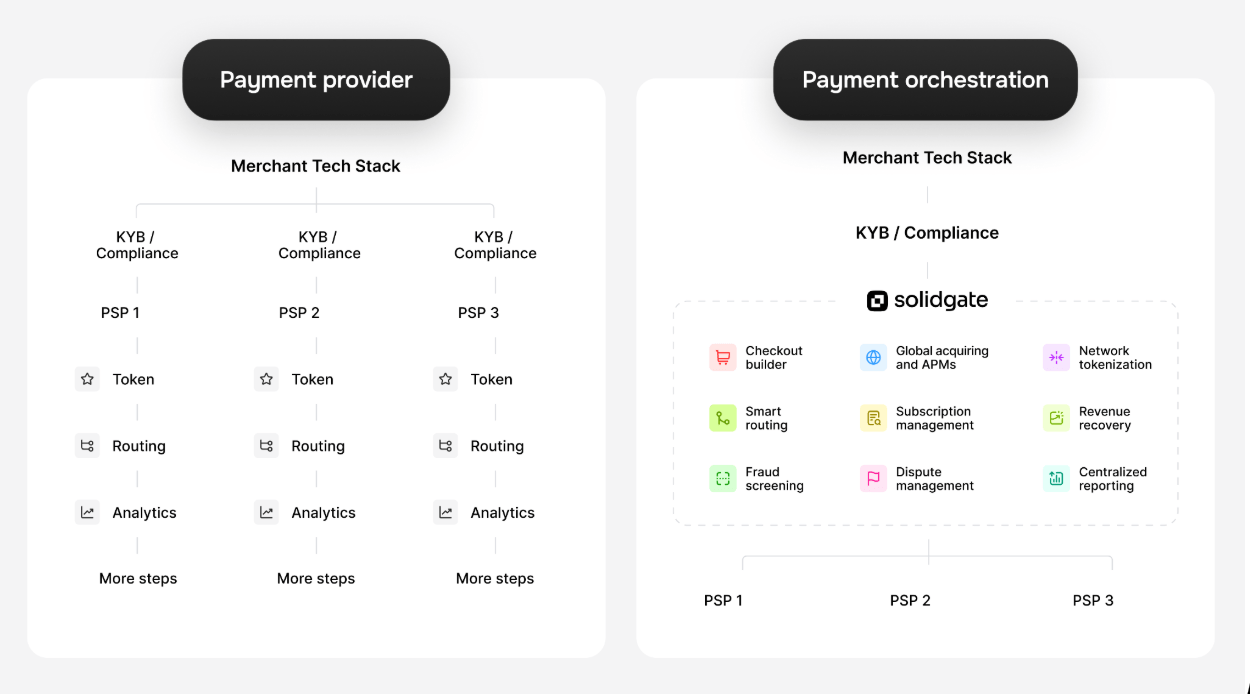
An orchestration platform sits above existing them through a single integration. It routes each transaction to the best-performing provider in real time, applies failover automatically when a provider underperforms, and normalizes reporting across all connected providers into one view.
Core insight: Adding a second PSP solves a specific gap. An orchestration platform managing multiple PSPs.
Optimizing your payment stack
A PSP gives merchants access to payment infrastructure – acquiring relationships, fraud screening, compliance, and settlement without managing each layer separately. The choice of provider determines which markets you can reach, which payment methods your customers see at checkout, and how much control you have over authorization performance and costs.
As you expand, those requirements grow – and gaps in local acquiring, method coverage, or compliance support become visible.
Adding more PSPs is the natural next step. And with more providers come more integrations, more settlement reports, more routing logic to maintain.
Payment orchestration solves that. It connects to multiple PSPs and routes each transaction to the best-performing provider in real time – improving approval rates, enabling automatic failover, and consolidating reporting across all connected providers into one view.
Solidgate is a that connects to 100+ PSPs, acquirers, and through one integration.
to map your existing payment setup and see where it can be optimized.
Frequently asked questions
A PSP (payment service provider) is a third-party company that enables businesses to accept payments – cards, digital wallets, and bank transfers – through a single integration. It manages acquiring relationships, fraud screening, compliance, and settlement on the merchant's behalf.
A payment processor handles the technical transfer of funds between the acquiring bank and the card network. A PSP includes that function and adds the merchant account, fraud tooling, compliance, and settlement reporting on top.
A payment gateway is the data transmission layer – it encrypts and routes payment data from the merchant to the acquiring bank. A PSP includes gateway functionality and bundles it with everything else: merchant account, fraud tools, settlement, and reporting.
It depends on the account model. Aggregators can have a merchant processing within hours – minimal paperwork, shared merchant account. Dedicated merchant account providers require underwriting, which typically takes days to a few weeks depending on the business type and risk profile.
Payment method coverage varies by provider. Most support major card schemes (Visa, Mastercard) and digital wallets (Apple Pay, Google Pay). Support for local payment methods – PIX in Brazil, iDEAL in the Netherlands, BLIK in Poland – depends on the PSP's network and regional partnerships.
Most PSPs include built-in fraud screening – device fingerprinting, velocity checks, card verification, and 3D Secure authentication. The depth of configurability varies: some offer basic rules, others give merchants full control over fraud logic and risk thresholds.
Most PSPs support through stored card credentials and automated charge cycles. The quality of subscription tooling varies – retry logic for failed renewals and subscription-level reporting are capabilities worth evaluating specifically if recurring revenue is a meaningful part of your model.
Yes. Merchants add more payment services providers when their primary provider has coverage gaps – in specific geographies, payment methods, or uptime resilience. Managing multiple PSPs independently adds operational complexity. A connects them through one integration and applies routing logic across the full stack.