The best subscription billing software: Top features and providers
Payments 101
16 Jan 2026
10 min

Valentyn Pidpalyi
Product Manager, Solidgate
Most subscription businesses hit the same wall: pricing experiments strain rigid systems, legitimate payments get declined, and ops overhead explodes. Here's how to evaluate billing platforms that actually solve these problems.
Subscription billing software is a platform that automates how you charge your recurring customers, manages subscriptions, and handles related financial workflows.
If you’re searching for the best subscription billing software, you’re probably trying to solve one or both of these problems:
- Billing logic complexity is catching up – pricing experiments, usage-based components, upgrades/downgrades mid-cycle, tax rules, revenue recognition, and invoice workflows.
- Payment performance is suffering – legitimate payments are getting declined, retries aren’t recovering revenue, local payment methods are missing, or your single payment service provider (PSP) is becoming a bottleneck as you scale internationally.
The right subscription billing platform can address both billing complexity and payment performance issues.
In this guide for payments, product, finance, and growth leaders, we break down the features that matter, the tradeoffs you should expect, and which providers tend to fit different subscription business models.
Who owns subscription billing as company scales
One reason subscription billing gets messy is that ownership shifts as companies grow. Engineering usually owns it early when pricing is simple. As you scale, ownership gets shared – payments teams care about conversion, finance about accuracy, and product teams about entitlement alignment.
The tooling you choose determines whether these teams can operate independently or step on each other constantly.
The best subscription billing process makes ownership explicit and allows different teams to operate within clear boundaries. That starts with choosing software that doesn't force constant cross-team dependencies.
The checklist below covers what each team typically cares about – from pricing flexibility to compliance workflows to payment performance. Use it to map which features matter most for your specific ownership structure.
What to look for in the best subscription billing software
Most billing platforms are built for different scenarios. Below is a checklist you can use in demos and evaluations.
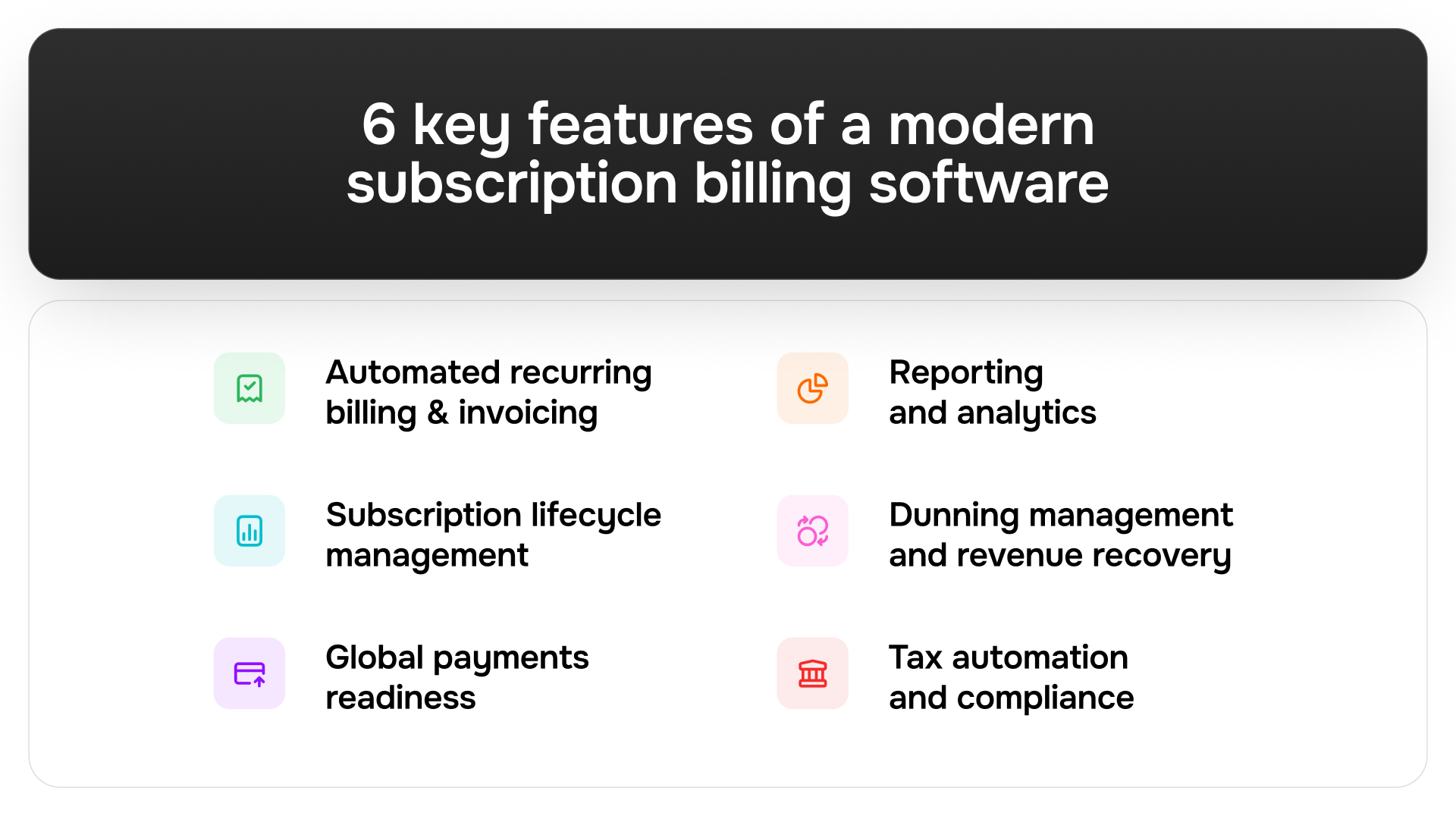
Pricing flexibility
Confirm the platform supports your pricing model today and the model you expect in 12–18 months.
- Flat-rate, tiered, volume, seat-based, hybrid, and usage-based pricing
- Add-ons and one-off charges or upsells
- Coupons and discounts
- Trials and billing schedules, e.g., monthly, annual, custom calendars
If your pricing changes frequently, prioritize platforms that let non-engineers easily configure tiered pricing and subscription plans.
Subscription lifecycle management and proration correctness
Look for:
- Upgrades, downgrades, pauses, reactivations, and cancellations
- Clear rules for mid-cycle changes
- Customer-facing invoice clarity
- Entitlements alignment, when billing state matches product access
A common failure mode is a technically correct proration calculation that produces confusing invoices and creates support tickets.
Dunning management and revenue recovery
For many subscription businesses, 20-40% of failed payments are recoverable with proper retry logic and customer communication. The difference between basic dunning and smart dunning can be 2-5% of MRR.
Baseline capabilities include:
- Configurable smart retry schedules (by reason codes when possible)
- Customer notifications (email templates, timing)
- Grace periods and account state handling
- Card updater support and wallet updates
If you’re losing meaningful revenue to declines, evaluate dunning like a product, not a checkbox. For example, a streaming platform by 3.5% and cut subscription churn by 5% after restructuring their retry logic and recovery flows — saving over €100K annually in the process.
Global payments readiness
Even if you are not “global” today, your customer mix might be. Even B2B SaaS companies selling primarily in the US often have 15-20% of customers outside their home market. These customers convert better and churn less when they can pay in local currency with familiar payment methods.
To ensure global-ready payments, confirm the availability of:
- Integration with multiple for flexibility and regional optimization
- Multi-currency pricing and invoicing
- Customizable checkout that supports various payment methods such as cards, ACH, wallets, and local payment schemes (e.g., SEPA, Alipay, WeChat Pay)
- Settlement and FX handling (what happens operationally when you expand)
- SCA and strategy for recurring transactions
If your checkout only supports cards in markets where digital wallets or local payment methods dominate, you’ll feel it in conversion rates.
Finance and compliance
Finance teams need to meet accounting standards like ASC 606 and IFRS 15. Payment teams handle region-specific requirements like SCA and 3DS for recurring transactions. Your teams will care about:
- Invoice numbering and audit trails
- Automated tax calculation and reporting
- Revenue recognition workflows (especially enterprise use cases)
- Data exports and accounting integrations
A common failure pattern: billing platforms handle invoicing and payments well, but export incomplete data for revenue recognition. Finance ends up running manual reconciliation in spreadsheets, which breaks down as transaction volume scales.
Some platforms focus heavily on revenue recognition and close processes; others assume you’ll handle that elsewhere. When evaluating platforms, understand which compliance workflows are handled directly and which require integrations or manual oversight.
Analytics and insights
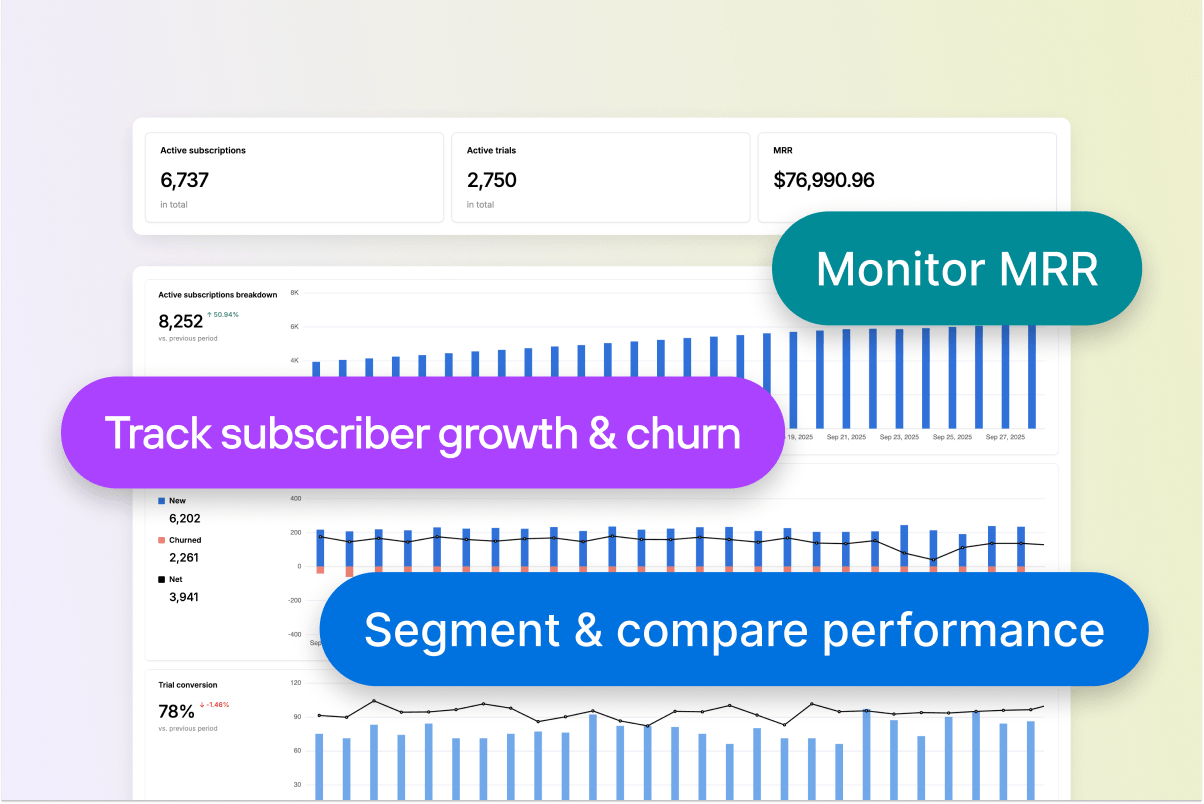
Strong billing analytics help you get a clear picture of your business without needing to manage spreadsheets. Look for platforms that can track and visualize:
- Monthly Recurring Revenue (MRR), Churn Rate, Lifetime Value (LTV), and Cohort Analysis
- rates and recovery performance
- Key performance indicators (KPIs) that matter for subscription businesses to spot trends and take action
- Predictive analytics that help you manage and forecast churn or customer lifetime value
The difference between basic reporting and strong analytics is action. Basic platforms tell you MRR went down. Strong platforms show you it dropped because a specific cohort churned due to payment failures with a particular card network in a specific region – actionable intelligence you can actually fix.
Top subscription billing software providers
Different providers excel in different use cases. What works for a SaaS startup will not necessarily fit an enterprise with complex pricing and operations. This comparison reflects each provider's primary strengths.
Platform comparison: Key features at a glance
| Provider | Key features | Best for |
| Solidgate | Subscription billing, payment orchestration, multi-PSP routing, global payment methods | Global subscription businesses scaling internationally, payment performance optimization |
| Chargebee | Flexible pricing, strong dunning, revenue recognition, extensive integrations | Mid-market SaaS, pricing experimentation |
| Stripe Billing | Developer APIs, usage metering, seamless Stripe integration | Tech companies, existing Stripe users |
| Zuora | Enterprise automation, advanced rev rec, multi-entity support | Large enterprises, complex billing |
| Maxio | SaaS metrics, revenue recognition, financial operations | B2B SaaS, finance-driven teams |
| Recurly | ML-powered dunning, retention tools, payment flexibility | Revenue optimization, churn reduction |
The sections below break down how each platform approaches subscription billing, what they optimize for, and which business models they fit best. If you're evaluating multiple providers, focus on the 'Best for' sections to narrow your shortlist quickly.
Solidgate Billing
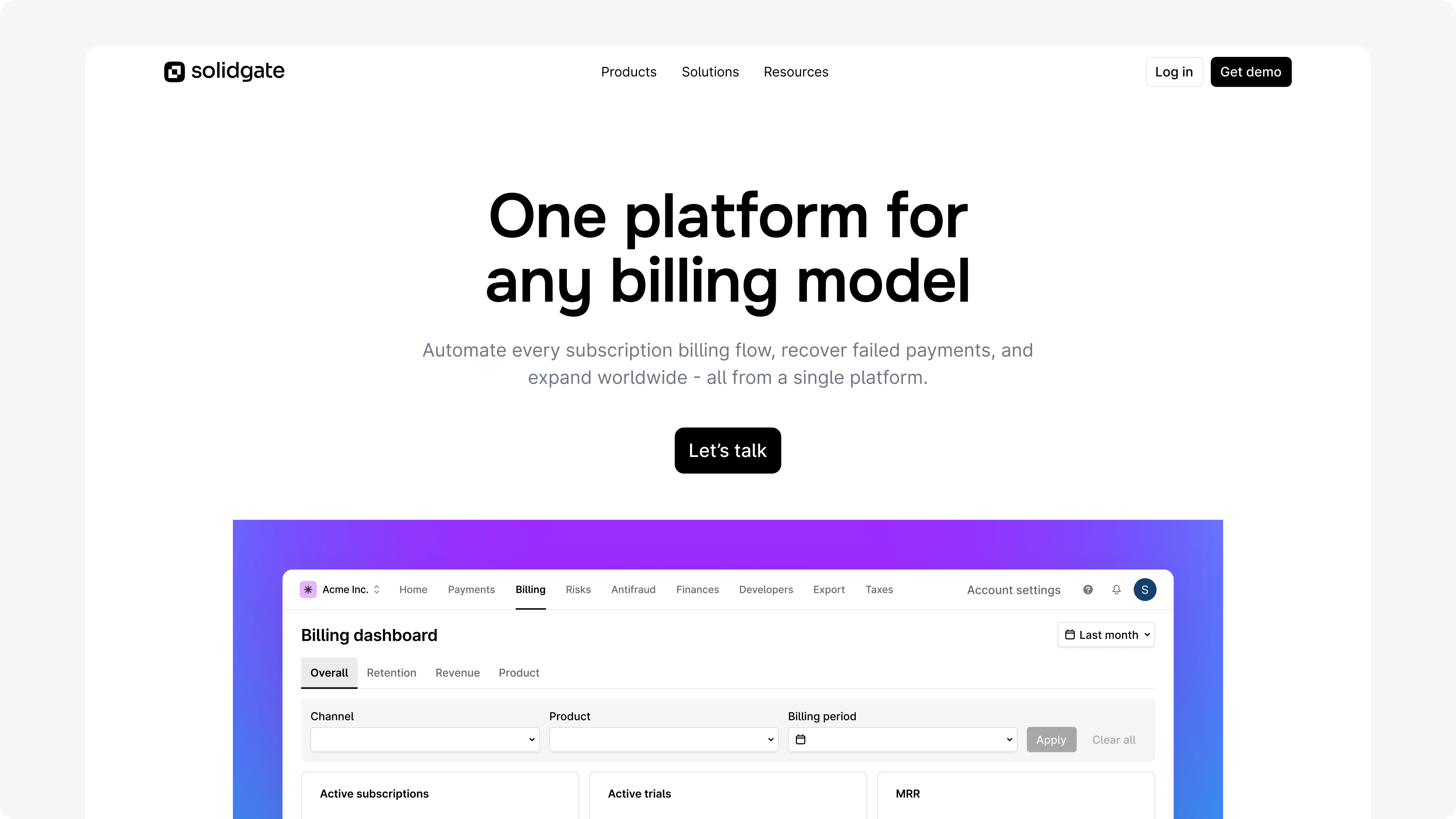
combines with , built for businesses that need both billing automation and payment performance optimization.
The platform addresses a specific problem: as subscription businesses scale internationally, they hit payment infrastructure constraints that billing-only tools can't solve – declining authorization rates, limited payment method coverage, single-provider lock-in, and revenue leaks from failed payments.
The platform works across three connected layers:
- Subscription billing and commerce: Product catalog, dynamic pricing, subscription lifecycle management, checkout, tax calculation, dunning, and logic.
- Payment orchestration: across multiple PSPs based on cost, approval rates, and geography. Token vault for secure credential storage. Automated failover when providers go down.
- Global payment infrastructure: Direct acquiring relationships and connectors to alternative payment methods (wallets, local schemes, bank transfers) across major markets.
This structure lets teams handle billing logic and payment performance from one platform instead of stitching together separate tools.
What it does well:
- Multi-PSP orchestration for subscriptions: Most billing platforms integrate with one or two PSPs. Solidgate routes subscription payments across multiple providers based on approval rates, cost, and performance—automatically. When a transaction fails with one provider, it can retry through another. This matters for recurring revenue because small improvements in authorization rates compound monthly.
- Global payment method coverage without provider switching: Connectors to acquiring banks and alternative payment methods (SEPA, PIX, Alipay, wallets) mean you can add local payment methods in new markets without migrating PSPs or rebuilding integrations.
- Revenue recovery infrastructure: Network tokenization, account updater, smart retry logic, and reason-code-based dunning reduce involuntary churn. The platform tracks which retry strategies work for different decline types and adjusts automatically.
- Unified subscription and payment analytics: Billing metrics (MRR, churn) alongside payment performance data (approval rates, retry effectiveness, provider costs) in one dashboard. Most teams run these separately and miss optimization opportunities.
Best for:
- Subscription businesses processing $300k+ monthly that are expanding internationally and need both billing automation and payment performance optimization in one platform.
- Companies running or planning to run multiple PSPs for redundancy, cost optimization, or regional coverage without operational chaos.
- Businesses where involuntary churn from payment failures is a top-3 growth constraint, and dunning needs to work across multiple payment providers.
Chargebee
focuses specifically on subscription billing solutions and has been built from the ground up for recurring revenue businesses.
Billing capabilities: Supports flat-rate subscriptions, tiered pricing, usage-based billing, seat-based models, and hybrid approaches. Proration handles complex scenarios correctly. Coupons, discounts, and promotional pricing work smoothly. Invoice customization matches your brand. Revenue recognition features support accounting requirements.
What it does well: Pricing flexibility stands out. You can test different models with customer segments, launch new tiers quickly, and adjust pricing without code changes. Dunning capabilities go beyond basic retry logic with smart timing and customer communication.
Extensive integrations connect billing data with accounting systems, CRM tools, and business intelligence platforms.
Best for:
- SaaS companies and subscription businesses that need sophisticated pricing flexibility without building custom billing systems.
- Businesses in growth mode testing pricing strategies.
- Companies with diverse product offerings requiring multiple subscription models.
Stripe Billing
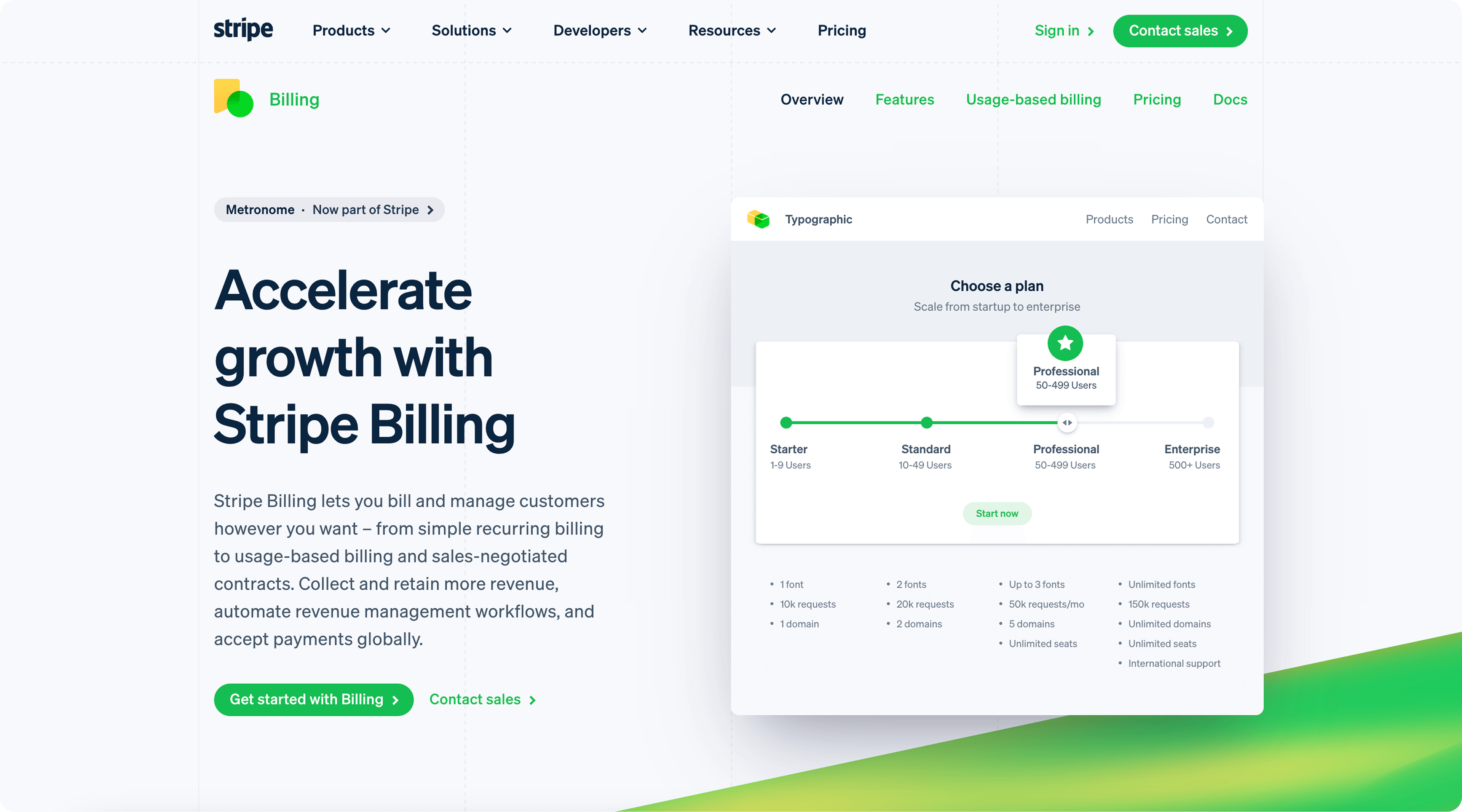
works best when you already process payments through Stripe and want to add subscriptions without stitching together another system.
Billing capabilities: Handles automated recurring billing with flexible scheduling. Usage-based billing supports metered charges based on API usage, resource consumption, or tracked metrics. Billing automation manages complex proration scenarios. Multiple currencies and payment methods work through Stripe's global network.
What it does well: Integration with Stripe's payment processing is seamless if you're already using Stripe. No additional platform fees beyond Stripe's standard payment processing costs keep pricing transparent. Strong developer documentation and tools make implementation faster for engineering teams. The API-first approach gives control over billing flows.
Best for:
- Tech-forward companies with engineering resources that want control over billing implementation.
- Businesses already using Stripe for payment processing get the easiest path to adding subscription capabilities.
- For companies needing custom billing logic beyond pre-built workflows.
Zuora
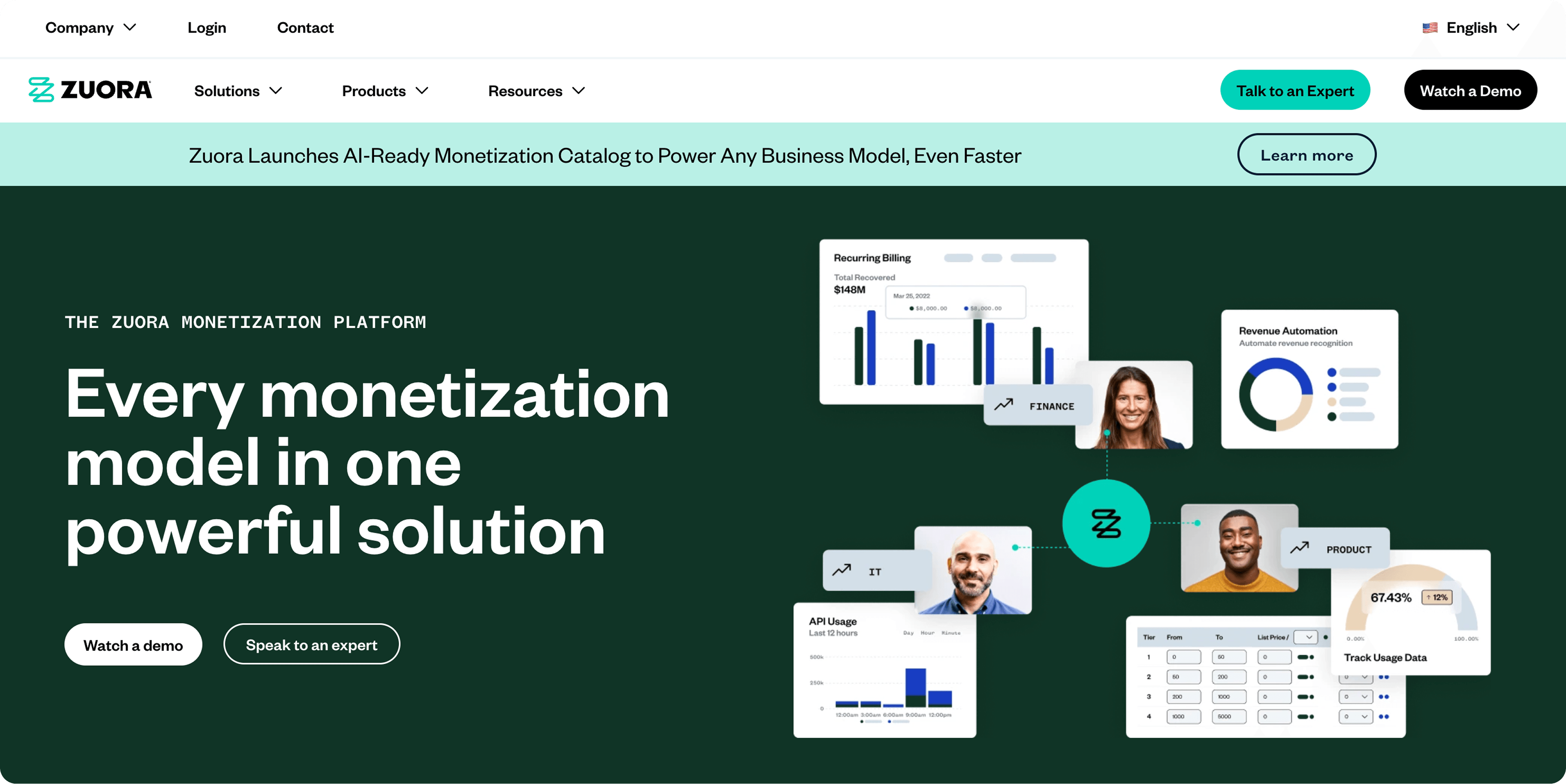
targets enterprise subscription businesses with complex requirements and significant scale.
Billing capabilities: Supports any pricing model, including tiered, volume-based, usage-based, and hybrid approaches. Complex proration rules handle enterprise scenarios. Contract management tracks commitments and amendments. Amendment handling processes mid-contract changes while maintaining revenue recognition integrity.
What it does well: Order-to-revenue workflow management covers the entire subscription lifecycle. Advanced revenue recognition capabilities meet strict accounting standards. Configurable for business users, meaning finance teams can make changes without depending on engineering. Handles complex organizational structures with multi-entity support.
Best for:
- Large enterprises with complex subscription products and significant transaction volumes.
- Companies with strict accounting and compliance requirements that need robust revenue recognition.
- Businesses running multiple subscription models across different product lines.
Maxio
combines subscription billing with financial operations tools, serving B2B SaaS companies needing both billing automation and financial planning.
Billing capabilities: Handles recurring charges, usage-based components, and seat-based pricing. Proration for mid-cycle changes works correctly. Billing data feeds directly into financial reporting and metrics tracking. Invoice customization and automated delivery reduce manual finance work.
What it does well: Financial operations features extend beyond basic billing. The SaaS metrics dashboard provides visibility into key indicators. Revenue recognition automation handles deferred revenue correctly. Collections management features improve cash flow by streamlining dunning and payment recovery.
Best for:
- B2B SaaS companies needing billing integrated with financial planning and analysis.
- Businesses where finance teams need direct visibility into subscription metrics.
- Good fit for companies preparing for fundraising or acquisition, where clean financial data matters.
Recurly
provides subscription billing with a specific focus on revenue optimization and churn reduction through better dunning and recovery tools.
What it does well: Smart dunning stands out as a core differentiator. The system learns from millions of transactions to optimize when and how to retry failed payments. Subscriber communication tools improve retention. A clean interface makes subscription management straightforward for operations teams.
Billing capabilities: Supports diverse pricing models, including flat-rate, tiered, usage-based, and hybrid approaches. Add-ons and coupons handled natively. Billing automation manages recurring charges and proration correctly. Focuses on maximizing revenue from existing subscribers through better retention.
Best for: Subscription businesses focused on optimizing revenue retention and reducing involuntary churn from payment failures. Good fit for businesses with high transaction volumes where small improvements in recovery rates create a significant revenue impact.
Most businesses will have multiple pain points. Prioritize based on which constraint is costing you the most revenue or creating the most operational friction.
Quick checklist for choosing a subscription billing platform
If your pain is pricing, invoicing, tax, and revenue workflows, prioritize a recurring billing platform that can model your subscriptions cleanly and keep finance and operations aligned.
If your pain is declines, retries, global payment coverage, or processor constraints, you’ll get more leverage from improving payment performance – especially once you’re operating across regions or multiple providers.
A simple way to decide:
- Are you using a single PSP today, and planning to add another within 12 months?→ Prioritize stack fit + multi-PSP readiness (orchestration matters).
- Do you run usage-based or hybrid pricing with frequent plan changes?→ Prioritize billing model flexibility + proration correctness.
- Is involuntary churn a top 3 growth constraint?→ Prioritize retries strategy, tokenization/card updater support, recovery analytics.
- Are you selling in multiple regions with local payment methods as a requirement?→ Prioritize coverage of multiple payment methods + multi-currency/settlement strategy.
- Does finance need revenue recognition and audit-readiness from the billing tool itself?→ Prioritize finance workflows (enterprise billing platforms).
Timing matters. If you're processing under $100k monthly, focus on ease of setup. Between $100k-$500k monthly, payment performance and pricing flexibility start to matter. Above $500k monthly, operational overhead and multi-PSP orchestration become critical.
If payment performance is the constraint – declining authorization rates, missing payment methods, single-provider limitations – Solidgate can help you add orchestration and global coverage without rebuilding your billing logic. to review your setup and identify where improvements would move the needle.
Frequently asked questions
Automated recurring billing, flexible pricing models that support your business, dunning management to recover failed payments, multi-currency and payment method support for international customers, tax automation for compliance, and analytics showing key subscription metrics. The subscription billing solution should handle these without requiring constant manual intervention or custom development.
Yes, some recurring billing software supports multiple currencies and international payment methods. Look for platforms that handle currency conversion, display prices in local currencies, support regional payment methods like SEPA in Europe or local wallets in Asia-Pacific, and calculate taxes correctly for different jurisdictions.
Smart dunning management automatically retries failed payments with optimized timing, sends customer notifications about payment issues before canceling service, updates expired card information through network token services, and provides analytics showing which payment failures are recoverable versus indicating customers who want to leave. This automation recovers revenue that would be lost with manual processes.