Recurring billing 101: Everything subscription businesses need to know
Payments 101
Updated 8 Oct 2026
11 min

Valentyn Pidpalyi
Product Manager, Solidgate
Recurring billing looks simple – until payments start failing silently and churn climbs for reasons that have nothing to do with your product. This guide covers the models, failure points, and what a setup that scales globally looks like.
Most subscription businesses have recurring billing set up. Far fewer have it actually working:
- A payment fails and no retry logic fires
- A card expires and the subscription lapses instead of updating automatically
- A business expands into a new market and authorization rates drop because the setup wasn't built for cross-border processing
None of these failures announce themselves loudly – they show up quietly in MRR that's lower than it should be and churn that looks voluntary but isn't.
Recurring billing looks simple from the outside. Charge a card on a schedule, send a receipt. But running it reliably – across payment methods, markets, card network rules, and customer edge cases – takes deliberate choices about retry logic, tokenization, and failure handling.
This guide covers what recurring billing actually is, how it works under the hood, and what you need to set it up in a way that grows with your business.
TL;DR
- Recurring billing automatically charges customers on a fixed schedule, removing the need for repeated checkout actions.
- The main models are daily, weekly, monthly, annual, usage-based, and tiered – and most subscription businesses use some combination.
- The biggest recurring billing challenges are, involuntary churn, and compliance gaps – all of which require deliberate infrastructure choices
- Setting up global recurring billing adds layers: local payment methods, multi-currency pricing, tax compliance, and cross-border authorization performance.
- The right recurring billing setup isn't just about collecting payments – it's about recovering them when they fail and keeping customers subscribed longer.
What is recurring billing?
Recurring billing means charging a customer automatically on a predetermined schedule and terms for continued access to your product or service. The customer agrees to those terms once – at signup – and every subsequent charge runs without them needing to return to a checkout.
This is the foundation of the subscription model. Instead of treating every payment as a standalone transaction, recurring billing creates a continuous financial relationship between your business and your customers. That distinction matters operationally: you're not just processing recurring – you're managing the full subscriber relationship across their lifetime with you.
Recurring payments vs recurring billing – what's the difference?
These terms get used interchangeably, but they refer to different things.
Recurring payments are the individual transactions – the actual charge that hits a customer's card or account on each billing date. They're the operational event: a merchant-initiated transaction (MIT) processed against stored payment credentials.
Recurring billing is the broader system around those payments. It includes the billing schedule, the subscription logic, the communication to the customer, the retry behavior when a payment fails, the invoicing, and the compliance controls that govern how and when you can charge.
Core insight: Recurring payments are what happens at the payment rail. Online recurring billing is everything your business manages to make those payments happen reliably – and to keep customers subscribed when something goes wrong.
What are the types of recurring billing models?
Whether you’re offering software as a service, membership access, or subscription boxes, there are a variety of recurring billing models that you can tailor to your needs:
| Billing model | Frequency | Best for | Common example |
| Daily | Every day | High-frequency services, micro-transactions | TikTok Coins |
| Weekly | Every week | Consumable products, short-term services | HelloFresh |
| Monthly | Every month | Memberships, digital services | Netflix |
| Annual | Once per year | Long-term commitment, discounted access | Spotify Premium annual plan |
| Usage-based | Variable, based on consumption | Pay-as-you-go infrastructure | Twilio or OpenAI API |
| Tiered | Fixed, based on plan level | Feature-gated SaaS | Dropbox |
Many businesses blend these models. For example, you might offer a base subscription with additional charges for premium features, creating a hybrid approach.
Core insight: Recurring billing models range from daily and weekly to annual and usage-based, and most subscription businesses combine more than one. The right model depends on your product type and the purchasing behavior you want to reinforce.
How does recurring payment work?
Recurring payments are straightforward: a customer signs up once, and the payments are charged automatically and repetitively.
1. Customer subscribes at checkout
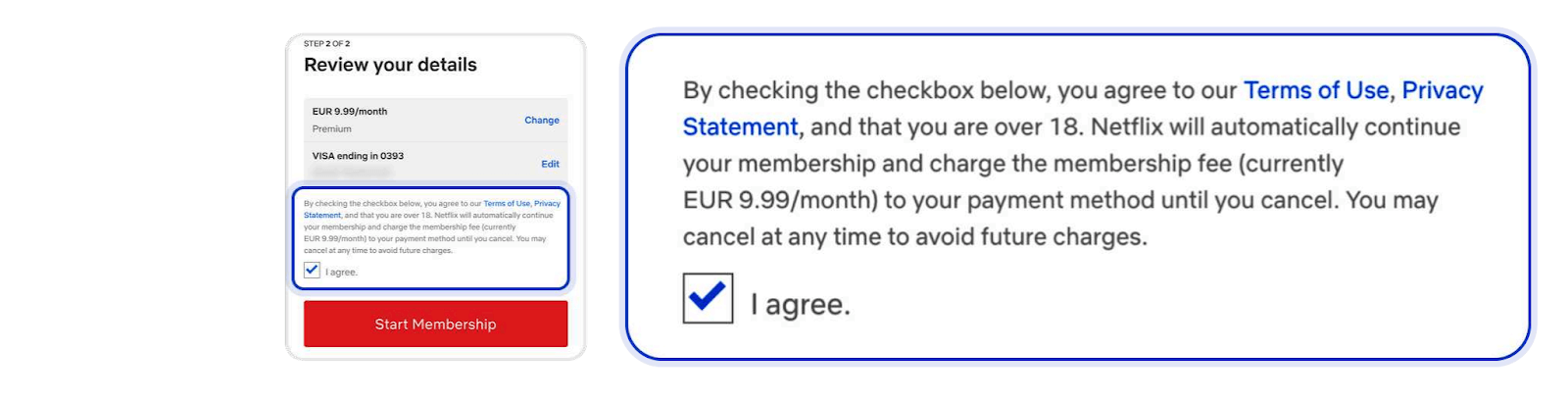
Your customer selects a plan, enters payment details, and agrees to the billing terms. This creates what the card networks call a card-on-file relationship. The initial charge – the moment the customer actively authorizes the payment – is a customer-initiated transaction (CIT). Your system stores a payment token tied to those credentials. Here's what it might look like:
2. Recurring charges run automatically
The first payment is automatically processed on the agreed date. After that, recurring charges are made on the same date at regular intervals, without the customer needing to do anything.
3. Invoice and receipt are sent
After each successful charge, your system generates and delivers a receipt. This keeps the customer informed, reduces dispute risk, and creates the audit trail you'll need if a cardholder challenges a charge.
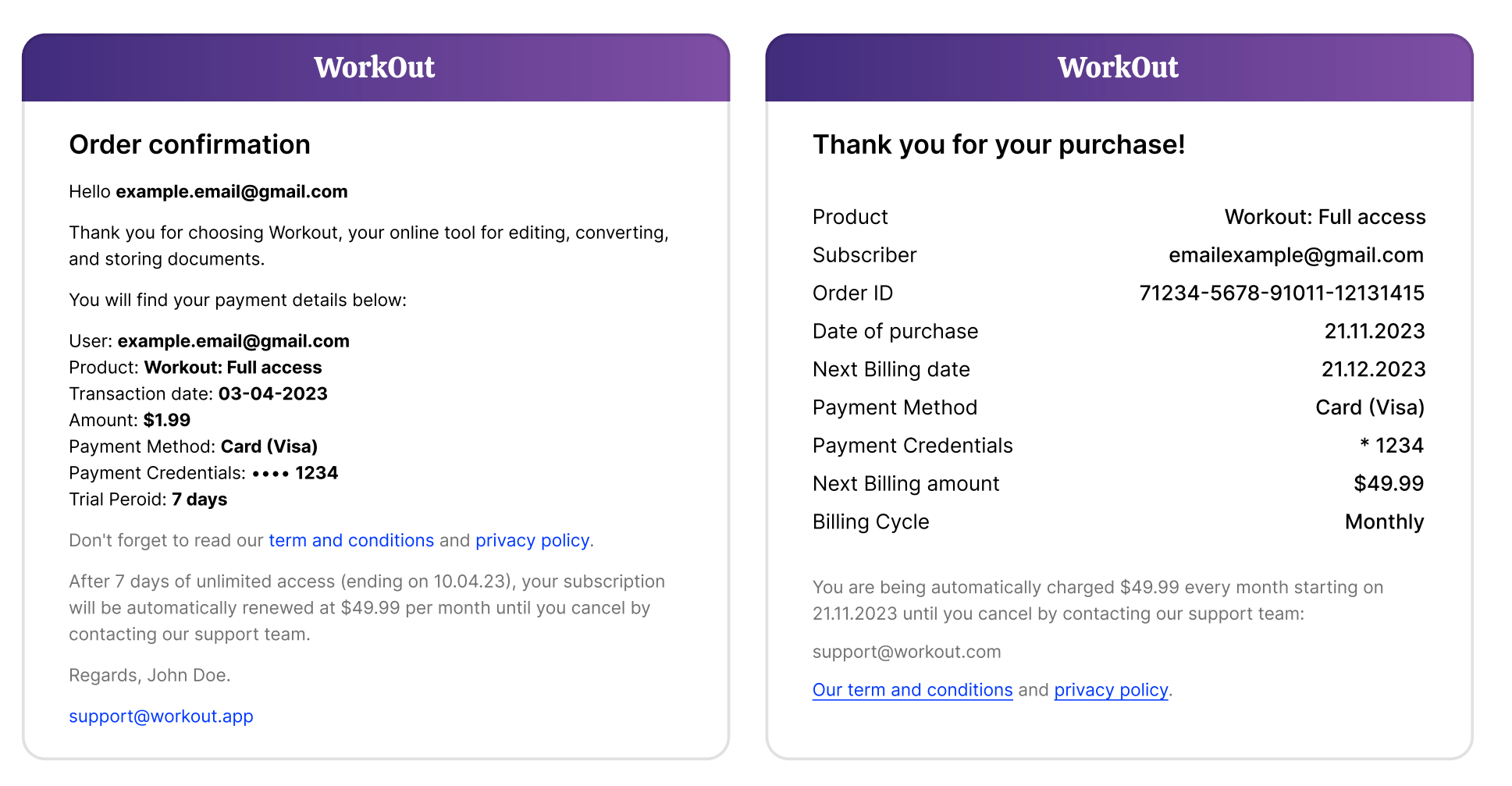
Core insight: A recurring payment works in three steps: the customer subscribes and consents to being charged, subsequent charges run automatically as merchant-initiated transactions, and a receipt is sent after each successful payment.
What are the benefits of recurring billing for subscription merchants?
Predictable revenue and cash flow
Subscription-based recurring billing creates a revenue baseline that one-off transaction models can't match. With a fixed billing schedule, you can forecast monthly recurring revenue (MRR) with reasonable accuracy, which makes reinvestment decisions more grounded and day-to-day operations easier to plan.
The predictability also compounds: as you reduce and improve payment recovery, the floor under your MRR gets higher.
Reduced friction for customers
The recurring billing model is predictable and, therefore, very convenient for both customers and merchants. Customers don’t have to think about the upcoming bill payments and input their payment information multiple times – they can just “set it and forget it.”
As long as the customer sees the value in your offering and your communication is clear and upfront, it typically leads to a higher lifetime customer value and lower churn rates. The more you can reduce payment friction and keep customers satisfied, the longer they’ll stick around.
Learn how subscription payment experiences affect your customer relationships in our survey .
Lower administrative overhead for your team
With recurring billing automated, your finance and operations teams stop chasing invoices and manually tracking payment status. The system handles charge execution, receipt generation, and automatically.
What this means in practice:
- Manual invoicing and are replaced by automated charge runs
- Accounts receivable management time drops
- Revenue recognition becomes more consistent and auditable
- Payment failure tracking shifts from reactive to systematic
That operational reduction compounds as your subscriber base grows. The team hours saved don't scale with volume the way manual processes do.
Core insight: Recurring billing gives subscription businesses three core advantages: predictable revenue and cash flow, reduced friction for customers that drives longer retention, and lower administrative overhead through automated charge runs and reconciliation.
What are recurring billing best practices?
To make recurring billing work effectively for your business, consider these best practices:
Be transparent about your pricing and T&C
Customers need to know what they're signing up for before they sign up.
What to get right at checkout:
- Display the price, billing frequency, and renewal terms prominently in the order summary. Not in a footnote.
- For trials, use a checkbox or an initial next to the terms, as some card networks require explicit cardholder consent for recurring charges after a trial. (Visa and Mastercard have compliance rules mandating this for free trials – make sure you meet them.)
- State clearly what happens when a trial ends. "Just $1" framing that obscures a $29.99 monthly charge is the kind of thing that generates chargebacks.
- If you have, summarize the billing-relevant parts at checkout. Don't rely on customers clicking through.
- Save a record of the user’s agreement to the terms (e.g., store the checkbox timestamp, IP, etc.). That record becomes evidence if a charge is disputed.
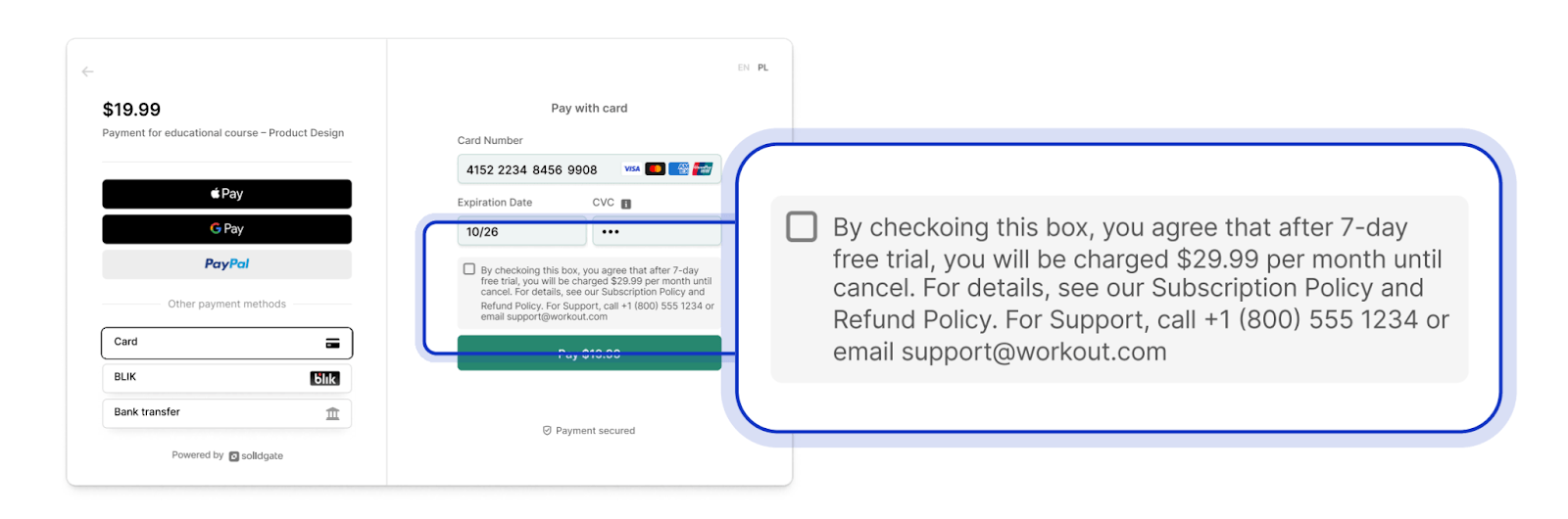
If you're operating under a subscription model, ensuring compliance with Visa and Mastercard requirements is crucial for your business's success and security. Check out our short PDF guide on the key VISA/Mastercard .
Make cancellation painless and instant
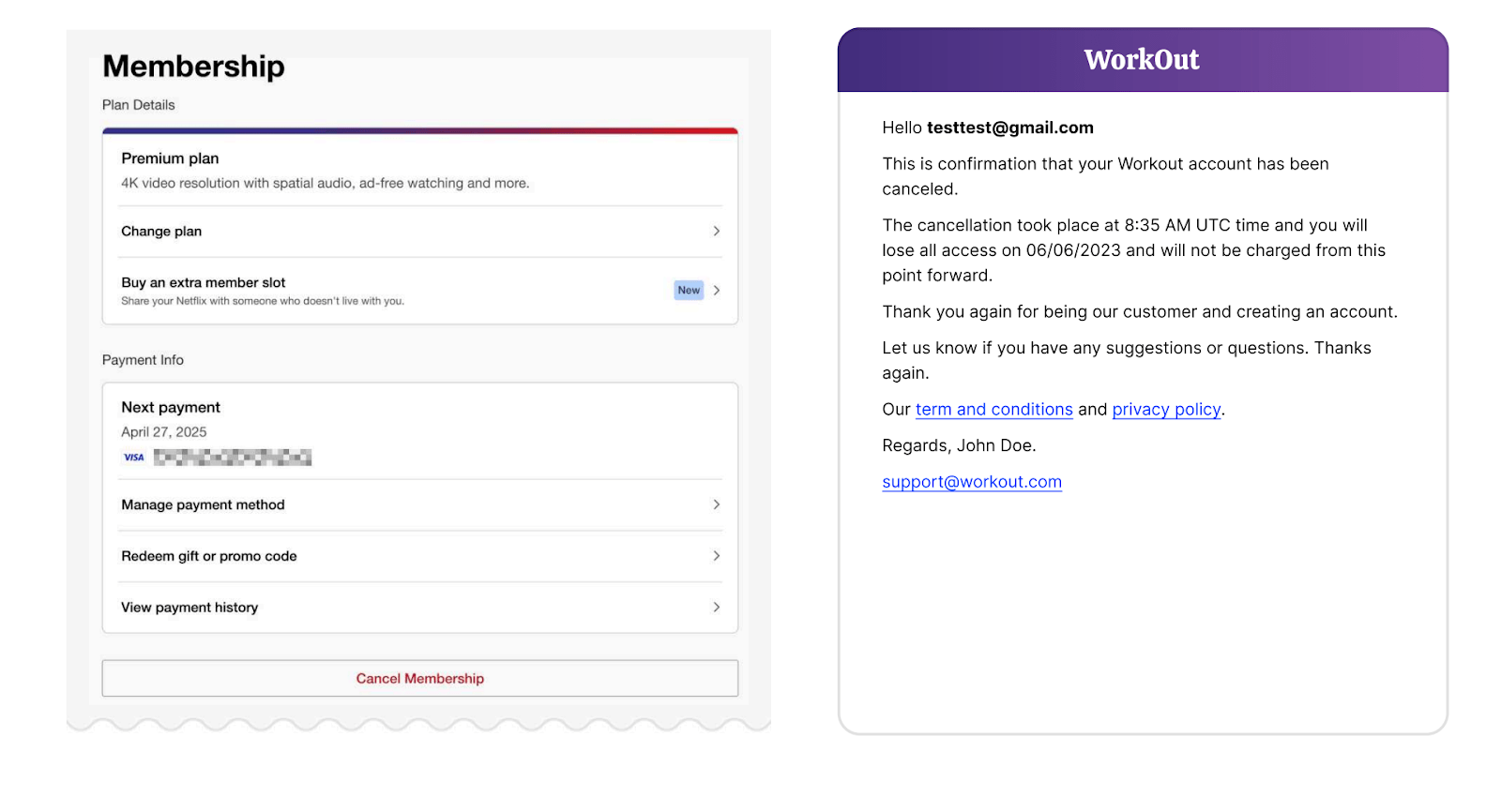
If a customer wants to cancel, let them. The cancellation flow must be self-service, obvious, and immediate.
Hiding the cancel button to protect churn numbers almost always backfires. Customers who can't cancel easily don't become retained customers – they become chargebacks and complaints. In some markets, difficult cancellation flows also create regulatory exposure.
Best practice: Offer an online cancellation in two clicks, with immediate confirmation. The customer goes to their account, clicks “Cancel Subscription,” and optionally completes a brief survey. They receive immediate confirmation that their subscription ends at the billing period or now – whichever they chose.
That’s it. Their subscription is canceled with no further charges.
Handle payment failures and retry logic
Failed payments are unavoidable in recurring billing. Cards expire. Banks re-issue cards due to fraud. Accounts hit spending limits. And the question is whether your system recovers them or loses those customers permanently.
The key tools are and.
Retry logic schedules automated reattempts based on the decline type – insufficient funds calls for a different retry window than a card expiry. Network tokens, issued by Visa and Mastercard directly, survive card reissues because they're linked to the underlying account rather than the physical card number.
Effective – proactive communication to customers when a payment fails – can recover 15–40% of failed payments that would otherwise become lost subscriptions.
See the for the full breakdown.
One of Solidgate merchants cut and lifted payment conversion by 3.5% by rebuilding its retry and dunning strategy. The infrastructure changes weren't complex – the impact came from treating failed payments as a recoverable revenue event rather than an acceptable loss.
Ensure you're PCI-DSS compliant
The Payment Card Industry Data Security Standard () sets the requirements for handling cardholder data securely. For online recurring billing specifically, compliance matters more than in one-time payment scenarios because you're storing credentials long-term.
To meet PCI-DSS standards, ensure you’re using a compliant processor and that all sensitive customer data is encrypted and tokenized. Regular security audits and keeping your team up to date on best practices will also reduce the risk of a breach.
Learn more in our.
Core insight: The four recurring billing best practices are: transparent pricing and terms at checkout, frictionless cancellation, automated payment failure recovery, and PCI-DSS compliant credential storage.
How to set up recurring billing
The setup path depends on where you're starting from. A business processing its first subscriptions has different needs than one already running at scale but hitting the limits of its current setup.
The core requirements stay the same regardless:
1. Choose a payment processor that supports recurring transactions
Most major handle recurring charges, but the quality of what sits around that capability varies. You want retry logic, network tokenization support, and clear reporting on decline codes – not just the ability to run a scheduled charge.
2. Integrate recurring billing management
Unless your payment provider already includes a full – like Solidgate – you'll need dedicated tooling to handle billing cycles, plan management, upgrades, downgrades, pauses, and. Managing this logic manually doesn't scale past a few hundred active subscribers.
3. Configure your billing terms
Set up the schedule – daily, weekly, monthly, annual – and the logic around free trials, mid-cycle changes, and proration. Be specific about what happens when a customer upgrades or downgrades mid-cycle.
4. Automate customer communication
Build out transactional emails for: signup confirmation, upcoming charge reminders, successful charge receipts, failed payment notifications, and cancellation confirmation. Every one of these touchpoints affects dispute rates and customer trust.
When evaluating implementation options, the criteria that matter most:
- Integration with your existing tech stack (CRM, ERP, analytics)
- Flexibility across billing models, especially if you run multiple product lines
- International payment and currency support if you sell across borders
- Reporting granularity – you need to see decline codes, not just success/fail
- Security and compliance certifications
For a comparison of the specific tools in the market, see our guide to the.
Core insight: To set up recurring billing, merchants need four things: a payment processor, subscription management tooling, configured billing terms, and automated customer communication.
Things to consider when setting up global recurring billing
If you plan to sell globally, a few more considerations come into play.
Do you need to offer local payment methods?
Every market has its preferred payment method – and that preference shows up directly in your conversion rate. , 10% of shoppers abandon checkout when they don't find their preferred payment method. In Brazil that's PIX, in Poland it's BLIK, in the Netherlands iDeal, in the US PayPal.
Nova Post, a logistics operator expanding across 15+ European markets and the US, made local payment methods available from day one in every new country. BLIK in Poland, iDEAL in the Netherlands, and PayPal and Open Banking across Europe. The result was 95%+ approval rates across all markets from launch.
See the full.
Do you have multi-currency support?
You’re not doing yourself any favors by forcing customers to deal with currency conversion. Offer pricing in their local currency and make sure your system automatically adjusts for currency fluctuations. That’s the way to reduce confusion and avoid chargebacks.
Multi-currency support also affects your – transactions processed in a customer's local currency tend to have higher authorization rates than cross-currency transactions. Issuers are more confident in domestic transactions.
Do you have a plan for handling tax compliance & local laws?
Different countries (and states) have different and constantly changing rules on tax, especially regarding digital products. Getting this wrong leads to fines, so make sure your payment system or tax solution can automatically apply the correct tax rates based on the customer's location.
The EU requires clear customer consent for auto-renewals, and in some places, you have to notify customers before renewing their subscription. Not complying can lead to regulatory issues and customer complaints.
Some global companies address this by partnering with a (MoR) who handles global taxes, compliance, and payment regulations on their behalf.
Have you considered cross-border payment performance & cost?
When you go global, and transaction costs become major factors that affect your revenue. Processing through a in your target market aligns transactions with local issuer preferences, which typically improves authorization rates and reduces cross-border fees.
Also, being able to across multiple PSPs or adds a second layer: fewer transactions decline at the first attempt, because each one goes to the acquirer with the strongest approval rate for that corridor.
Core insight: Setting up global recurring billing depends on whether you support local payment methods, price in local currencies, stay tax compliant, and optimize authorization rates.
Make your recurring billing work for you
Recurring subscription billing drives predictable revenue, reduces churn, and removes manual payment work from your team's plate – but only if the setup is right.
✓ Choose the right billing model: daily, weekly, monthly, or annual, depending on your product and customer behavior.
✓ Be transparent with pricing and terms – customers who understand what they're signing up for dispute charges less often.
✓ Make cancellation easy. Two clicks, immediate confirmation, no further charges.
✓ Implement smart retry logic for failed payments and keep customer card details current with an automatic card updater.
✓ Regularly audit your recurring billing setup, especially as you scale into new markets.
Solidgate offers a full – covering recurring and usage-based billing, smart retries, automatic card updates, dunning, tax, and a checkout that adapts to local payment methods and currencies by market.
The orchestration layer on top handles smart routing, network tokenization, and multi-acquirer failover – the infrastructure that keeps those billing cycles running reliably at scale.
If your setup is hitting limits, to map your current infrastructure and identify where the gap is.

Hily lifted ARPU ~20% with smart retries and routing
How Hily used multi-acquirer routing and smart retries to boost renewal performance after switching to direct billing.
Frequently asked questions
The recurring payment model allows businesses to charge customers automatically and repetitively, based on a pre-set schedule and conditions.
Recurring payments are the individual charge events – the actual transaction that runs against a customer's stored payment credentials on each billing date. Recurring billing is the broader system that manages those payments: the schedule, the subscription logic, the retry behavior on failures, the customer communication, and the compliance controls. You can process a recurring payment with a basic PSP. Running recurring billing as a reliable system requires subscription management infrastructure on top of that.
Recurring subscription billing creates predictable cash flow, improves customer LTV by reducing payment friction, and reduces administrative overhead by replacing manual invoicing with automated charge runs. It also creates a long-term customer relationship built on consistent, uninterrupted service delivery.
You've definitely come across recurring billing models in your everyday life. Think streaming services like Netflix or Spotify, or even gym memberships, which all rely on fixed monthly payments. Then, there are freemium models, like Canva, YouTube Premium, or LinkedIn Premium, where you get basic access for free and can upgrade to a paid version for extra features. And of course, usage-based models are common in services like Twilio and phone plans, where you pay based on what you actually use.
Yes, recurring billing is highly customizable. You can offer different billing cycles and even create flexible plans that allow customers to upgrade, downgrade, or pause their subscriptions at any time.
A failed payment doesn't mean the customer is lost – if your system is set up to recover it. The right response depends on the decline reason. Insufficient funds calls for a retry at a different time of day or billing cycle. An expired card requires a card updater or a prompt for the customer to update their details. A stolen card flag means the subscription should be paused, not retried.
The best practice is automated retry logic that reads the decline code and responds accordingly, paired with a dunning sequence that notifies the customer and gives them an easy path to update their payment method. Systems built around this approach – Solidgate being one – recover a meaningful share of payments that would otherwise result in involuntary churn.
When selling internationally, you need to consider, currencies, tax regulations, and compliance. Make sure your payment processor supports multi-currency transactions and offers local payment options for each region you sell to. Also, be aware of local tax laws to ensure you're charging the correct rates.