How network tokenization works – and why your authorization rates depend on it
Payments 101
10 Feb 2026
6 min

Andrii Kononenko
Head of Merchant Operations, Solidgate
Network tokens signal trust to issuers, so they say "yes" more often. We break down how network tokenization works – and the approval rate gains merchants actually can see.
TL;DR:
- Network tokenization replaces raw card numbers with scheme-issued tokens that stay valid when cards are reissued.
- The result: fewer failed renewals, fewer false declines, and measurably higher authorization rates – especially across borders.
- Solidgate merchants using network tokens have seen acceptance rate improvements of up to +15%.
- If you're processing recurring billing or card-on-file payments at scale, network tokenization is the highest-leverage infrastructure upgrade available to you right now.
Your renewal billing just for a customer who never intended to cancel. Their card was reissued last month, but your system didn't know.
The charge hit a stale primary account number (PAN), the issuer declined it, and that subscriber is now in a dunning sequence they'll probably ignore.
If you're running subscription products, digital goods, or card-on-file e-commerce at scale, this happens every billing cycle. A 2% failed renewal rate on $500k monthly recurring revenue costs roughly $10k per cycle – $120k a year – before you account for the downstream churn those failures trigger.
Payment network tokenization fixes this problem – along with many others – at the infrastructure level. This guide explains how it works, why it lifts authorization rates, and what adopting it through Solidgate looks like in practice.
What is network tokenization?
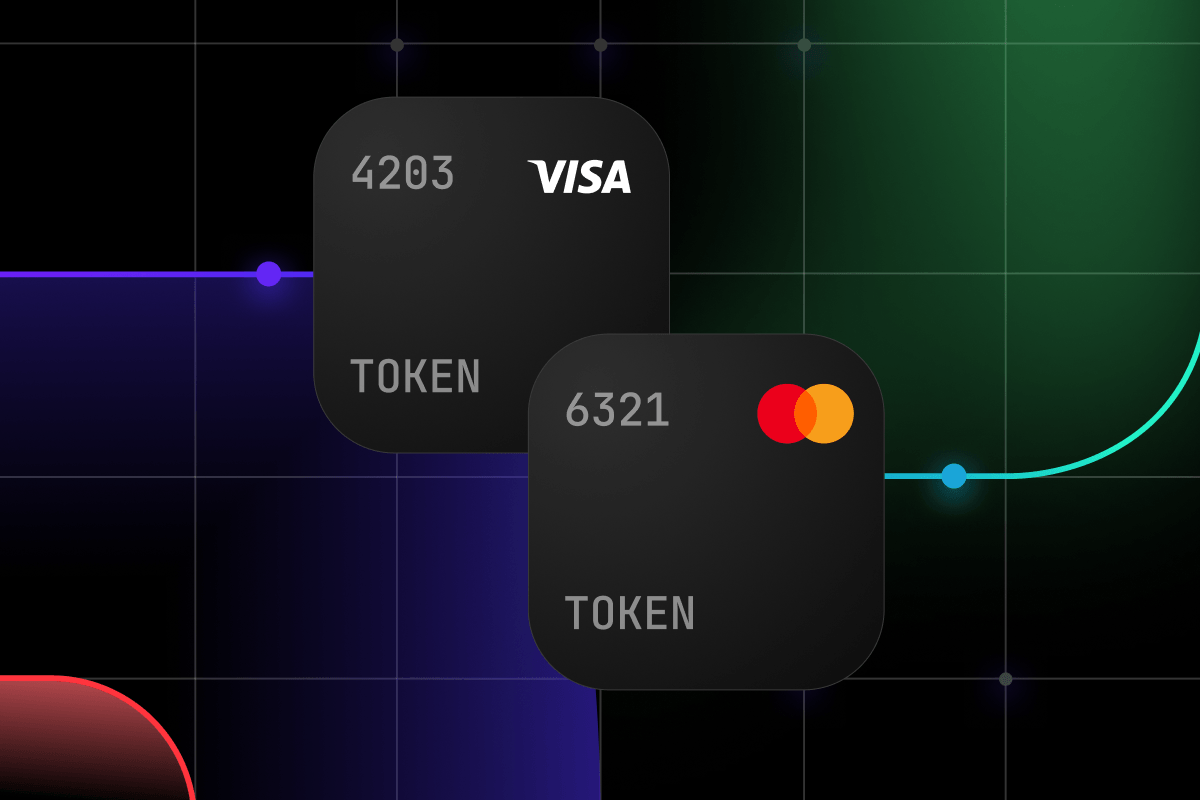
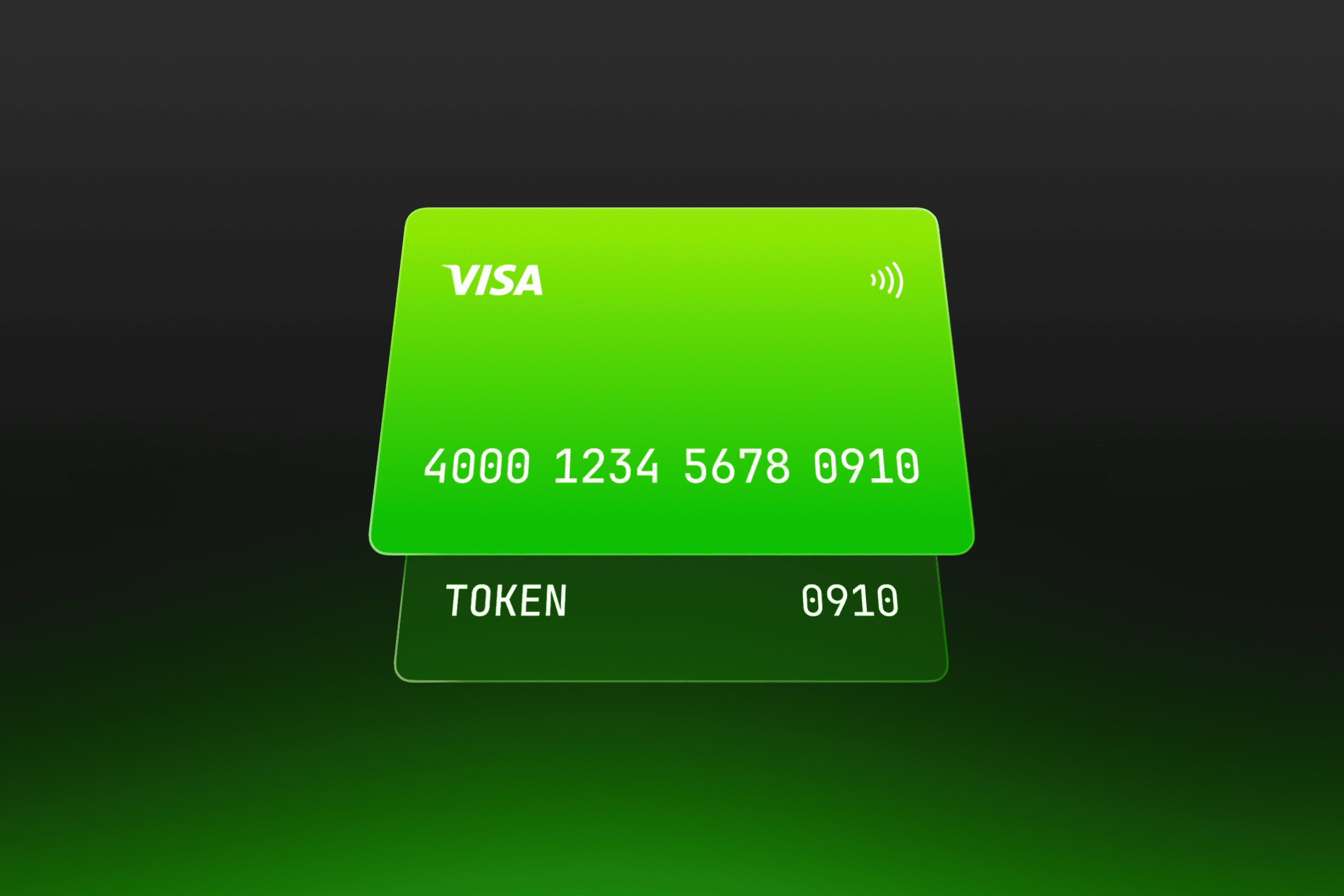
The simplest way to explain network tokenization: your customer's real card number never travels through your payment system. Instead, the card network, Visa, Mastercard, American Express, or another scheme, generates a unique digital substitute called a network token. That token stands in for the primary account number (PAN) at every stage of the transaction.
A network token is not a gateway token or a PSP-level token. Those exist within a specific provider's ecosystem and don't carry the same relationship with the card issuer.
Network tokens are issued and managed by the card schemes themselves, which means the issuing bank recognizes them natively. That recognition is central to why they perform better at authorization.
How a tokenized transaction flows
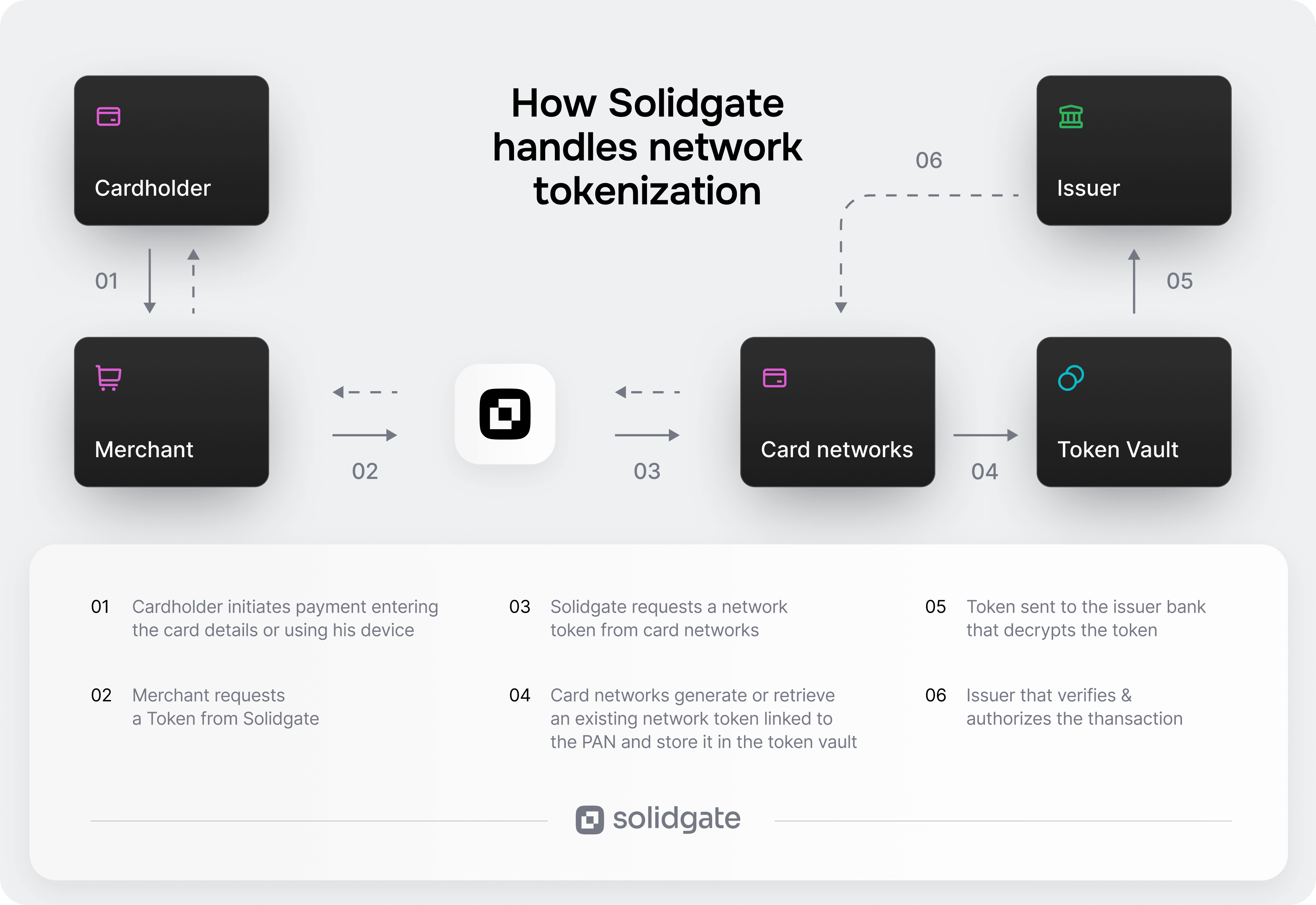
When a customer pays on a tokenized network, the sequence looks like this:
- The customer enters card details or uses a stored payment method
- The card network generates a token tied to that specific card, merchant, and device combination
- Each transaction using that token is paired with a unique cryptogram, a one-time code that validates the transaction without exposing underlying card data
- The token and cryptogram travel through the payment chain to the issuer, which validates them against its own records
- Authorization is granted or declined based on that validation, with no raw card data having moved anywhere
Even if a token is intercepted, it can't be reused, because each transaction cryptogram is single-use and expires immediately. This is categorically different from static card data, which retains its value indefinitely once compromised.
How network tokenization improves authorization rates
This is where the practical value becomes concrete. Authorization rates don't improve because tokenization is more modern or sounds better. They improve because of specific, identifiable mechanisms.
Issuers trust tokenized transactions more
Authorization decisions are fundamentally trust decisions. Network tokens strengthen that trust by giving issuers richer, more reliable data at the point of decision. Visa's data shows that the in tokenized transaction volume in 2024 translated into a 6% improvement in approvals and up to 30% reduction in fraud.
When a tokenized transaction arrives, the issuer knows the token was generated by the network, tied to a verified card, and paired with a cryptogram that only the legitimate party could produce. That's a higher-quality signal than a raw PAN with a CVV. Issuers respond to better signals with higher approval rates.
Fewer declines from outdated card data
Card credentials change constantly. Cards expire. Cards get reported lost or stolen and are reissued with new numbers. Banks proactively reissue cards after data breaches.
Every time this happens with a traditional PAN-based system, any stored card-on-file record for that customer becomes invalid. The next transaction fails. For subscription businesses, this is a primary driver of involuntary churn.
With network tokens, the reissued card gets updated automatically. The next billing cycle processes cleanly, without any action required from the customer or the merchant.
In our experience, for businesses with , this single mechanism can increase retention by up to 7.5%.
Lower fraud-related declines
Legitimate card-not-present transactions get declined due to fraud suspicions all the time. A transaction that looks suspicious based on its data profile gets declined even if the underlying card is valid.
Tokenized transactions carry a different risk profile. A token that's been used consistently for the same subscription across the same device looks very different to an issuer's fraud models than a raw PAN being used at a new merchant.
That differentiation reduces the false positives.
Smoother cross-border authorization
International transactions fail at higher rates than domestic ones. Card issuers apply more scrutiny to cross-border payments because the fraud risk profile is genuinely higher. A raw PAN being used for the first time at a foreign merchant generates more friction than a tokenized transaction with an established cryptogram pattern.
Payment network tokenization reduces that friction because the issuer can validate the token and cryptogram independently of where the transaction originates. The merchant-specific token carries context that the issuer trusts. Cross-border declines driven by unfamiliarity or elevated risk scores decrease as a result.
Read more on the
How Solidgate handles network tokenization for you
Most merchants who want network tokenization face the same wall: you need direct relationships with Visa and Mastercard's token services, PCI DSS-certified infrastructure to store and manage the tokens, and then logic to apply them correctly across every payment flow.
That's a significant build. And it has to work before you see a single basis point of uplift.
Solidgate's removes that wall.
Here's what it handles for you:
1. Token provisioning and lifecycle management without engineering overhead
When a customer pays for the first time, Solidgate automatically provisions a network token from Visa or Mastercard in place of the raw PAN. Every subsequent transaction – whether customer-initiated at checkout or merchant-initiated on a billing cycle – uses that token. You never touch raw card data again.
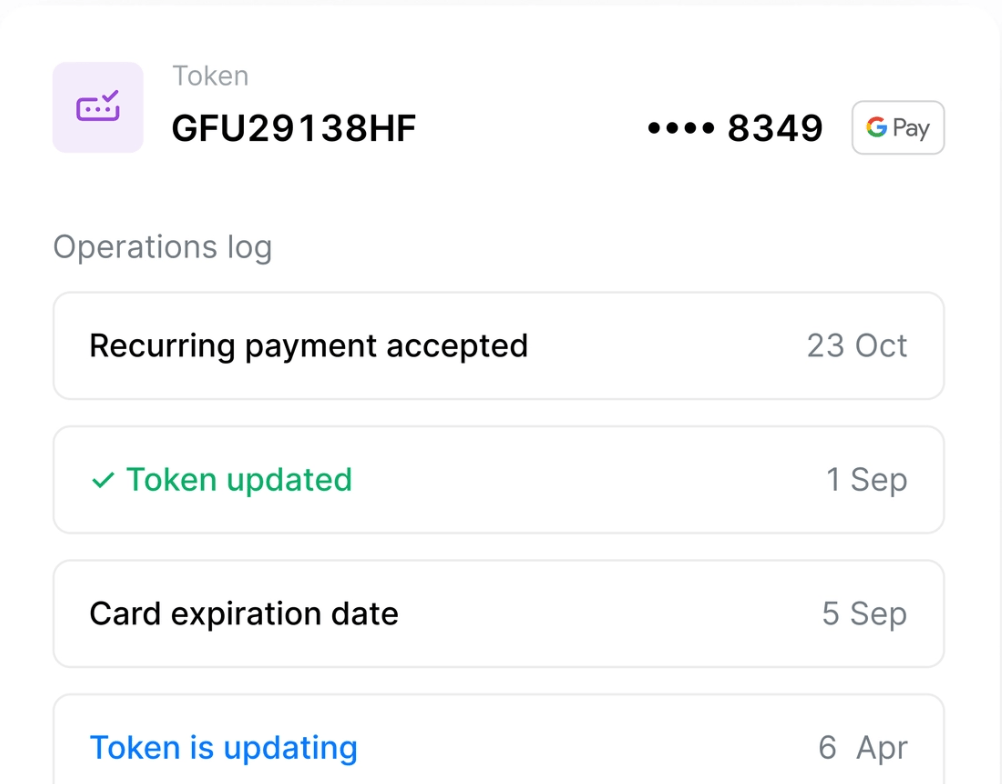
When a card is reissued, a refreshes the token automatically, in real-time. Your stored credential stays valid. The next renewal charge processes cleanly, without a failed payment, a dunning email, or a customer who wonders why their subscription stopped working.
Across Solidgate merchants, this alone accounts for a meaningful share of the acceptance rate improvement of up to +15% they see after switching to network tokens.
2. Processor-agnostic token portability – no PSP lock-in
The structural problem with tokenizing through a single PSP: the tokens only work with that PSP. Switch providers, and you're starting over.
Solidgate Vault sits above your processors, not inside one of them. Tokens are stored centrally and routed to any connected payment provider without re-tokenization. If you add an acquirer for a new market or route away from a processor that's underperforming in a specific region, your existing tokens go with you.
This matters when a PSP experiences downtime or elevated decline rates in a specific geography. Solidgate can reroute in-flight transactions to an alternative processor using the same token. Customers see nothing, and your authorization rate doesn't take a hit.
Our vault processes 100M+ tokens annually and delivers 100% token portability across providers. That's the infrastructure reality behind the promise of "no lock-in."
3. Network tokenization connected to your full payment stack
Network tokens work best when they're not isolated. A token that improves issuer trust at authorization becomes significantly more powerful when it's combined with intelligent retry logic, , and subscription billing that understands decline codes.
Solidgate connects all of these in one infrastructure layer:
- Smart routing directs each transaction to the acquirer most likely to authorize it – by market, card type, issuer behavior, and other parameters – using the network token as the credential throughout.
- apply the right retry window and strategy when a charge fails, using token-based credentials that don't degrade in value between attempts.
- Subscription billing automation manages the full recurring lifecycle, including trials, upgrades, pauses, and cancellations. Tokenization improvements feed directly into LTV, not just payment success rates.
You don't need to build relationships with Visa and Mastercard's token service providers directly. You don't need to stitch together separate integrations for provisioning, routing, and billing. And you don't need to manage PCI DSS compliance for the vault – Solidgate does it for you.
The infrastructure is ready. with our experts to see what it can look like for your setup.
Frequently asked questions
Three mechanisms drive the improvement.
- First, tokens stay valid when cards are reissued, so stored credentials don't expire silently.
- Second, the per-transaction cryptogram provides issuers with stronger fraud signals, reducing false positive declines.
- Third, merchant-specific tokens carry established trust patterns that issuers recognize, which matters particularly for recurring billing and cross-border transactions.
Yes, through two connected effects. Tokenized data has no value outside its specific merchant-network context, so stolen tokens can't be used to generate fraudulent transactions elsewhere. And because each transaction requires a unique cryptogram, replay attacks and credential stuffing don't work against tokenized networks.
Fewer fraudulent transactions mean fewer chargebacks, and a cleaner fraud profile improves how issuers score future transactions from the same merchant.
Not strictly necessary, but increasingly difficult to avoid if authorization rate optimization is a real business priority. Both Visa and Mastercard have made clear that tokenization is the direction their networks are moving, with mandates and incentives already in place in multiple markets.
Businesses on non-tokenized infrastructure are working against network-level momentum. For subscription and e-commerce businesses specifically, where card-on-file performance directly drives revenue, the case for adopting tokenized network payments is straightforward.
It depends on your payment infrastructure. Merchants using a payment platform with native network token support — like Solidgate — don't need to build direct integrations with Visa or Mastercard's token services. The platform handles token provisioning, lifecycle management, and cryptogram generation behind the scenes.
For merchants building on direct acquirer connections, more integration work is typically involved. Either way, the migration path doesn't require replacing your existing checkout or billing flows.
They're complementary, not redundant. Network tokenization secures the credential and improves authorization confidence at the issuer level. 3DS adds a cardholder authentication step that further reduces fraud liability for the merchant.
In practice, tokenized transactions combined with 3DS friction-right authentication produce the best outcomes: high authorization rates and low fraud rates simultaneously.
Typically, it involves three steps:
- Migrating existing stored PANs to tokens. Network-connected platforms can handle through a one-time bulk migration.
- Updating billing logic to use token references instead of raw card data.
- Enabling token lifecycle hooks so your system responds to automatic credential updates.
For most subscription businesses, the migration can be phased by cohort to minimize disruption to live billing.