Solidgate vs ProcessOut: Choosing a payment orchestration platform for your business
Industry
Updated 18 Nov 2026
10 min

Anton Tsyslytskyi
Product Manager, Solidgate
This Solidgate vs ProcessOut comparison shows what each platform documents and where their scopes differ, so teams can match a platform to their own setup.
Solidgate and ProcessOut are both payment orchestration platforms that connect merchants to multiple providers and route payments between them using rules and performance data. Both tend to come up when a business outgrows a single payment provider. Merchants comparing them often ask where the two differ and which setup each one fits.
This guide compares Solidgate vs ProcessOut on several criteria, from routing, vaults, and billing to fraud tools, analytics, and checkout. The comparison draws on publicly available information to show which setup each platform fits.
TL;DR: A snapshot
- Solidgate: a payment orchestration platform with orchestration (smart routing, cascading, multi-provider connectivity, and a token vault) as the core layer, extended by payment infrastructure – including card acquiring for eligible merchants – and platform services (billing, tax, and fraud and dispute management).
- ProcessOut: positions itself as an agnostic orchestration layer, with smart routing, Telescope monitoring, a vault, and an operations suite.
- How to choose: the right fit depends on a team’s markets, volumes, and needs.
Solidgate vs ProcessOut at a glance
| Solidgate | ProcessOut | |
| Product scope | Orchestration (smart routing and cascading, a token vault) + payment infrastructure (100+ providers, acquirers, and payment methods, PayFac capabilities; card acquiring for eligible clients) + platform (billing, antifraud, disputes, tax) + treasury (business accounts for eligible clients). | Orchestration, smart routing, monitoring, vault, ops suite |
| Provider and payment method coverage | 100+ providers, acquirers, and payment methods across 100+ markets, including EMEA, the US, LATAM, and APAC | 100+ payment service providers and alternative payment methods |
| Routing | Smart routing with no-code rules by amount, card brand, country, and BIN + smart splitting and uplift analytics | Smart routing with custom rules and a control group for uplift reporting |
| Retries and fallbacks | Cascades of up to 5 steps: a failed payment moves to the next provider in the configured sequence. Smart retries time each failed renewal by decline reason and payment history. | Up to two fallback PSPs per custom routing rule; smart routing also learns its own fallback path |
| Vault and network tokens | PCI-compliant token vault for cards, network tokens, and wallets + VTS and MDES network tokenization | PCI-compliant vault with provider-agnostic network tokens |
| 3DS, fraud, and disputes | 3DS2 with SCA exemptions, antifraud rules and lists, prevention alerts, automated representment | 3DS and block rules, chargeback metrics, and webhooks. Dispute management: Not listed among its products in sources reviewed |
| Subscriptions and billing | One-time invoices and recurring subscriptions, trials, coupons, and tax per customer location, with smart retries for failed renewals | Stored-token recurring payments. Billing and dunning: Not listed among its products in sources reviewed |
| Analytics and monitoring | Hub analytics for payments, orchestration, billing, and risk, with decline reasons, per-order routing trace, and finance reports | Telescope benchmarking, alerting, data explorer |
| Checkout | Embedded Payment Form, hosted Payment Page, no-code Payment Link, and API for a custom checkout UI | Dynamic Checkout, hosted payment page, mobile SDKs |
| Fit | Businesses scaling globally that want orchestration, billing, and fraud and dispute management through one integration | Teams that want an agnostic orchestration layer with benchmarking and alerting, connected through their own PSP credentials |
Disclaimer: This comparison is based on publicly available information from each company's website, reviewed on November 11, 2026, and reflects Solidgate's independent view of their core features. It is not intended to be exhaustive. Features and offerings may change, so confirm current details with each provider. We compared the two platforms on nine criteria, starting with our own solution since we know it best.
What is Solidgate?
Solidgate is a built for businesses scaling globally. Its core connects merchants to 100+ providers, acquirers, and payment methods through one integration and routes payments using rules and performance data.
The platform runs on four layers:
- Orchestration. The core layer, with multi-provider connectivity, and cascading, a PCI-compliant token vault, universal checkout.
- Payment infrastructure. Access to 100+ providers, acquirers, and payment methods, including local , plus PayFac capabilities. Card acquiring is available for eligible clients (additional compliance checks apply).
- Platform services. Billing, fraud and dispute management, and tax compliance.
- Treasury. Multi-currency business accounts for eligible clients (additional compliance checks apply).
Core insight: Solidgate provides orchestration as its core layer, extended by payment infrastructure, platform services, and treasury.
What is ProcessOut?
ProcessOut positions itself as a payment orchestration platform that connects merchants to multiple payment providers. According to its website and documentation, merchants can choose from 100+ PSPs and APMs and configure their provider credentials in the dashboard.
The website lists smart routing, Telescope monitoring, a vault, and an operations suite for reconciliation and accounting integrations among its product areas. ProcessOut states that Checkout.com it in 2020 and that it operates as a standalone business unit.
Core insight: ProcessOut positions itself as an agnostic orchestration layer, and its website lists smart routing, monitoring, a vault, and an operations suite for reconciliation.
Solidgate vs ProcessOut: Head-to-head comparison
Architecture and product scope
Solidgate provides as the core layer, with smart routing and cascading. A provider-agnostic token vault supports routing across providers, alongside billing, tax, and fraud and dispute management, all through one integration. The platform extends with card acquiring and business accounts for eligible merchants (additional compliance checks apply).
Merchants choose how customers pay. The embedded Payment Form renders checkout on the merchant’s page without a redirect, with card fields, wallet buttons, APM buttons, and 3D Secure. Payment Page is a hosted checkout with built-in security, mobile optimization, and custom branding.
Payment Link creates a code-free, reusable link that merchants can share by email, SMS, or chat. The Solidgate API supports a fully custom checkout UI.
ProcessOut's website lists five product areas: orchestration, smart routing, monitoring, a vault, and an operations suite. Merchants integrate through client and server SDKs or a REST API, and Dynamic Checkout lets them manage payment methods from the dashboard without code.
Routing and provider coverage
Solidgate connects merchants to 100+ providers, acquirers, and payment methods, from to wallets and local payment methods.
is configured in Hub with no-code rules based on amount, card brand, country, BIN, and other parameters. If a payment fails, it cascades to the next option in the configured sequence, up to five steps. Smart splitting shifts traffic toward better-performing routes, and analytics report uplift against an even split.
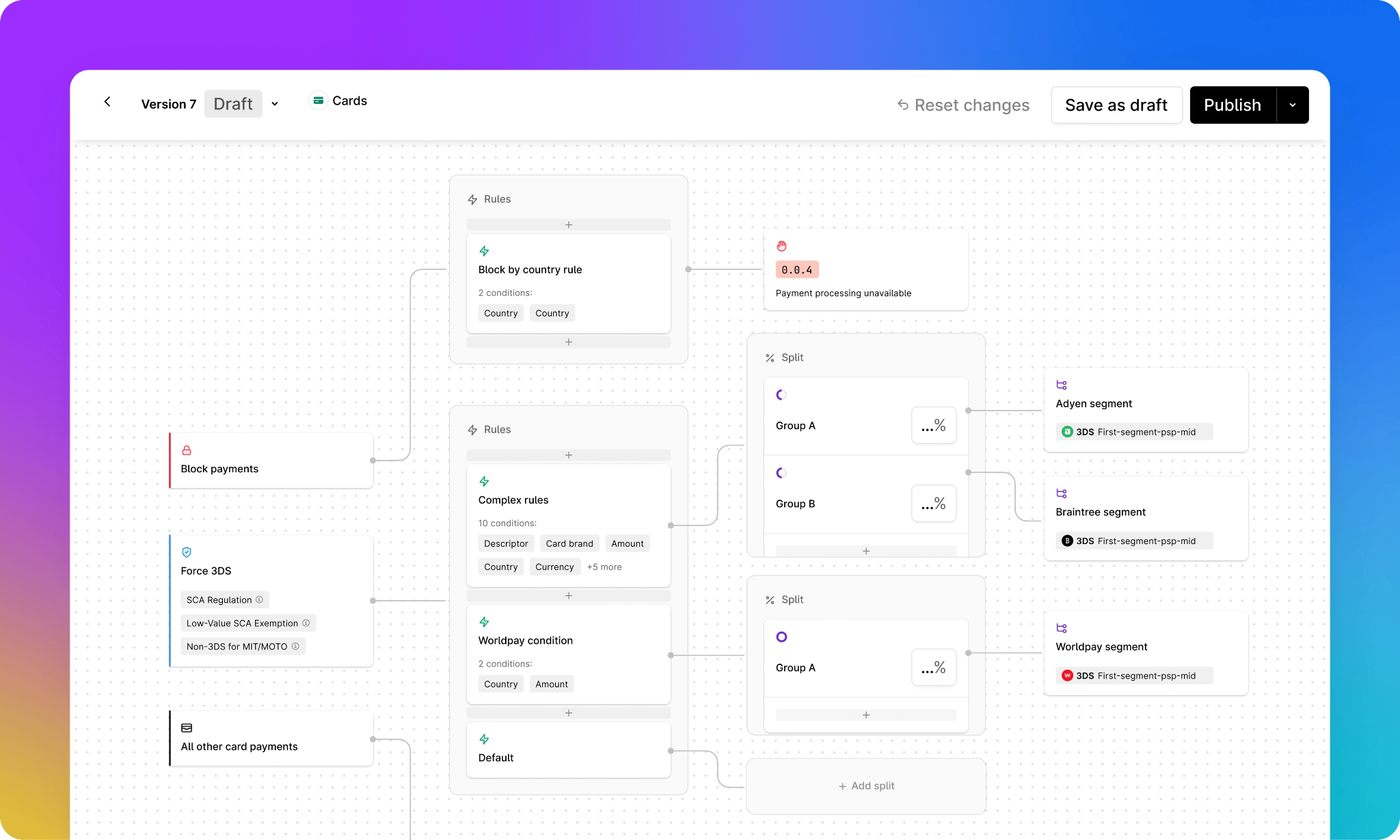
For some merchants in our base, cascading has added 2–5 percentage points to the .
ProcessOut’s smart routing chooses a provider for each transaction from the observed outcomes of similar past transactions. The same model learns an instant fallback for failed attempts. Merchants can also write custom rules with up to two fallback PSPs per rule. Each smart routing rule holds back a control group that reports uplift.
Vault and network tokenization
Solidgate's PCI-compliant token vault stores cards, network tokens, Apple Pay, Google Pay, and other payment methods. The vault returns a token for one-click and subscription payments, so card details can stay off the merchant's server in hosted flows.
Solidgate also enables VTS and MDES on the merchant's behalf. network data puts the average authorization gain from tokenized card-not-present payments at about 4% compared with card-number payments.
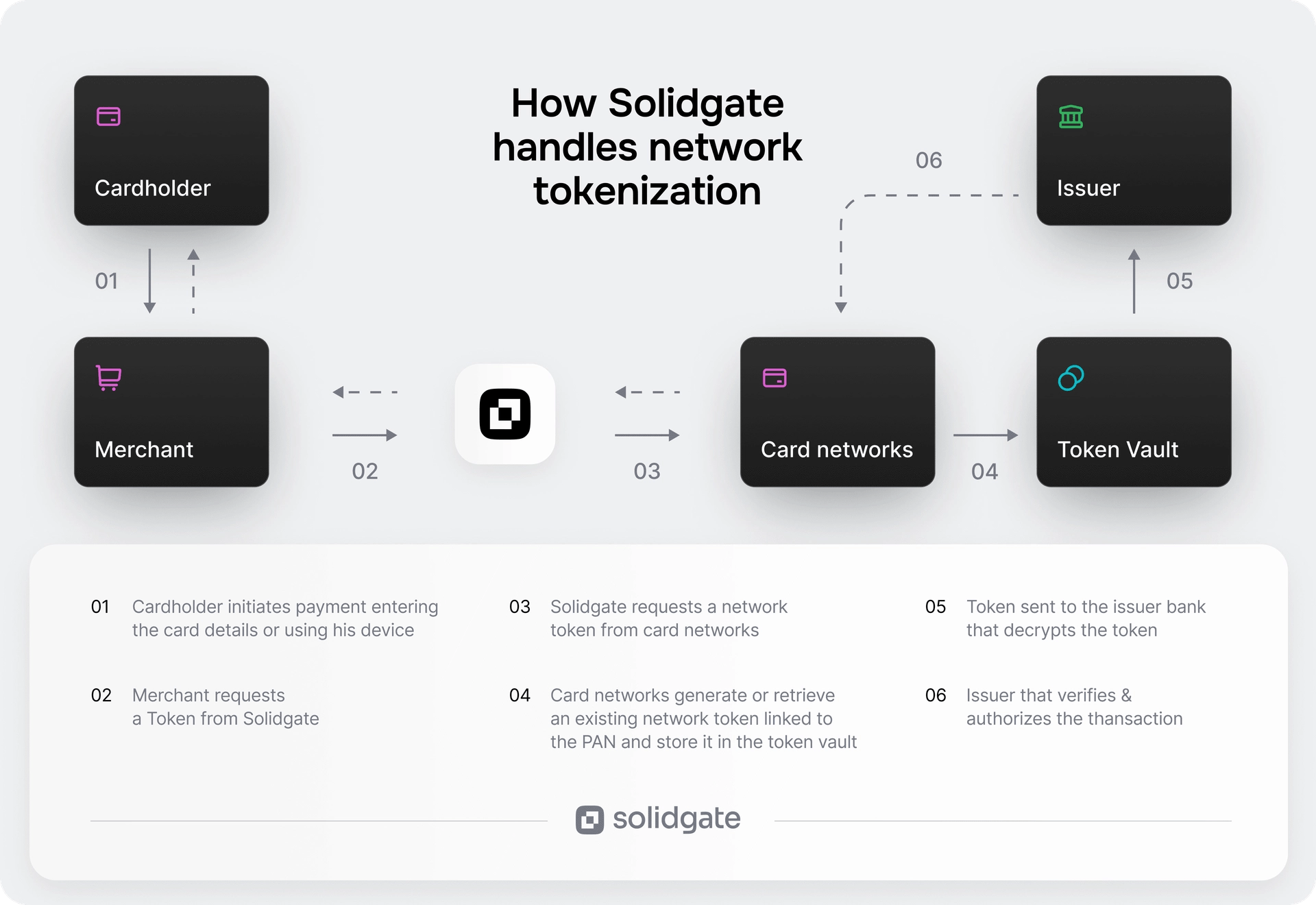
According to its website, ProcessOut's standalone vault is PCI-compliant and keeps card details outside the PSP. Its network tokens are provider-agnostic, and routing can choose between a network token and the card number for each transaction.
Subscription billing and revenue recovery
Solidgate Billing handles one-time invoices, recurring subscriptions, and pricing models such as flat-rate and per-seat. Merchants build a product catalog, set prices by currency and region, apply coupons, and run free or paid trials. Billing sits on the orchestration layer, so subscription payments use the same routing as the merchant's other payments.
Billing also includes tax calculation, which applies VAT, GST, or sales tax based on the customer’s address. Payment methods saved during the first purchase can be reused for renewals and repeat purchases.
Smart retries time each failed-renewal retry by decline reason and payment history. They run by default with four retries within four weeks.
ProcessOut's website and API reference describe recurring payments through stored customer tokens and per-payment invoices. A subscription billing or dunning product is not listed on the website or in the documentation we reviewed.
Risk, disputes, and compliance
Solidgate covers the risk workflow from authentication to dispute recovery: 3DS2 with SCA exemptions, antifraud screening, and dispute management.
Antifraud rules and lists help screen card payments, and routing settings control when 3DS2 applies.
Prevention alerts flag disputes before they become chargebacks through Verifi, Ethoca, and Visa RDR. Automated representment, once enabled, compiles and submits dispute evidence for the merchant.
ProcessOut's routing rules include block rules, velocity rules, 3DS triggers, and per-PSP exemption and challenge indicators. Its analytics track chargeback rates, and webhooks notify a merchant's server when a chargeback opens. Dispute case management is not described in the pages we reviewed.
Analytics and payment monitoring
Solidgate's Hub reports across the stack. Payment analytics shows approval rate and volume with decline reasons and codes, filtered by method, country, channel, and connector account. Orchestration analytics breaks approval rate down by route and cascade segment, and Hub traces the routing path of a single order.
Billing analytics adds subscriber growth, MRR, churn, and trial conversion, and risk analytics adds card and APM risk ratios such as VAMP. Finance reports include settlement files and financial entries for transaction-level reconciliation. Reporting exports go through API and Hub.
ProcessOut's Telescope benchmarks payment performance across providers and can import data from third-party sources, such as a merchant's existing PSPs. Alerting supports threshold rules and smart rules that learn seasonal patterns from 30 days of data.
Core insight: Both platforms route across multiple providers using performance data. Solidgate extends orchestration into payment infrastructure and platform services such as billing, and fraud and dispute management. Card acquiring and treasury are available for eligible clients (additional compliance checks apply). ProcessOut documents a focused suite of orchestration, vault, and monitoring tools.
When Solidgate can be a better fit
Here are some of the use cases where Solidgate’s features were a good fit for merchants.
One infrastructure that grows with your business. Merchants can start with orchestration and add services such as billing and fraud and dispute management through the same integration when the business needs them. Card acquiring and treasury are available to eligible merchants (additional compliance checks apply).
Keeping stored credentials through a provider change. Solidgate's vault and network tokenization keep stored credentials on Solidgate's side, so recurring revenue can continue through a provider change.
, a marketing platform with recurring subscriptions, kept all of its stored tokens on Solidgate’s side when one of its tier-2 banks closed. Its recurring payments moved to the new acquirers with near-zero loss.
Subscriptions on a billing engine and orchestration. Billing handles invoices, trials, coupons, plan changes, and tax. Charges run through the same orchestration layer that is Solidgate’s core product, so merchants manage the subscription lifecycle and the payment flow on one platform.
Routing across multiple acquirers. Smart routing and cascading, plus traffic splitting, give each payment more chances to be approved and let merchants route to lower-cost options. Results depend on each merchant’s providers, markets, and traffic.
, a subscription app, processed all transactions through one cross-border acquirer, with no local merchant IDs in its target markets. After adding multiple acquirers routed for performance and cost, Headway saw up to a 15% lift in payment acceptance.
Dispute prevention alongside fraud tools. Prevention alerts and antifraud rules help merchants spot disputes before they become chargebacks. Dispute management then covers the response, including automated representment once enabled.
Retries for failed renewals. Smart retries choose retry timing by decline reason and payment history, skipping permanent declines such as expired cards.
, a streaming service, moved subscriptions into the same orchestration platform that routes its payments. MEGOGO saw about 5% lower subscription churn, with renewal success improving through network tokenization and smart retries.
Core insight: Merchants choose Solidgate to run orchestration, billing, and fraud and dispute management in one integration. This lets them keep stored credentials through provider changes, route renewals through the same orchestration layer, resolve pre-dispute alerts before they become chargebacks, and retry failed renewals by decline reason.
When ProcessOut can be a better choice
In our view, here are some of the cases when merchants can consider ProcessOut.
Benchmarking existing providers. Telescope can import data from third-party sources, such as a merchant’s existing PSPs, and benchmark performance across providers. Alert rules can be simulated before going live. This can suit teams that want to analyze current provider performance first
Testing routing changes. A routing control group reports uplift, and routing can choose between a network token and the card number for each transaction. This can suit teams that want to measure routing changes against a baseline
Managing payment methods without code. Dynamic Checkout lets merchants add payment methods and set which customers see them from the dashboard. This can suit teams that change their payment method mix often
Core insight: ProcessOut can suit teams that want to benchmark existing providers, test routing changes against a control group, and manage payment methods from the dashboard.
How to choose between Solidgate and ProcessOut
The right fit depends on a business's markets, volumes, and team. These questions can help structure an evaluation of either platform.
- Scope of services. Consider whether orchestration alone is enough, or whether billing, acquiring, and fraud and dispute management should run on the same platform
- Provider setup. Consider how the team wants to manage provider connections and which providers and payment methods it needs in each market
- Routing and recovery. Consider how much control the team wants over routing rules, cascades, and traffic splitting, and how each platform reports results
- Subscriptions. Consider how failed renewals are retried and whether subscription management should sit inside the payments platform
- Monitoring. Consider whether the team needs cross-provider benchmarking, alerting, or billing and risk metrics in one view
Core insight: Product scope, provider setup, routing and recovery, subscriptions, and monitoring are the areas that can guide the choice. The same areas often apply when comparing the .
Matching the platform to the payment stack you run
Solidgate and ProcessOut each have their own set of capabilities, and the right fit depends on a merchant’s markets, volumes, and needs. This comparison sets out what each platform documents, so teams can weigh those capabilities against their own priorities before they decide.
Ready to explore Solidgate for your stack? to see how the platform fits your payment setup and growth plans.
Frequently asked questions
Solidgate extends orchestration with payment infrastructure, including card acquiring for eligible merchants (additional compliance checks apply), and platform services such as billing, antifraud, and dispute management. ProcessOut’s website lists smart routing, Telescope monitoring, a vault, and an operations suite. The right fit depends on which of these a team wants on one platform.
Solidgate can fit merchants that want routing, a vault, billing, and risk tools on one integration as they add markets and providers. Teams comparing it with ProcessOut can weigh scope, provider relationships, routing control, and monitoring needs. The right fit depends on a business’s markets, volumes, and needs.
Checkout.com acquired ProcessOut in 2020, according to ProcessOut’s website. ProcessOut states that it operates as a standalone business unit and describes itself as provider-agnostic. Teams that need to confirm the current relationship can check ProcessOut’s website directly.
According to its website, merchants can choose from 100+ PSPs and APMs and enter their provider credentials in the dashboard. Its operations suite lists reconciliation and accounting integrations. Merchants connect to ProcessOut through client and server SDKs or a REST API, and Dynamic Checkout manages payment methods without code.
ProcessOut’s pricing is not listed on its website or in the documentation we reviewed as of November 11, 2026, so teams can contact the company for a quote. Solidgate pricing depends on the products a merchant uses and its processing volumes. Talk to our team to get an estimate for your setup.