Transaction fee
What is a transaction fee?
Transaction fee is a charge applied to a financial transaction by a , , or other participants in the payment flow to cover the cost of processing it. It pays for payment processing infrastructure, card network fees, and other operational expenses.
Transaction fees are calculated either as a flat per-transaction rate, as a percentage of the purchase amount, or as a combination of both. The exact charge depends on the payment method, whether the transaction is online or in-person, and the pricing agreement between the merchant and its payment provider.
Key facts
- Also known as: processing fee or per-transaction fee, depending on how it's billed.
- Charged by: the , , and – often bundled into a single rate by a .
- Calculated as: a fixed amount per transaction, a percentage of the transaction value, or both.
- Main cost layers: , scheme fees, and processor markup.
- Pricing models: flat-rate, interchange-plus, or blended (tiered).
- Applies to: card payments and many alternative payment methods.
How transaction fees are calculated
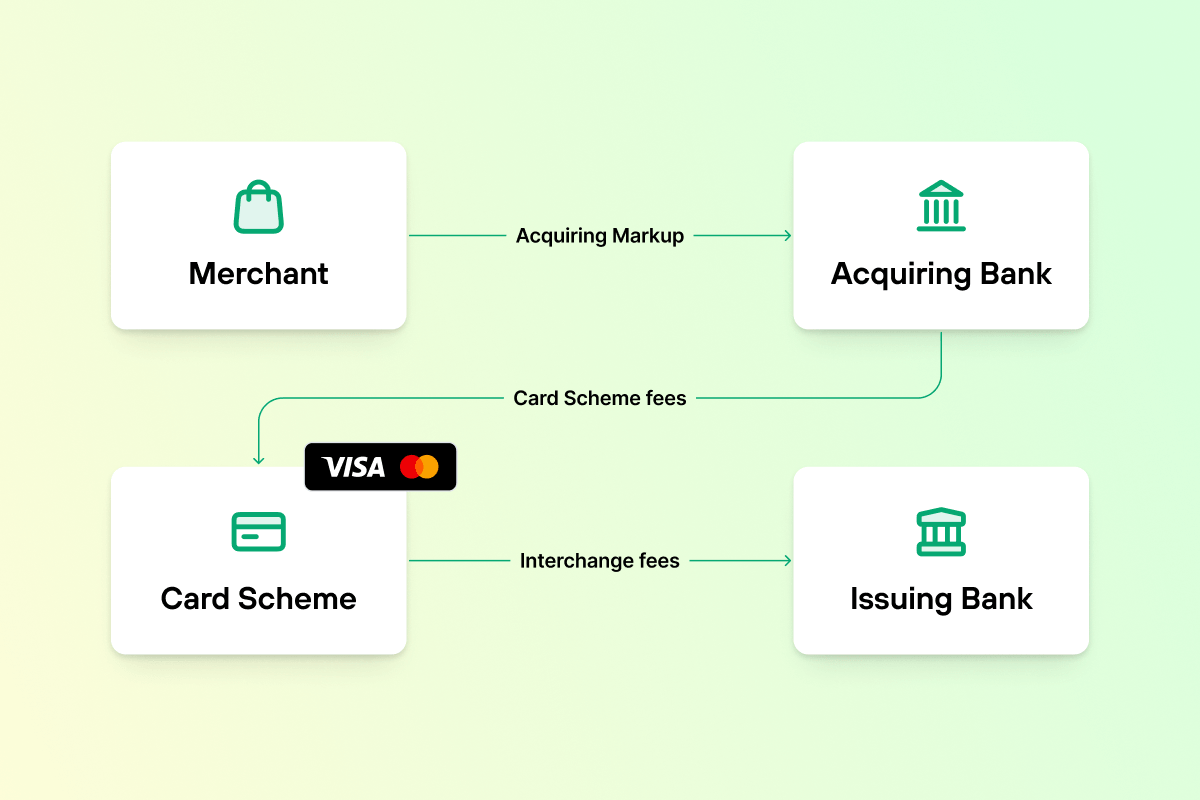
A card transaction fee is built from three layers, which a provider may pass through separately or bundle into one headline rate:
- Interchange: the largest component, set by the card networks and paid to the cardholder's . It is the wholesale cost of the transaction. Debit interchange is generally lower than credit, which is one reason card type changes the final fee. For the full breakdown, see .
- Scheme fees: charged by the card networks (such as Visa and Mastercard) for routing and using their rails.
- Processor markup: the or acquirer's own margin for handling the transaction.
How those layers reach the merchant depends on the pricing model. Flat-rate pricing charges one fixed rate for every transaction, which is simple but hides the underlying interchange. Interchange-plus passes interchange and scheme fees through at cost and adds a fixed markup, so the merchant sees exactly what each layer costs. Blended (tiered) pricing groups transactions into rate tiers, which trades transparency for a single predictable number. The result a merchant pays is closely related to the – the total deduction taken from each sale.
What affects transaction fees
The same transaction can cost different amounts depending on:
- Payment method: premium and rewards cards carry higher interchange than standard debit; alternative payment methods price differently again.
- Channel: card-not-present transactions cost more than card-present ones because they carry higher fraud risk.
- Geography: cross-border transactions add fees that local acquiring can avoid by processing in the customer's region.
- Merchant category: the groups businesses by industry and feeds directly into interchange rates and risk pricing.
- Volume and ticket size: higher processing volume and larger average tickets give merchants leverage to negotiate lower rates, since fixed per-transaction costs weigh less on bigger payments.
- Pricing model: flat-rate, interchange-plus, and tiered structures produce different effective costs for the same mix of transactions.
How to reduce transaction fees
Merchants lower their effective transaction fees through several levers rather than a single setting:
- Interchange-plus pricing exposes each cost layer, making it easier to see and challenge markup that flat-rate bundles hide.
- Local acquiring routes payments through an acquirer in the customer's region to cut cross-border and currency fees.
- A higher reduces failed-then-retried payments, each of which can add cost without adding revenue.
- Efficient settles authorized transactions together, avoiding the per-item overhead of one-off settlement.
- Shifting the method mix toward lower-cost options, such as account-to-account payments or debit cards where suitable, moves volume away from premium-card interchange.