Usage-based billing: What it is, how it works, and how to collect payments
Payments 101
Updated 23 Oct 2026
11 min

Valentyn Pidpalyi
Product Manager, Solidgate
Usage-based billing looks simple until the first declined card. This guide shows what to set up before it happens.
Whether you’re weighing a model, fixing collection problems, or learning the basics, usage-based billing comes down to one fact. Each invoice is a new amount, set by consumption and charged after the service is delivered.
A new amount each time brings flexibility for customers and growth for merchants. It also affects how you forecast revenue, how customers read their invoices, and how declines, retries, and fees play out.
Each of these areas has practical fixes, from accurate metering and clear customer agreements to current stored cards and retry logic. This guide covers what usage-based billing is, how it works, the main models and examples, and how to collect the payments.
TL;DR
- Usage-based billing prices what customers consume, so invoices change with use and the total is known only once the period ends.
- Models pair a pricing structure with a commitment structure, and they suit products whose usage and cost to serve vary widely, including AI.
- The upside is revenue that grows with customer use. The trade-offs are harder forecasting, metering disputes, revenue recognition rules, and bill shock.
- Payments can slip at four points: surprising amounts, declines after delivery, expired stored cards, and fixed fees on small invoices. Each has a specific fix.
- Managing it well means accurate metering, a clear sign-up agreement, current stored cards, and retries with a second route for declined charges.
What is usage-based billing?
Usage-based billing charges a customer for the units of a product or service they consume, such as API calls, gigabytes stored, or messages sent.
Metered billing and consumption-based billing are common names for the same approach, and pay-as-you-go pricing is its simplest form. Each unit carries a price, and the invoice total follows the number of units consumed in the billing period.
Two customers using the same product can receive invoices of very different size in the same month.
How usage-based billing works
Usage-based billing turns consumption into a payment in five steps, and the amount owed is known only after the billing period closes.
- Define the billable metric. The merchant picks the unit that tracks the value customers receive, such as API calls, compute hours, or tokens.
- Meter and aggregate usage. Metering records each usage event, which is why the model is also called metered billing. Usage aggregation then totals the events per customer across the billing period.
- Rate the usage. Rating applies the rate card’s unit price to the aggregated total and produces the amount owed.
- Invoice the customer. The invoice lists the units consumed, the price applied, and the total.
- Collect payment. The merchant charges the customer’s card on file in a merchant-initiated transaction, or the customer pays the invoice directly.
Billing software can automate steps two through four, so invoices generate without manual calculation. Real-time usage dashboards can show a running total, but the invoice amount is final only when the billing period closes.
Core insight: A usage-based charge starts as a measured event and becomes a priced invoice when the billing period ends. The merchant receives the money only after payment collection succeeds.
Usage-based billing models
Usage-based billing models differ on two dimensions: how each unit is priced and how usage connects to a commitment.
How units are priced
Three structures set the price of each unit: per-unit, graduated, and volume pricing.
Per-unit pricing charges one flat price for every unit.
Graduated pricing charges each tier of units at that tier’s rate, so higher-tier units cost a different rate from lower-tier units.
Volume pricing applies the rate of the tier the total reaches to every unit.
Graduated and volume pricing are both forms of tiered pricing.
Take a hypothetical price list: $0.10 per unit for the first 1,000 units and $0.08 for every unit above that. A customer consumes 1,500 units. Graduated pricing bills $140: 1,000 units at $0.10 plus 500 units at $0.08. Volume pricing bills $120: all 1,500 units at $0.08. The same consumption produces a $20 difference, set by the pricing structure.
How usage connects to a commitment
Four commercial structures decide whether usage stands alone or sits on top of a commitment.
Pay-as-you-go in arrears. The customer consumes first and receives an invoice for the period, with no commitment attached.
Commit and overage. The customer agrees to a minimum commitment, and units above that minimum bill as overage.
Prepaid credits. The customer buys credits upfront, and each unit consumed burns down the balance.
Base fee plus usage (hybrid). A fixed recurring fee covers a baseline, and usage above an included amount bills on top. Hybrid models soften the revenue volatility that pure usage-based pricing can bring.
Usage-based billing vs other billing models
Usage-based billing differs from subscription, tiered plan, and hybrid billing in what the customer’s invoice depends on.
Subscription billing charges a fixed recurring fee for access, whatever the customer consumes. Flat-rate and per-seat pricing are variants, with the fee set per account or per user. on a fixed fee produces the same invoice every period, and each charge runs as on a stored card.
Tiered plans charge a fixed fee for a chosen package, and each package includes a set allowance of features or usage.
| Model | What the customer pays | Invoice predictability | Typically fits |
| Usage-based | Units consumed × unit price | Varies each period | Products with wide differences in customer consumption |
| Subscription | Fixed recurring fee | Same every period | Products with steady, uniform usage |
| Tiered plans | Fixed fee for the chosen package | Same within a package | Products sold as distinct feature or allowance bundles |
| Hybrid | Fixed fee plus usage above an allowance | Fixed base, variable top-up | Products with steady baseline use and occasional spikes |
Core insight: Per-unit, graduated, and volume pricing set what each unit costs. Pay-as-you-go, commit and overage, prepaid credits, and hybrid structures set how much of the bill is fixed.
Usage-based billing examples
Usage-based billing fits products where customer consumption varies widely and the cost to serve rises with each unit.
Four conditions mark the fit:
- Consumption differs widely from one customer to the next
- The cost to serve grows with each unit consumed
- Customers can measure the unit and link it to the value they receive
- A low entry price helps win customers who start small
The following hypothetical cases show how these conditions play out in different industries. They illustrate charge patterns and carry no performance figures.
EV charging network. The network bills per kilowatt-hour after each session. Drivers who charge daily generate frequent small charges, and occasional drivers generate a few.
Cloud storage product. The product bills cloud consumption per gigabyte stored each month at one per-unit price. A customer’s invoice rises as the archive grows and falls when files are deleted.
B2B software platform. A base fee covers an included number of API calls, and each call above it bills as overage. A quiet month costs the base fee, and a busy month adds an overage line.
In all cases, the amount the merchant must collect changes from one charge to the next.
Core insight: Products with wide differences in usage and a per-unit cost to serve suit usage-based billing, as EV charging, cloud storage, and API access show. Each produces a different amount to collect.
Usage-based billing for AI companies
AI products increasingly bill tokens, requests, or generations because the cost of serving each request scales with the work the model performs.
links the cost of AI coding tools to token consumption and reports that AI coding agent vendors have moved from seat-based to consumption-based pricing.
AI is pushing software companies to align pricing with product value, according to In an a16z survey of 100 chief information officers (CIOs) across 15 industries, 39% favored pricing tied to tokens, API calls, or time. Seat-based pricing drew 21%.
Core insight: AI companies increasingly bill tokens, requests, or generations because those units track what each request costs to serve.
Benefits and challenges of usage-based billing
Usage-based billing ties revenue to customer consumption, which opens growth upside for merchants and adds forecasting and billing work.
| Area | Benefit | Challenge |
| Revenue | Income grows as customers consume more | Forecasting is harder, and recognition follows usage period by period |
| Customers | A small first invoice lowers the barrier to entry | Bill shock when an invoice exceeds expectations |
| Data | Metering data shows which features customers use | Every invoice depends on accurate metering |
Benefits for merchants
- Revenue follows customer value. When a customer consumes more, the invoice grows with it, so expansion can happen without a new contract.
- A lower barrier to entry. A customer can start with small consumption and a small invoice, which can shorten the path to a first purchase.
- Usage data. Metering shows which features customers consume, which can inform pricing and product decisions.
Challenges for merchants
- Forecasting. Revenue moves with customer consumption, so a quiet month lowers revenue with no customer leaving.
- Metering accuracy. Every invoice depends on the usage record behind it. When a customer cannot match a charge to their own usage, the merchant may need to show the underlying metering data.
- Revenue recognition for usage-based billing. Revenue recognition rules decide when revenue is recorded. A fixed subscription fee is typically recognized evenly over the contract term. Fees that vary with usage are typically recognized in the period the usage happens, so reported revenue changes with consumption.
- Bill shock. Bill shock is an invoice that exceeds what the customer expected, and a consumption spike can cause it. Nearly 8 in 10 IT leaders unexpected charges tied to AI or consumption-based pricing.
Core insight: Revenue grows with customer consumption and entry prices stay low. Forecasting, metering accuracy, revenue recognition, and bill shock are the costs.
Payment risks in usage-based billing
Usage-based billing payments can fail at four points: the amount, the retry, the stored credential, and the cost of each charge. Each has a specific cause and a specific fix.
An amount the customer didn’t expect
An invoice that surprises the customer can turn into a dispute with their bank.
Each chargeback puts the payment at risk and typically adds a fee. Usage invoices carry this risk because every invoice is a variable amount, and the customer can’t read it off a price list.
The fix starts before the first charge. The agreement the customer accepts at sign-up should explain what is measured, the price per unit, and how the total is calculated. Usage alerts and a recognizable help the customer match each charge to their usage. And metering records give the merchant evidence if a dispute arrives.
A failed charge after the service is consumed
Billing in arrears means you deliver the service first and charge later, so a declined charge leaves usage consumed and unpaid.
Declines come in two kinds, and each needs a different response. A soft decline is temporary, such as a card with insufficient funds that day, and a later attempt can succeed. A hard decline is final, such as a closed account, and only a new card from the customer fixes it.
Smart retries and dunning help address both. choose when to try a soft decline again, so the next attempt lands when it can succeed. handles hard declines with reminders and requests for a new card, which can keep a customer from lapsing into involuntary churn.
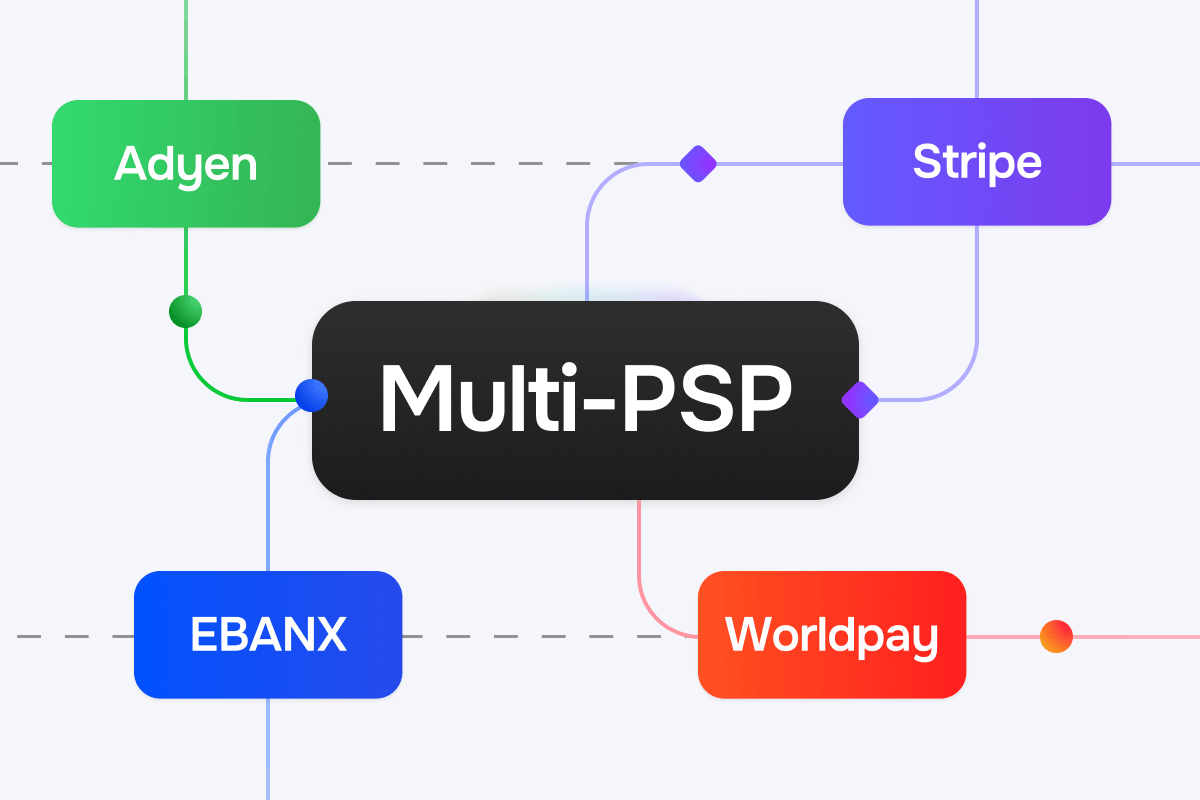
A charge declined through one provider can still succeed through another, because the differs from provider to provider. Cascading retries the declined charge through the next provider you work with.
– a subscription app and one of Solidgate’s merchants – runs custom retry rules calibrated to its billing cycles and cascading across several providers. Its case study reports up to a 15% lift in payment acceptance from local acquiring and orchestration together.
Stored credentials that expire before the charge
Cards expire and get reissued, so the details you stored can be out of date by the next invoice. With billing in arrears, the service is already delivered when that charge fails.
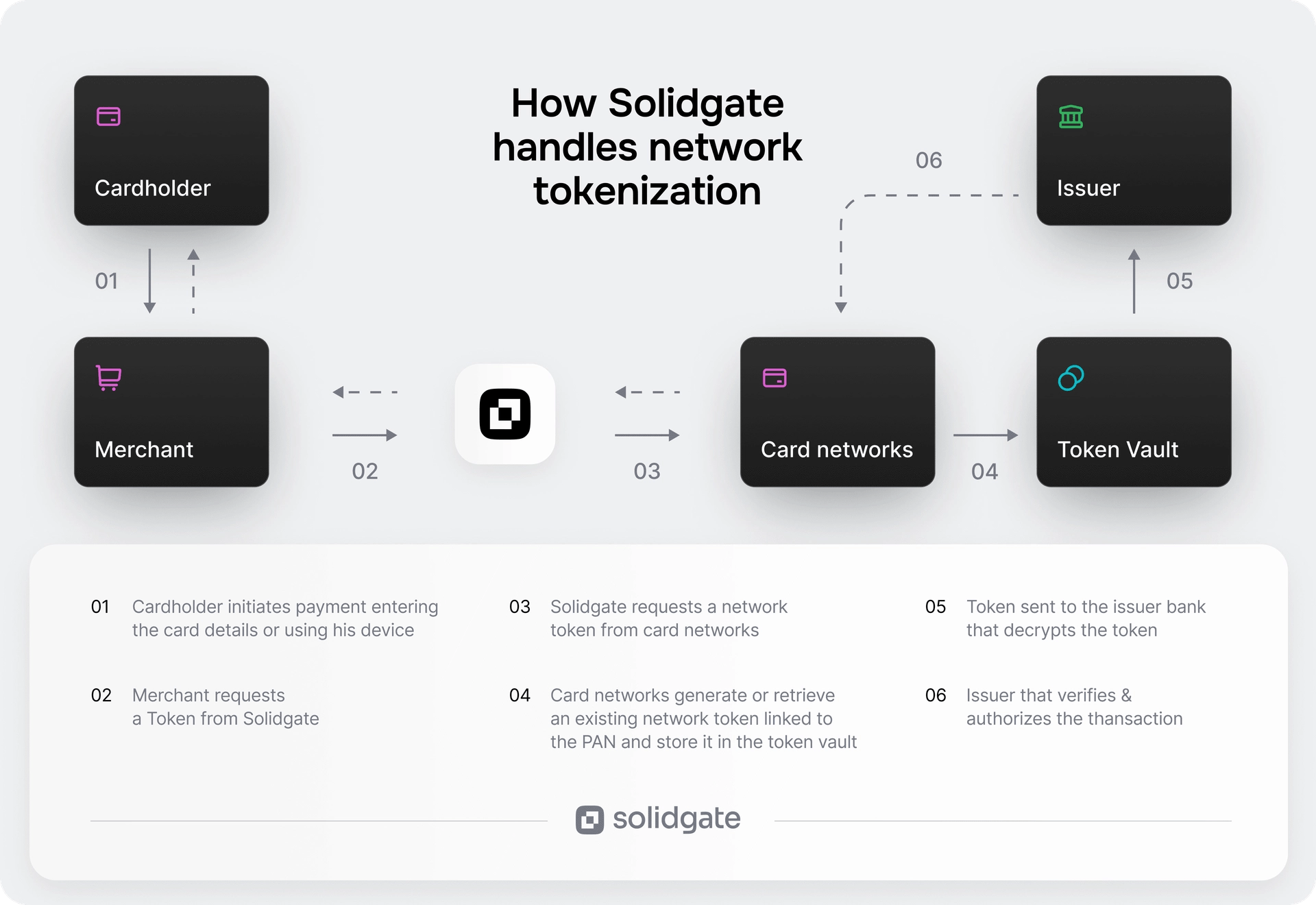
Network tokenization addresses this. The card network issues a token that replaces the card number and stays linked to the cardholder’s account when the card is renewed or reissued.
According to , the network checks with the issuer that the card behind a token is valid, which helps reduce failed transactions. Nearly half of Visa’s e-commerce transactions worldwide are tokenized, as reported by .
An account updater adds another layer, covering the cards that can’t get a token. It refreshes stored card details when an issuer replaces or reissues a card, so the next charge runs on current details. Solidgate provides both network tokenization and Direct Account Updater, which together can cover all the cards a merchant stores.
, an AI-powered SaaS company, saw conversion rise by 7–14 basis points after network tokenization went live. When one of its acquirers closed, its recurring payments moved to new acquirers with near-zero loss, because the tokens stayed on Solidgate’s side.
Per-charge costs that outweigh small usage charges
Card processing fees typically include a fixed fee per transaction, and small invoices feel it most. As a hypothetical illustration, a 30-cent fixed fee takes 0.3% of a $100 invoice and 7.5% of a $4 invoice.
Low-usage accounts produce those small invoices. Cross-border payments in a currency other than the customer’s own can add a conversion cost on top.
Two changes can cut these costs. Carrying small balances forward until they pass a minimum invoice amount reduces the number of charges. Charging in the customer’s own currency through processing can help the customer avoid that conversion cost.
Core insight: A usage-based charge can go wrong on an unexpected amount, a decline after delivery, an outdated stored card, or per-charge costs on small invoices. Clear agreements and alerts, timed retries with cascading, network tokens with an account updater, and minimum invoice amounts address them in turn.
Managing usage-based billing setup effectively
A reliable usage-based setup meters accurately, shows customers their consumption, and runs a payment layer built for variable charges.
- Model fit. Match the model to how much customer usage varies. Wide swings favor usage-based or hybrid pricing, and steady use favors a fixed fee.
- Meter accurately and automate invoicing. Reconcile usage records with invoices, so a customer’s question gets an answer backed by data. Use a usage-based billing solution to generate each invoice from that data, so invoices don’t depend on manual calculation.
- Plan for declines. Retry soft declines at the right time, and ask for a new card after hard declines. Automate both, so recovery runs without manual follow-up. Use across several providers, so a declined charge has a second path.
- Agreement and visibility. Check that the sign-up agreement explains how usage is priced and how the total is calculated. Customers should also see a running usage total and receive alerts before the invoice closes. The same consent groundwork applies when you on a stored card.
- Stored credentials. Look for network tokens and an account updater that keep stored cards current, and tokens that stay usable when a provider changes.
- Cost and currency. Look for a minimum invoice threshold and charging in the customer’s own currency.
Metering decides what a customer owes, and the payment layer decides whether the merchant receives it. When a setup connects to one provider, a declined charge has only one path.
Solidgate is a payment orchestration platform, and its runs on the full-stack orchestration layer. Billing covers recurring, usage-based, and hybrid models, with dunning and retries built in.
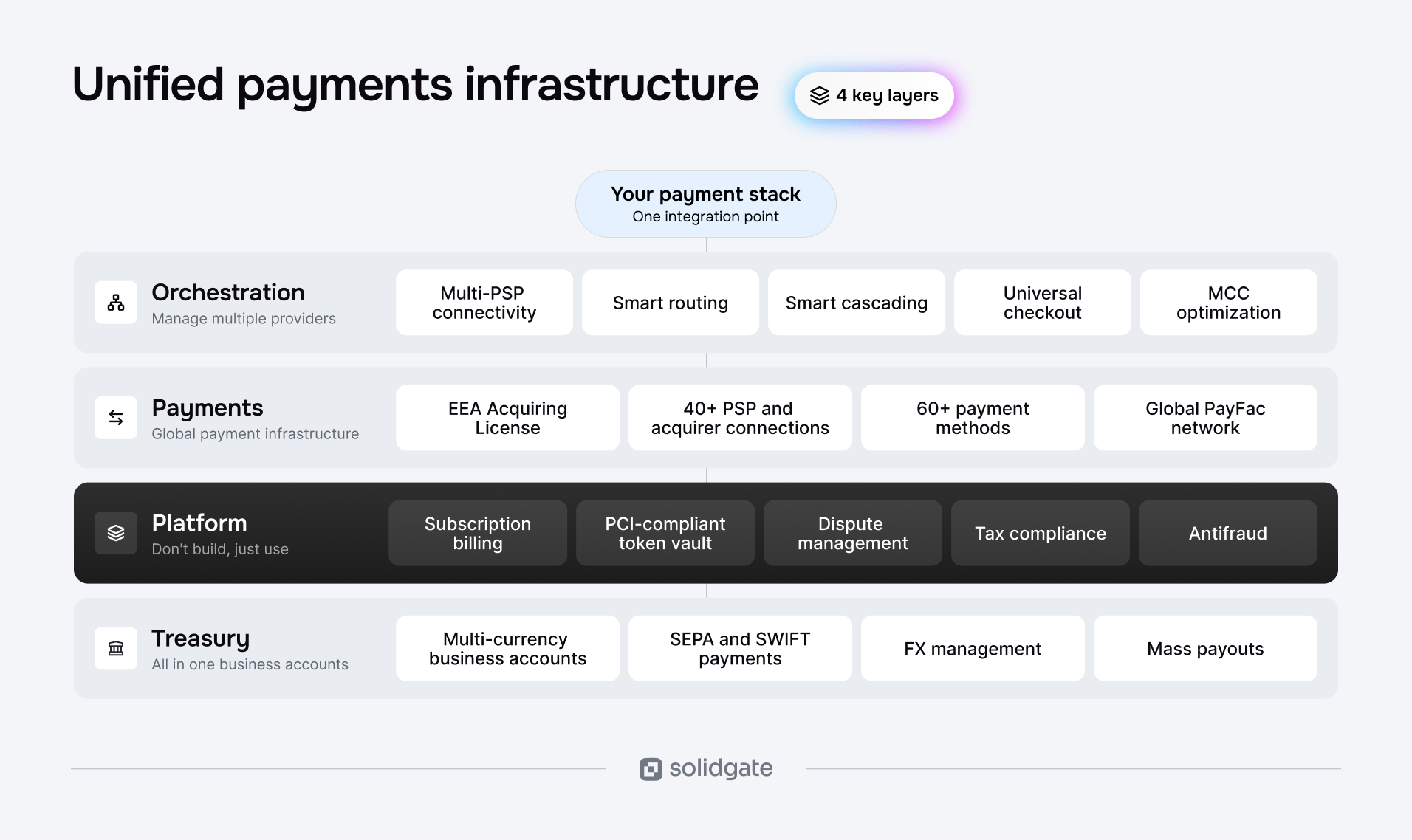
Orchestration adds across 100+ providers, network tokenization, and automated failover. Each charge goes to the provider most likely to approve it, and cascading retries a decline through the next one. Stored cards sit in a provider-agnostic token vault, so the tokens stay usable if you change providers.
Ready to map your current setup and see where the gaps are? today.
Frequently asked questions
A subscription bills the same fee every period for access, whatever the customer uses. Usage-based billing charges for measured consumption, so the invoice rises and falls with use. Hybrid billing sets a fixed base fee and adds charges for usage above an included amount.
Metered billing is another name for usage-based billing, seen from the measurement side. A meter counts each unit a customer consumes, such as an API call or a gigabyte. The billing system totals those units for the period and prices them to produce the invoice.
Declines on usage charges come from the same sources as other card payments: expired or reissued cards, temporary soft declines, and final hard declines. The timing adds exposure, because arrears billing charges after the service is delivered, so a failure leaves usage unpaid.
Some common examples include ride-hailing and micromobility apps, which bill per ride or minute, and parking apps, which bill per hour. Generative AI apps bill per generation, and B2B software platforms bill per API call. Each product has a measurable unit and a cost to serve that grows with use, so each charge changes with consumption.
It depends on how much customer usage varies. Usage-based billing fits products where customers consume very different amounts, each unit adds to serving costs, and customers can tie the unit to value. Steady, uniform use suits a fixed fee, and a hybrid model fits a steady baseline with occasional spikes.
Recent articles