Subscription billing automation: What to automate and how
Payments 101
Updated 2 Sept 2026
10 min

Valentyn Pidpalyi
Product Manager, Solidgate
Billing automation goes deeper than invoices and plan changes. Here's what it actually covers and how to build it in the right order.
Most merchants start with the most visible layer of billing automation – invoices, plan changes, proration. It's tangible, easy to measure, and most billing platforms handle it out of the box.
But subscription billing automation goes deeper than that. It covers:
- Invoicing, proration, plan changes, trial-to-paid conversions
- Retry logic, dunning sequences, routing failover
- Keeping payment credentials current between billing cycles
The layer most merchants build first has the lowest revenue impact. The layers that determine whether subscribers stay or silently churn get configured last – if at all.
This article maps what subscription billing automation is, what to automate first and why, and what the revenue impact looks like when the sequence is right.
TL;DR
- Subscription billing automation covers: billing logic, payment recovery, and stored card accuracy. Most merchants start with the most visible layer rather than the most impactful one.
- Payment recovery comes first. Soft declines account for 70–90% of all failed card-not-present payments and are recoverable with the right retry timing. Hard declines aren't – retrying them causes harm.
- Stored card accuracy comes second. Cards expire and get reissued between billing cycles. Account Updater and network tokenization keep stored credentials current without subscriber action.
- Billing logic comes third. Invoicing, proration, and plan change automation reduce operational overhead – but only deliver full value once the payment layer beneath them is stable.
- Billing automation isn't worth pursuing if you have low volume, simple billing models, predominantly voluntary churn, or one-time payment models.
What is subscription billing automation?
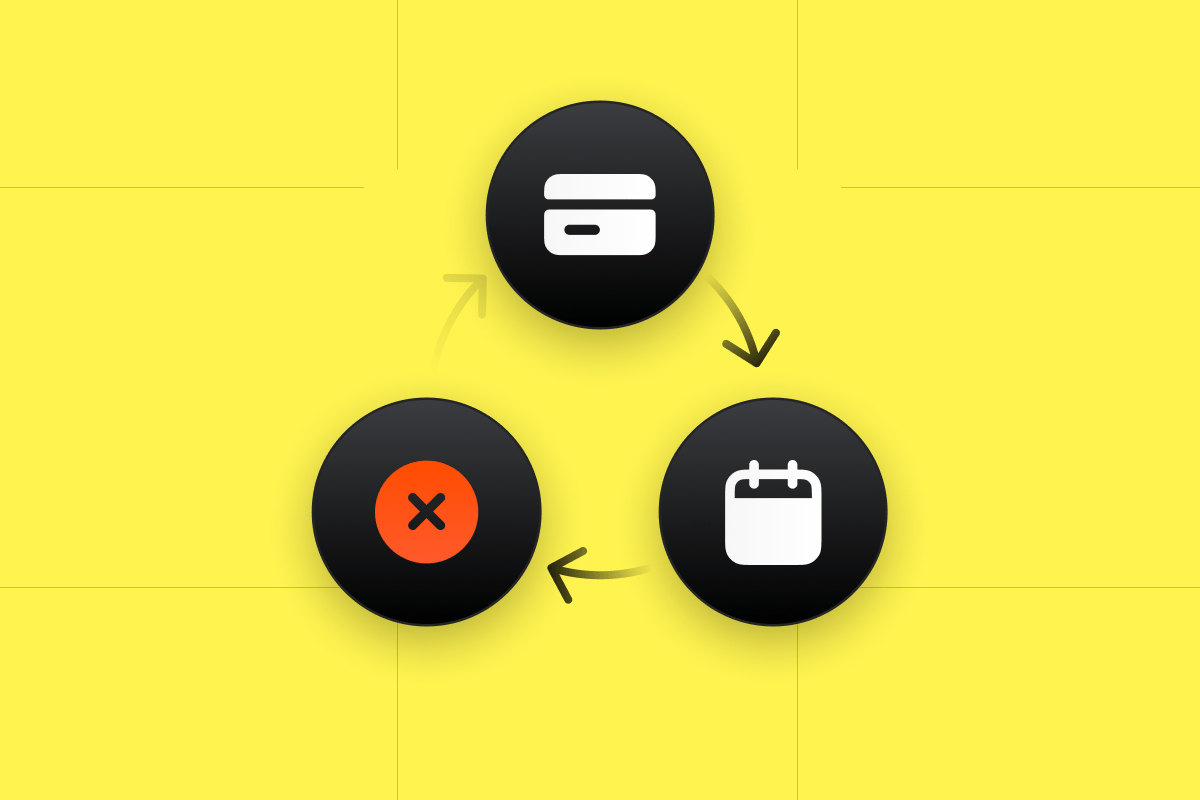
Subscription billing automation is the use of software to execute, manage, and recover recurring payment workflows – from invoice generation to failed payment recovery – without manual intervention. The term covers three distinct layers:
Billing logic automation handles the business rules of a subscription. It generates invoices, calculates proration when a customer upgrades mid-cycle, applies discounts, triggers plan changes, and manages trial-to-paid conversions, which helps reduce human error in invoicing. This layer is the most visible – finance teams live in it – and most subscription billing platforms handle it reasonably well out of the box.
Payment execution automation handles what happens when a billing event fires and the charge fails. This includes smart retry logic, dunning sequences, and routing failover. It sits between the billing engine and the , and it's where the majority of recoverable revenue loss lives.
Credential maintenance automation handles what happens between cycles: refreshing expired card credentials, updating replaced cards via Account Updater, and replacing static card numbers with dynamic network tokens that survive reissuance. This layer runs before a failure occurs. Its impact is lower per event than smart retries, but it compounds across every billing cycle.
Automation replaces repetitive financial operations with continuous workflows.
Most merchants build billing logic automation first because invoices are tangible and easy to measure. Retry logic and credential maintenance are invisible until something goes wrong – and by then, the revenue has already left.
What to automate (and in what order)
Start with the layer that has the fastest, most measurable impact on revenue. For most , that means payment recovery first, credential maintenance second, and billing logic third.
Payment recovery
Not every is worth recovering.
Soft declines are temporary. The card is valid – the charge was blocked by a momentary condition:
- Insufficient funds at the moment of attempt
- A spending limit
- A velocity flag
- An issuer's fraud filter
Soft declines account for 70–90% of all failed card-not-present payments. The underlying issue resolves on its own, and the payment can succeed on a retry.
Hard declines are permanent. A closed account, a card reported stolen, a fraud flag that won't lift – none of these resolve through retrying. It consumes scheme retry allowances, can trigger fines, and damages MID relationships with the acquirer.
Payment recovery automation earns its place first in the sequence because soft declines represent the largest pool of revenue a subscription business can win back without any subscriber action.
Credential maintenance
A subscription that billed successfully for months can fail at the next renewal because the stored credential the billing system is charging against no longer exists. Neither the merchant nor the subscriber knew it was coming.
This is a distinct failure type from soft and hard declines. It isn't a timing problem or a permanent card issue – it's a data accuracy problem. The card is valid, but the stored record of it isn't.
Stored card accuracy sits second in the sequence because it operates between billing cycles. The failure it causes is silent and preventable – but only if the credential is refreshed before the billing event fires.
Billing logic
Billing logic controls what the payment system charges, when, and how much. It governs proration on mid-cycle upgrades and downgrades, trial-to-paid conversions, discount application, plan change execution, billing frequency, and usage based charges. When billing logic is misconfigured, the payment system executes correctly against the wrong instruction.
This makes billing logic errors a distinct failure type from the first two. Soft declines are a payment execution problem. Credential decay is a data accuracy problem. Billing logic errors are a business rules problem – the payment infrastructure did exactly what it was told, but it was told the wrong thing.
That’s why billing logic comes last in the automation sequence as it inherits the reliability of the payment layer beneath it.
Core insight: Not every failed payment has the same fix. Soft declines, stale credentials, and billing logic errors are three distinct failure types. Automating the response to each in the right order determines how much revenue a subscription business recovers.
How to automate subscription billing
Configure smart retries and dunning
Start by mapping your failure split: what percentage of failed payments are soft declines versus hard declines? That ratio determines how to configure the two tools and where to focus first.
Smart retries handle soft declines. Configure retry logic to read the decline code and map it to the likely recovery window:
- Payday cycles for insufficient funds
- Off-peak hours for velocity limits
- A short delay for issuer fraud flags
Timing precision matters: a retry fired at the wrong moment burns a scheme allowance without recovering the payment. allows up to 20 retries within 30 days. Retries beyond those limits can incur additional fees and damage MID relationships.
Solidgate's typically deliver a 51–67% improvement in first retry conversion by matching retry timing to the specific failure reason.
Dunning handles hard declines – the failures retries can't reach. Configure it as a fallback, not a primary recovery tool. The sequence fires after retries are exhausted, prompting the subscriber to update their payment method before access closes.
Enable Account Updater and network tokenization
Enable Account Updater first, then add network tokenization on top.
connects to Visa and Mastercard networks and refreshes stored card details automatically when a customer's card changes – expiry updates, reissued numbers, account upgrades. The updated credential is in place before the next billing attempt fires. The subscriber does nothing. It works across your full stored credential base regardless of whether those credentials are tokenized.
99% of Solidgate merchants use Account Updater, and merchants using it see up to 4% increase in annual subscription revenue.
Network tokenization replaces the stored card number with a token issued by Visa Token Service (VTS) or Mastercard Digital Enablement Service (MDES). When the underlying card is reissued, the network updates the token automatically. The stored credential never goes stale because it isn't tied to the card number in the first place. Note that for European transactions the payment flow may also require Strong Customer Authentication (SCA) when collecting payment details.
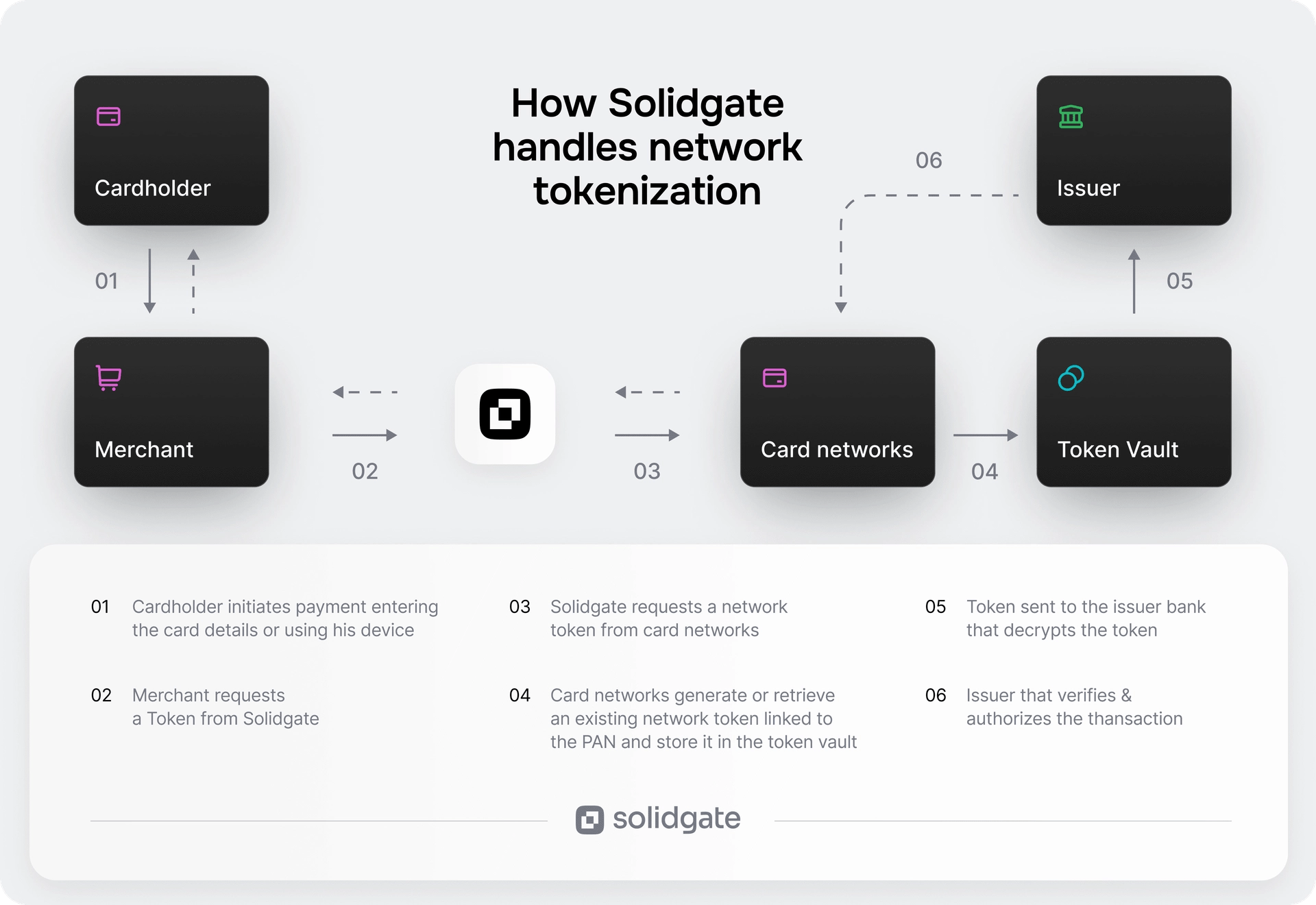
Merchants using VTS/MDES network tokenization see up to 7.5% better retention compared to standard bank tokenization, because fewer renewals fail due to card reissuance.
Network tokenization solves reissuance for enrolled cards – but not every card type, issuer, or region participates in VTS/MDES enrollment. Account Updater covers the credentials that network tokenization can't reach.
Solidgate's connects to Visa and Mastercard's network tokenization services and Account Updater across major card networks, reducing failed payments by 27%.
Automate invoicing, proration, and plan changes
Once the payment layer is stable, automate recurring billing logic to reduce operational overhead:
- Fewer manual reconciliation cycles
- Cleaner AR aging buckets
- Self-service plan changes that reduce support volume
Evaluate coverage for markets where cards aren't dominant, integration depth for custom billing logic, and webhook reliability for real-time subscription state updates.
For infrastructure-level recovery – when an acquirer degrades or declines a corridor consistently – add with automatic failover. It routes each transaction to the best-performing acquirer in real time without manual intervention.
Measure three metrics to confirm automation is working.
at billing events tells you whether the payment layer approves charges at the rate your subscriber quality warrants.
Recovery rate on retried payments tells you whether smart retry logic converts soft declines into successes.
Involuntary churn rate by billing cycle tells you whether stored card accuracy is preventing the failures retry logic can't reach.
See our for a full measurement framework.
Core insight: Map your decline data first, connect the billing engine to the payment layer, and configure each tool to the failure type it's designed to recover. That sequence is what makes automation work.
The revenue impact of automated billing
Merchants who automate payment recovery and credential maintenance before billing logic retain more subscribers, recover more revenue, improve cash flow, and reduce operational cost per billing cycle.
Here's how some of the businesses benefited from Solidgate's combined with the layer.
MEGOGO, an international streaming platform operating across Eastern Europe and Central Asia, was losing subscribers to renewal failures. They were caused by expired credentials, suboptimal retry timing, and a payment stack that couldn't route around regional performance gaps.
After connecting Solidgate's orchestration, network tokenization, and Account Updater in a single integrated stack, MEGOGO reduced subscription churn by 5% and improved payment conversion by 3.5%.
See the full .
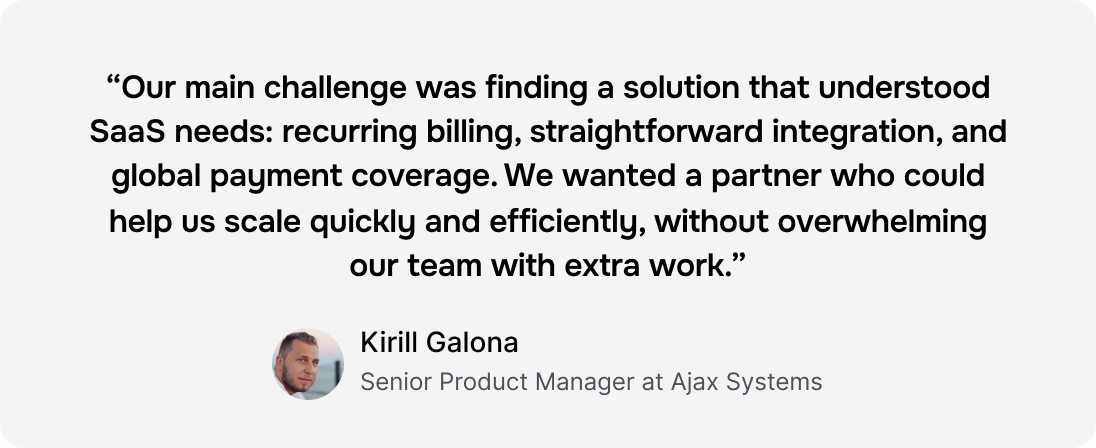
Ajax Systems – a security hardware company launching B2B SaaS subscriptions in the EU – faced a different version of the same problem. They had no existing subscription payment infrastructure and needed production-ready recurring billing with high authorization rates from day one. Building in-house would have taken 6–12 months.
With Solidgate's billing engine, intelligent routing, and network tokenization integrated in a single platform, Ajax achieved 90%+ approval rates across EU markets from launch and went live in one week.
See the full .
The common thread in both cases is architecture. The billing engine and the payment execution layer shared context – billing events, failure codes, credential state – which made retry precision and routing decisions possible. Merchants running decoupled systems consistently leave recoverable revenue behind because the retry layer doesn't know what it's retrying or why.
If you’re comparing platform options, check our guide on the .
Core insight: Merchants who connect recurring billing automation to the payment execution layer retain more subscribers and recover more revenue per billing cycle. In practice: 5% churn reduction, 3.5% payment conversion improvement, and 90%+ approval rates from day one.
When subscription billing automation isn't worth it
Automated subscription billing isn't worth pursuing in the following cases:
Low transaction volume. At very low MRR, the revenue lost to failed payments is too small to justify the investment. A business with a few hundred subscribers losing a small percentage to payment failures each month recovers more cost-effectively through manual dunning and a basic billing tool than through a fully automated retry stack.
Simple, stable billing model. A business with one plan, one market, no mid-cycle changes, and no proration has little billing logic to automate. A straightforward recurring charge on a stable subscriber base doesn't need a connected billing and payment orchestration stack.
Predominantly voluntary churn. If most subscribers are leaving because they no longer see value in the product – not because a payment failed – billing automation won't recover them. Smart retries and credential maintenance solve involuntary churn. They don't address pricing, product fit, or engagement. Automating payment recovery in a business where churn is primarily voluntary optimizes the wrong variable.
One-time payment model. Billing automation is built for recurring revenue. Businesses that charge customers once have no credential decay between billing cycles, no retry sequences to configure, and no dunning logic to automate.
Core insight: Subscription billing automation earns its cost when volume is high, the model is recurring, and churn has an involuntary component. Outside those conditions, the investment doesn't pay off – and the right move is to solve for product, pricing, or model first.
Build your billing automation in the right order
Most platforms handle the visible layer – invoices, plan changes, proration – without much configuration. The layer that determines whether subscribers stay or silently churn is the one most merchants configure last: payment recovery and credential maintenance.
Start with mapping your decline data. Then, identify whether failures are soft declines, hard declines, or credential failures. Match the automation to the failure type, and connect the billing engine to the payment layer so retry logic has the context it needs. Finally, add multi-acquirer failover when single-provider retries hit their ceiling.
Solidgate is a payment orchestration platform that combines, network tokenization, and intelligent routing in one integration. Solidgate connects to 100+ payment service providers (PSP), acquirers, and through a single API, so merchants don't have to build or maintain those connections separately.
If your current setup is producing involuntary churn you can't diagnose or recover consistently, to map where in the stack the failures are concentrating.
Frequently asked questions
Yes. Most subscription billing platforms automate invoice generation, plan changes, and proration natively. Payment recovery – the automation with the highest revenue impact – requires more intentional setup: retry logic connected to decline data, Account Updater for stored card accuracy, and a payment layer that shares context with the billing engine.
Start with your decline data to identify whether failures are soft declines or hard declines. Match the tool to the failure type: smart retries for soft declines, routing failover for PSP-level failures.
Separately, enable Account Updater and network tokenization to prevent stored card accuracy failures before billing events fire. Connect the billing engine to the payment layer so retry logic has billing context. Measure authorization rate at billing events, retry recovery rate, and involuntary churn rate by cycle – see our guide for a full framework.
Automated recurring billing fires a payment attempt at the scheduled renewal. If the charge fails, the system reads the decline code to classify the failure. Soft declines route to smart retry logic, which waits for the optimal retry window based on failure reason, card type, and time zone.
Hard declines skip the retry path and go directly to dunning – an email and SMS sequence that prompts the subscriber to update their payment method before access closes. Stored card accuracy failures are prevented: Account Updater and network tokenization keep credentials current between billing cycles so the failure doesn't occur in the first place.
Recurring billing automation reduces involuntary churn – subscribers who lose access because a payment failed, not because they decided to cancel. Smart retries recover failed charges before the subscriber notices. Account Updater and network tokenization keep credentials current so renewals don't fail silently. Voluntary churn – subscribers who actively cancel – requires a different approach entirely. Billing automation doesn't address product fit, pricing, or engagement.
The cost depends on platform choice, integration complexity, and current failure rate. The savings depend on current involuntary churn rate, MRR, and how much of that churn is recoverable through retry and stored card accuracy automation.
As a framework: calculate your monthly billing event volume, identify the share that fails, and determine what percentage are soft declines – that's the addressable pool.
Recent articles