Subscription payment processing: A complete guide for merchants
Payments 101
Updated 8 Oct 2026
8 min

Valentyn Pidpalyi
Product Manager, Solidgate
Subscription payment processing is more than a scheduled charge – it's the infrastructure that determines whether renewals succeed, credentials stay current, and failed payments get recovered.
Businesses processing subscription payments are managing more than a scheduled charge. Every renewal runs on a stored credential, moves through a chain of participants, and succeeds or fails based on decisions made long before the billing date.
Getting that infrastructure right matters before you launch, not after. The payment methods you accept, how stored credentials are maintained, and how your setup handles failed renewals all determine whether subscriptions renew reliably at scale.
This guide explains how subscription payment processing works, which payment methods support recurring flows, why payments fail and how to recover them, and what to look for when choosing a processor.
TL;DR
- Subscription payment processing is the infrastructure that executes recurring charges – moving each renewal from the billing engine through the processor, acquirer, card network, and issuing bank.
- The first charge is customer-initiated (CIT) and creates a stored credential – a card-on-file (CoF). Every renewal after that is merchant-initiated (MIT) and draws on that credential automatically.
- Not all payment methods support recurring charges equally – cards are the most renewal-resilient, while local schemes vary by market and method.
- Subscription payments fail for three distinct reasons: soft declines (temporary, recoverable with smart retries), hard declines (permanent, require dunning), and credential decay (preventable with network tokenization and account updater).
- When choosing a subscription payment processor, evaluate billing model support, subscription lifecycle management, payment method coverage, security and compliance, and reporting granularity.
What is subscription payment processing?
Subscription payment processing is how recurring charges are executed – the system connecting a merchant's engine to the payment networks that authorize and settle each charge.
What separates subscription processing from one-time payments is the stored credential. At the customer's first checkout, their payment details are tokenized and stored. Every renewal charges against that token automatically – no re-entry required, no customer action needed.
Subscription businesses run on different billing models – fixed recurring, usage-based, tiered, per-seat, and freemium among them – and this billing model determines what the processing layer is instructed to charge and when.
How does subscription payment processing work?
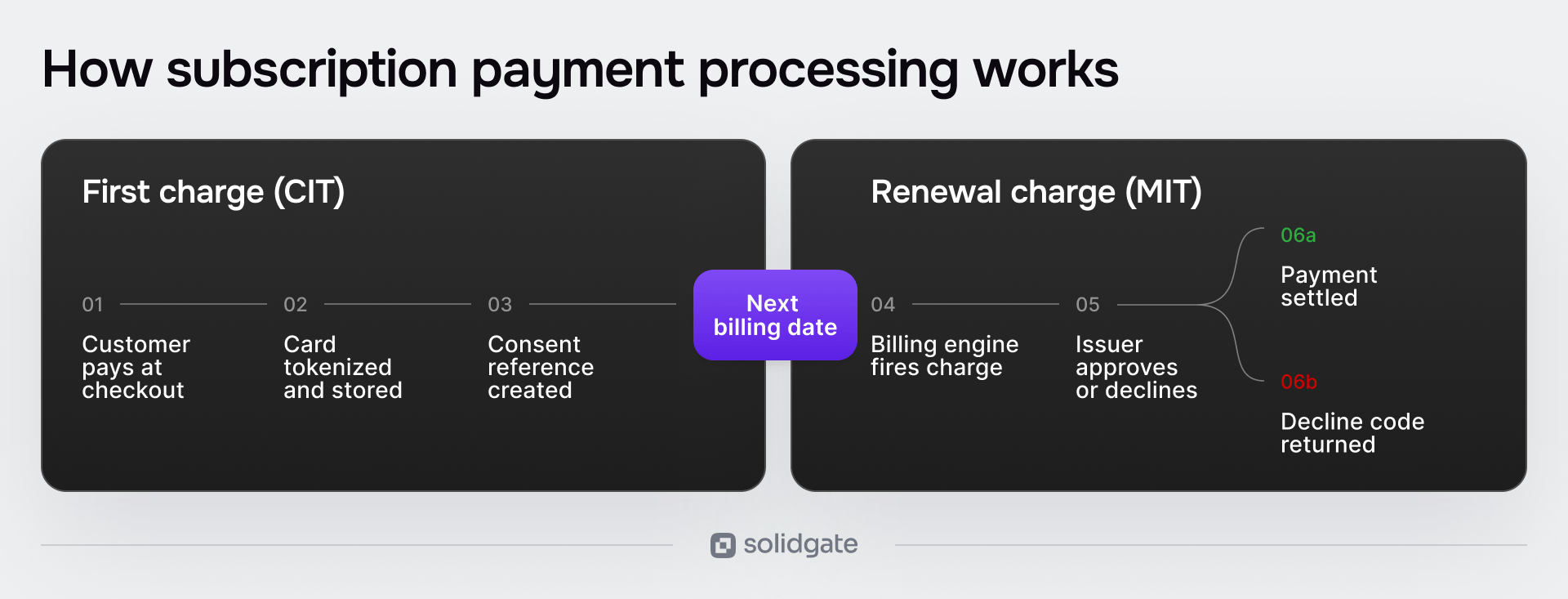
Every subscription charge moves through the same sequence. The first charge and every renewal after it follow the same path through the payment network – but they are treated differently at the authorization level, and that distinction matters for how renewals are authenticated and what happens when they fail.
Step 1 – Customer initiates the first payment
The customer enters their payment details at checkout and completes the purchase. This is a customer-initiated transaction (CIT). In Europe, PSD2 requires strong customer authentication (SCA) at this step – typically via 3D Secure 2 (3DS2). The customer authenticates and the payment is authorized.
Step 2 – Credential is stored and consent is recorded
The processor replaces the raw card number with a token and stores it against the customer record. This is what the billing system will use on every future charge – the raw card number never travels through the system again.
Separately, the card network records the customer's consent to future merchant-initiated charges, creating an authorization reference that every subsequent renewal must carry to be recognized as legitimate.
Step 3 – The billing engine fires the renewal
On the next billing date, the billing engine fires a merchant-initiated transaction (MIT). The customer takes no action. The processor passes the stored token and flags the charge as an MIT, including the authorization reference from the original CIT. That reference is what tells the card network this charge is linked to the customer's original consent.
Step 4 – The transaction routes to the issuing bank
The processor passes the MIT to the acquiring bank. The acquirer routes it through the card network – Visa, Mastercard, or another scheme – to the customer's issuing bank.
Step 5 – The issuer approves or declines
The issuing bank evaluates the charge: available funds, card status, fraud signals, and whether the MIT authorization reference is correctly linked. It returns an approve or decline. That response travels back through the card network and acquirer to the processor.
Step 6 – The outcome is handled
If approved, the transaction moves to settlement and the customer receives a receipt. If declined, the processor returns a decline code – the diagnostic signal that tells the billing system why the charge failed and what to do next.
Core insight: Payment processing for subscription businesses runs on two transaction types. The customer-initiated first charge creates the CoF and the consent record. Every merchant-initiated renewal draws on both – and the decline code the issuing bank returns when something goes wrong is the only signal the system has to act on.
Payment methods for subscriptions
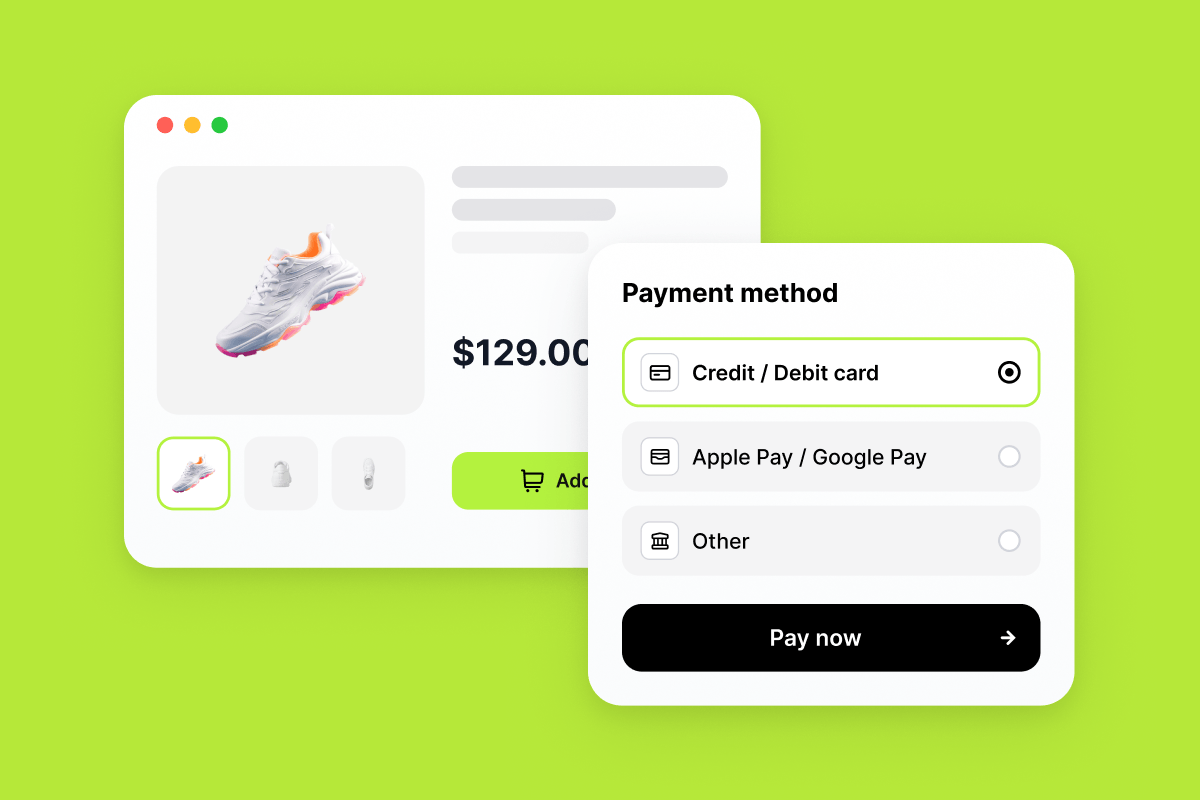
Not all payment methods support recurring charges, and among those that do, behavior at the processing layer varies significantly. The method a subscriber uses at signup determines what the billing system has to work with at every renewal.
Cards are the most renewal-resilient method. Visa and Mastercard support the full MIT stored-credential framework – including network tokenization via Visa Token Service (VTS) and Mastercard Digital Enablement Service (MDES), and account updater for refreshing credentials when cards are reissued or expire.
A card-paying subscriber whose card is reissued after a fraud event can continue renewing without any action on their part, if the processing layer supports these tools.
Wallets – Apple Pay, Google Pay, PayPal – support recurring flows but operate differently from card MITs. Apple Pay and Google Pay use device tokens, managed at the device and network level. PayPal uses billing agreements: the customer authorizes future charges at signup, and renewals draw on that agreement. Wallet behavior on renewals varies by issuer participation and market.
Direct debit and bank-based methods – SEPA Direct Debit in Europe, ACH in the US – support recurring billing through mandate authorization. The customer authorizes the merchant to debit their account directly on a recurring basis.
There is no card network in the middle, which means card network retry rules and network tokenization don't apply. Bank-based methods often carry lower decline rates on renewals because the mandate model is more direct.
Local and regional payment methods vary significantly in recurring support. Some support scheduled recurring charges on a fixed billing cycle – BLIK Recurring and PIX are examples.
Others support unscheduled recurring flows, which suit usage-based billing models. Before relying on any local method for subscription renewals, verify that it supports the recurring flow type your billing model requires.
Core insight: Cards are the most reliable method for subscription renewals. Wallets and direct debit support recurring flows but behave differently at the processing layer. Local payment methods vary – some support scheduled recurring, some unscheduled, and some not at all.
Why subscription payments fail – and what to do
Subscription payment failures lead to involuntary churn – subscribers who lose access not because they chose to cancel but because a renewal didn't go through. Estimates around 7.2% of subscribers are at risk of being lost each month this way.
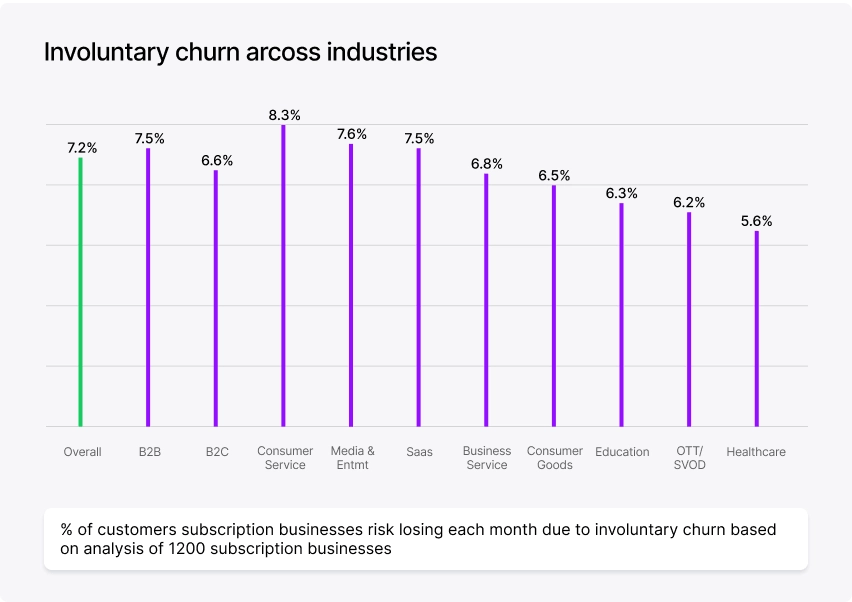
Here are the most common reasons why payments fail and how to recover them.
Soft declines
Soft declines are temporary issuer-side blocks. The card is valid and the subscriber intends to stay – the charge was blocked by a momentary condition:
- Insufficient funds at the time of the attempt
- A spending limit
- A velocity flag
- An issuer fraud filter
Soft declines are recoverable with correctly timed retries. The right retry window depends on the decline code – insufficient funds typically clears around payroll cycles, while a velocity flag may clear within hours.
automate this by matching retry timing to the specific failure type rather than running on a fixed schedule.
Hard declines
Hard declines are permanent. A stolen card, a closed account, a fraud flag that won't lift – none of these resolve through retrying. Continuing to retry burns scheme allowances and risks exceeding card network retry limits, which can damage MID standing with the acquirer. The correct response is to stop retrying immediately and prompt the subscriber to update their payment method.
handles this – a structured outreach sequence that prompts action before access lapses.
Credential decay
Credential decay is a different failure type. The stored token the billing system is charging against is no longer valid – the underlying card expired, was reissued after a fraud event, or the account was closed or upgraded. The subscriber didn't cancel and may not know anything went wrong.
Two tools help address this:
- Network tokenization (VTS/MDES) replaces the stored card number with a network-managed token that updates automatically when the underlying card changes – the credential stays valid without any action.
- catches what network tokenization doesn't cover: expiry changes, account upgrades, and billing address changes.
Together they address the full range of credential decay scenarios before the next billing cycle fires.
Core insight: Soft declines, hard declines, and credential decay are the three reasons subscription payments fail. Smart retries, dunning management, and network tokenization with account updater are how businesses can fix them.
What to look for in a subscription payment processor
Choosing a subscription payment processor means evaluating whether the platform covers the full set of capabilities a recurring billing business needs.
Billing model support. The processor should handle the billing structures your product requires: fixed recurring, usage-based, tiered, free and paid trials, and mid-cycle changes with automatic proration.
A subscription payment service provider that can't handle plan upgrades mid-cycle or calculate proration correctly forces custom engineering workarounds that compound as the subscriber base grows.
Subscription lifecycle management. Beyond the charge itself, the processor needs to manage what happens between charges – plan changes, pauses, cancellations, and reactivations. These should run without manual intervention.
A processor that handles only the payment and requires a separate system for lifecycle events creates data fragmentation that makes reporting and recovery harder.
Payment method coverage. Cards, wallets, direct debit, and the local payment schemes relevant to your markets. The payment methods available at signup are the methods the billing system charges at every renewal – coverage gaps at checkout become renewal gaps over time.
Also verify that the methods offered actually support the recurring flow type your billing model requires: scheduled, unscheduled, or both.
Security and compliance. PCI DSS compliant credential storage, tokenization of stored payment details, and SCA/3DS2 support for European transactions.
For merchants operating across borders, compliance requirements vary by market – the processor should handle authentication flows correctly without the merchant carrying that implementation burden.
Reporting. Granular visibility into , decline codes by payment method and market, MRR, and churn. Without decline-code-level reporting, payment failures are invisible until they show up as subscriber losses. Aggregate success/fail reporting is not sufficient to diagnose where renewals are breaking down.
For a comparison of specific platforms, see our guide to the.
Core insight: A subscription payment processor needs to cover more than transaction execution – billing model flexibility, lifecycle management, payment method coverage, compliance, and reporting all determine whether the platform holds up as the subscriber base grows.
Get your subscription processing right from the start
Subscription payment processing is the layer most businesses configure once and rarely revisit – until authorization rates drop, renewals start failing silently, or a new market underperforms for reasons that aren't visible in aggregate reporting.
The decisions that determine renewal performance aren't complex, but they are specific:
- Which methods you accept and whether they support recurring flows
- How your platform responds to each decline type
- Whether your stored credentials stay current between billing cycles
Each gap compounds quietly across every billing cycle until it shows up as involuntary churn.
Solidgate's covers the full subscription lifecycle and runs on the full-stack orchestration layer. Billing brings recurring and usage-based billing, dunning, and subscriber self-service. Orchestration brings routing across 100+ providers, network tokenization, and automated failover. Solidgate combines the two for that need reliable renewal performance at scale.
If your current subscription payment setup is leaving recoverable revenue on the table, to map your infrastructure and identify where the gap is.
Fewer declines, 15% higher acceptance
See what Solidgate changed in Headway's payment flow
Frequently asked questions
Online subscription payment processing runs on a stored credential created at the customer's first checkout. Every renewal fires as a merchant-initiated transaction (MIT) against that stored token – no customer action required. The charge moves from the processor through the acquirer and card network to the issuing bank, which approves or declines it and returns a response code.
Subscription payment processing covers three layers: retry logic that matches timing to the decline type, credential maintenance via network tokenization and account updater, and billing logic automation for invoicing, plan changes, and proration.
The terms are used interchangeably in practice. Technically, recurring payments are the individual transactions – the charge that hits a customer's account on each billing date. Subscription payments refer to those transactions in the context of a subscription relationship, with a billing schedule, lifecycle management, and failure recovery built around them.
Recurring payment processing costs typically include three components: interchange fees set by the card networks and paid to the issuing bank, processor margin charged by the payment service provider, and scheme fees assessed per transaction by Visa or Mastercard. Rates vary by card type, market, transaction volume, and provider.
Recent articles