How to accept subscription payments: A merchant’s guide
Payments 101
Updated 8 Oct 2026
7 min

Valentyn Pidpalyi
Product Manager, Solidgate
From choosing a processor to configuring billing cycles and recovering failed payments – everything you need to start accepting subscription payments and keep them performing.
Whether you're launching a subscription product, moving customers onto a model, or setting up automated invoicing – the foundation is the same. You need the right processor, a billing model that fits your product, customer consent that satisfies card network requirements, and payment methods that match your target markets.
Each decision affects how well your billing performs – at launch and as your subscriber base grows.
This guide covers how to accept subscription payments step by step – and what to optimize once billing is live to keep renewal performance strong.
TL;DR
- Recurring payments work on a stored credential from the first charge — every renewal after that is merchant-initiated
- Accepting subscription payments requires five decisions: processor, billing model, customer consent, billing cycle, and payment methods by market
- Once live, three strategies improve renewal performance: credential maintenance, smart retry logic, and multi-provider routing
What are subscription (recurring) payments?
Subscription payments (also called ) charge a customer on a repeating schedule using a payment credential stored after their first transaction. The customer pays once upfront, agrees to future charges, and the billing system handles every renewal from that point without requiring them to re-enter their card details.
What separates recurring billing from a one-time sale is how subsequent charges work. The first payment is customer-initiated (CIT): the customer actively enters their card, consents to the subscription terms, and completes a standard checkout.
That transaction creates a stored credential – a token representing the card – and establishes the authorization reference that card networks use to identify all future charges as legitimate.
From the second billing cycle onward, those renewals are merchant-initiated (MIT): you charge the stored credential on schedule, referencing the original consent. The customer takes no action.
This structure has direct implications for how you handle compliance, authentication, and payment reliability. The initial charge typically requires stronger verification than a one-time purchase – in Europe, PSD2 mandates strong customer authentication (SCA) on that first CIT. Other markets have their own requirements or use 3DS as a best practice. Every renewal after it carries a lower authentication burden because the consent is already on record.
How to accept recurring payments in 6 steps
Step 1: Choose a payment processor
Choose a that is PCI DSS compliant, supports card tokenization for stored credentials, and offers subscription-specific features – automated payment retries, , and billing cycle configuration.
Also consider how it integrates with your existing tech stack and whether it supports the payment methods your target markets require.
Step 2: Choose a billing model
Pick the pricing structure that fits your product – flat-rate, tiered, usage-based, or freemium. The decision with the most downstream impact is trial configuration:
- A free trial needs card verification before the first real charge
- A paid trial is a standard charge with clear upfront disclosure
How you set up trials also affects proration logic when customers upgrade or downgrade mid-cycle.
Step 3: Collect customer authorization
Get explicit, documented consent before the first charge – to the amount, billing frequency, and cancellation terms. Your checkout flow needs clear recurring consent language, a recognizable billing descriptor, and an accessible cancellation path.
Step 4: Configure the billing cycle
Configure the billing interval (weekly, monthly, annual), the billing anchor date, and how the system handles proration when customers upgrade or downgrade mid-cycle.
Also set up trial-to-paid transitions – define what happens at trial end, whether the customer is notified beforehand, and how the first full charge is triggered.
Step 5: Add payment methods by market
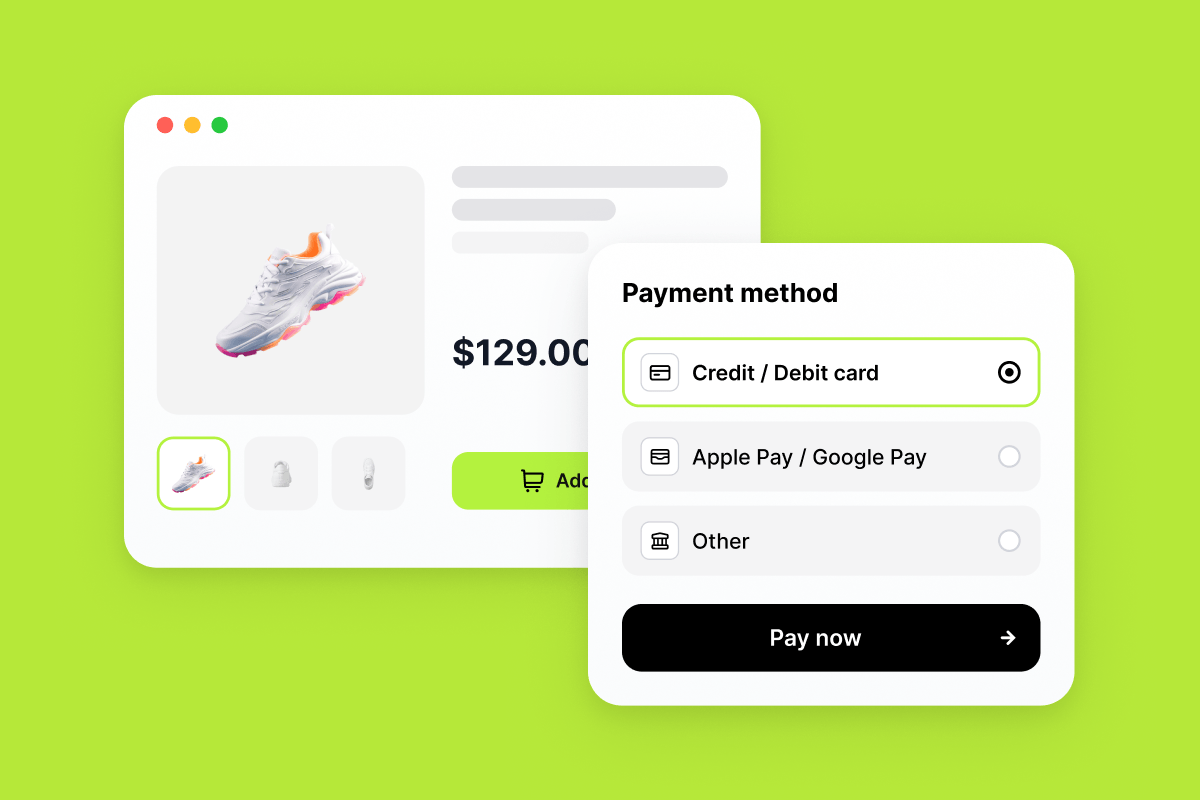
Customers pay with whatever method they trust most, and that varies by market – iDEAL in the Netherlands, BLIK in Poland, PIX in Brazil. Matching local payment preferences increases conversion at signup and reduces drop-off at checkout.
Offer the payment options – cards,, digital wallets - most used in each market you operate in.
Step 6: Communicate clearly with subscribers
Notify customers before each renewal – the charge amount, the billing date, and how to cancel if they choose to. A recognizable billing descriptor on the statement reduces confusion and disputes.
Make cancellation easy to find and complete through the same channel the customer used to subscribe. Clear communication at every billing touchpoint reduces chargebacks and builds the trust that keeps subscribers from cancelling voluntarily.
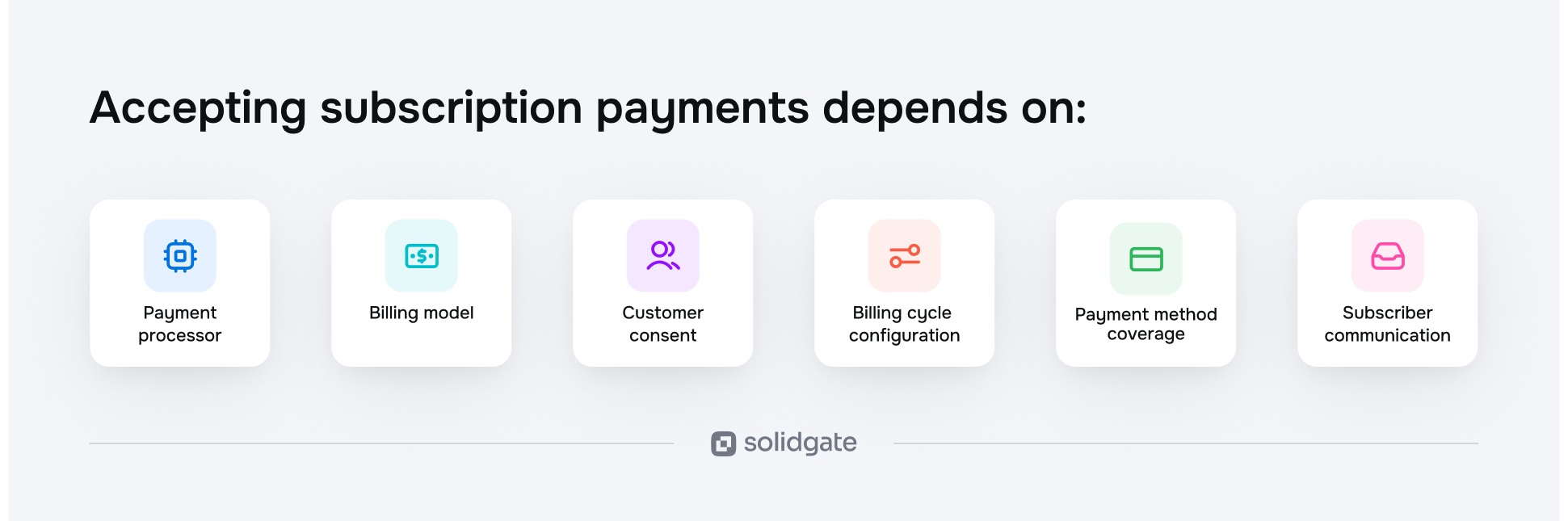
Core insight: Accepting subscription payments depends on getting six decisions right – processor, billing model, customer consent, billing cycle, payment methods, and subscriber communication.
From accepting payments to optimizing them
Once recurring billing is live, the next question is how well it performs. Authorization rates on stored credentials decay over time, renewal failure rates increase as the subscriber base ages, and cross-border approval gaps compound in multi-market setups.
The optimization strategies below help you address these issues.
Keep payment credentials up to date
Stored card credentials go stale – cards get reissued after fraud events, replaced during bank portfolio refreshes, or simply expire. When that happens, the token tied to the old card fails on the next renewal without warning. Two mechanisms address this.
– Visa Token Service (VTS) and Mastercard Digital Enablement Service (MDES) – replaces the raw card number with a scheme-managed token that stays valid through reissuance and replacement events automatically.
handles expiry changes and replacements that network tokenization doesn't cover, refreshing credentials in your vault before the next billing cycle.
reports a 4.6% authorization rate lift on card-not-present transactions using VTS tokens – the issuer trust signal is stronger when the credential is validated at the network level.
Where you store those credentials matters as much as how you maintain them. A provider-agnostic vault stores tokens independently, routing them to whichever provider handles each transaction. When you add or switch a provider, or expand to a new market, stored credentials travel with you – no re-tokenization, no credential re-collection from subscribers, no authorization gap.
MEGOGO reduced subscription churn by approximately 5% after deploying network tokenization and account updater – fewer false failures from expired cards and credential changes led directly to stronger renewal performance.
See the full .
Manage renewals with smart routing and local acquiring
Approval rates on renewals depend not only on which payment methods you offer, but on how you manage your payment setup.
directs each renewal to the provider most likely to approve it for that specific combination of market, card type, and transaction type. Different providers have stronger issuer relationships in different corridors – routing logic that accounts for this improves renewal authorization rates across your subscriber base.
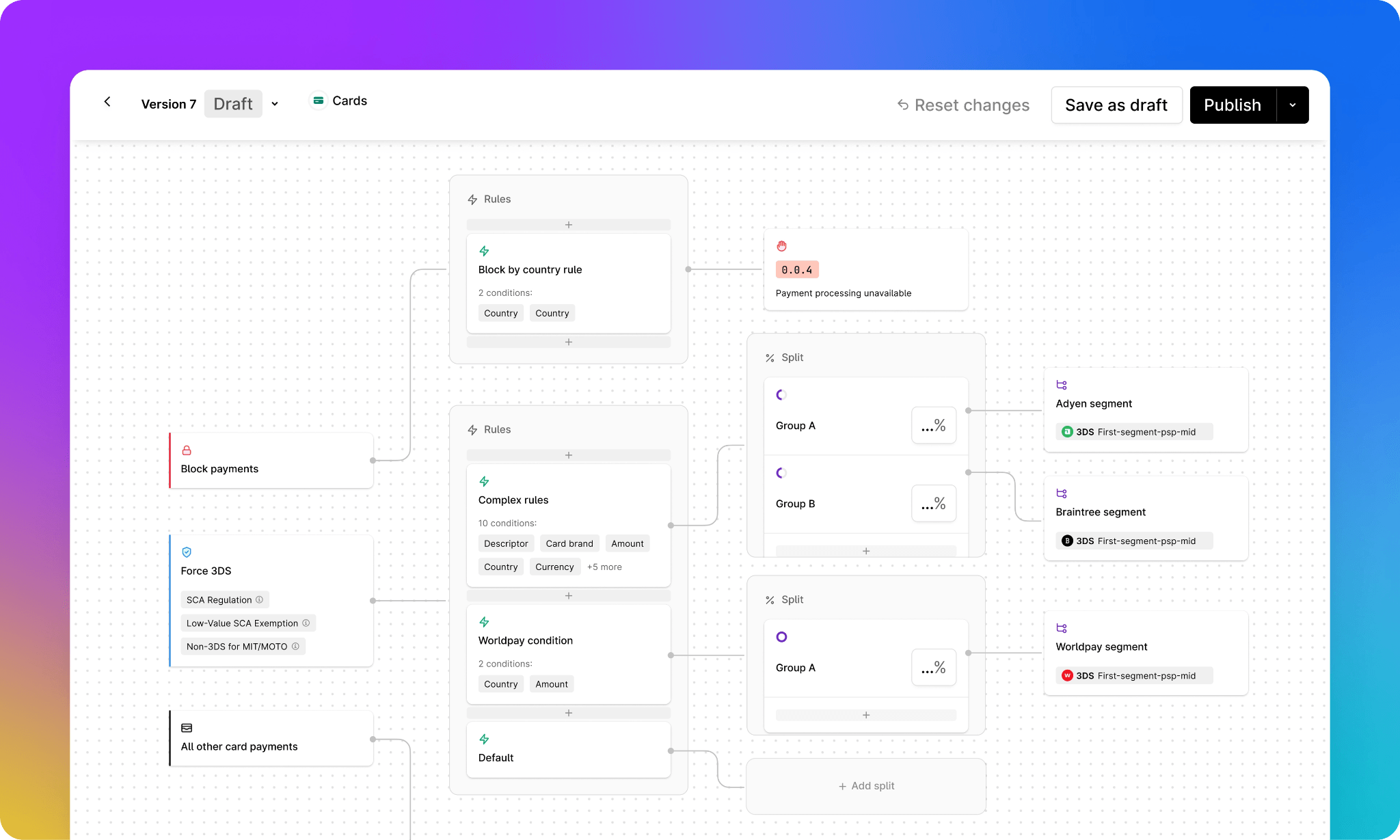
Cross-border subscription businesses need to go further. Local acquiring – through acquirers with an established presence in each market – reduces declines driven by unfamiliar routing and aligns each renewal with local issuer expectations. Without it, approval rate gaps by corridor compound across every billing cycle.
If a provider fails or declines, automatic fallback moves the transaction to the next available one – no manual intervention, no lost renewal.
Ajax Systems achieved 90%+ approval rates across EU markets from day one by combining payment orchestration, intelligent routing, and network tokenization.
See the.
Recover failed payments with smart retry logic
Configure retry logic that accounts for why a , not just that it failed. Insufficient funds, issuer timeouts, and card activity limits are temporary states – the subscriber's intent to remain subscribed is intact, and a retry at the right time recovers the charge without any customer action.
Compared to fixed-schedule retries that treat every failure the same way, smart retry logic factors in:
- Decline type
- Customer's billing history
- Location
- Issuer behavior patterns
Such an approach helps find the optimal retry window per failure.
But not all declines are worth retrying. Hard declines – stolen cards, closed accounts, fraud flags – won't clear on a second attempt through any provider. Continuing to retry against them wastes processing attempts and risks exceeding card network retry limits and potentially triggering fines.
A well-configured retry system identifies hard decline codes and stops immediately, keeping retry attempts focused on failures that are actually recoverable.
Across Solidgate's merchant base, deliver +11.6% subscriber lifetime value improvement.
Core insight: Optimizing recurring payments comes down to three levers – keeping credentials current, recovering failed payments smartly, and managing renewals across providers and markets with routing logic.
Beyond accepting subscription payments
Getting recurring billing live is the foundation – processor, billing model, consent, cycle configuration, payment methods. enables businesses to accept subscription payments and manage the full lifecycle: plans, pricing, trials, invoices, and dunning.
For businesses looking to optimize renewal performance across providers and markets, payment orchestration can add the infrastructure layer that makes it possible.
Solidgate is a with a built in. The billing layer covers the full subscription lifecycle – checkout, free and paid trials, plan upgrades and downgrades, automated invoicing, tax, and failed payment recovery with smart dunning.
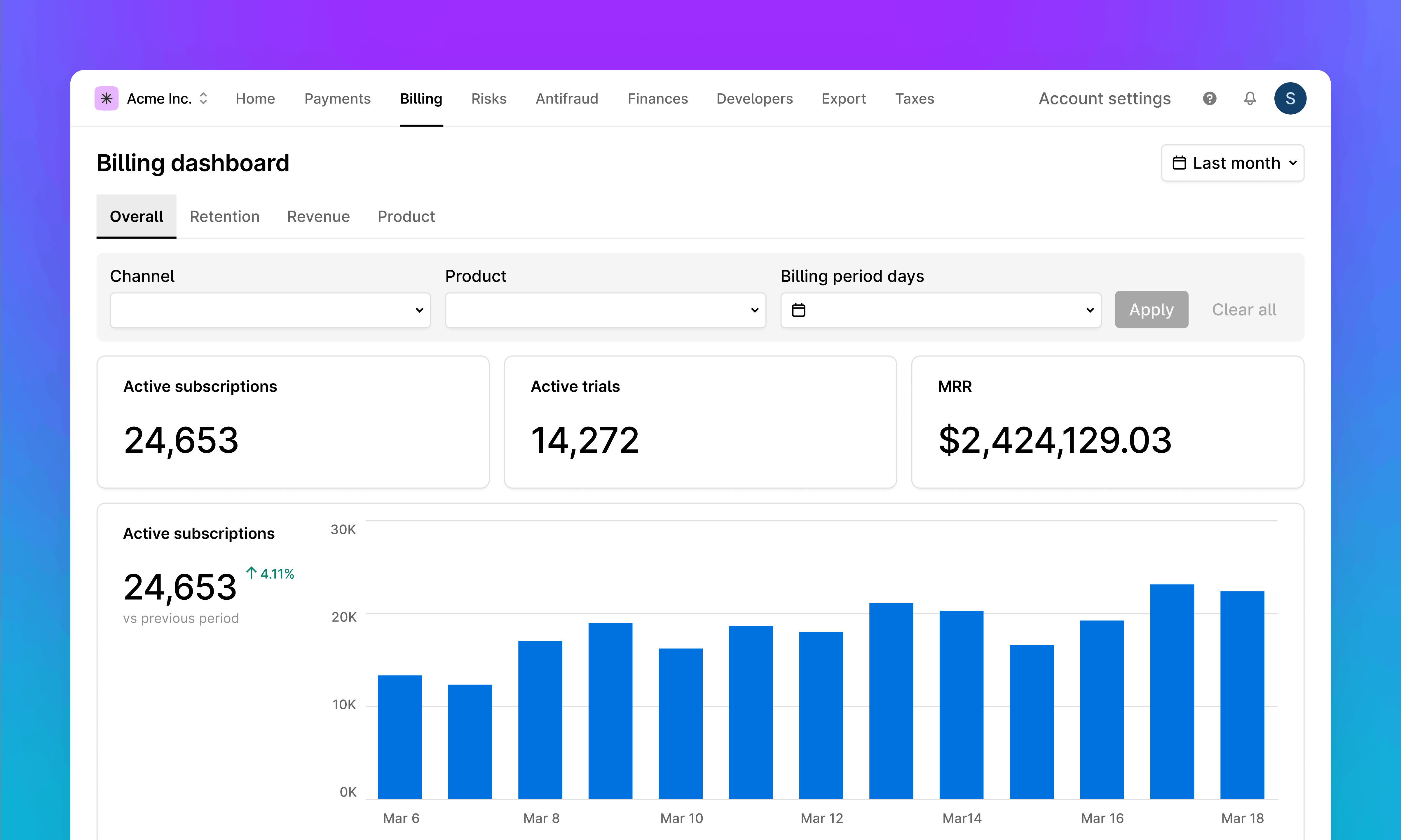
The orchestration layer adds:
- A provider-agnostic vault that keeps credentials portable across your entire payment stack
- Intelligent routing that sends each renewal to the best-performing provider for that market and card type
- Local acquiring for cross-border businesses
- Automatic fallback if a provider fails
That means one integration covers the full stack – billing engine, orchestration layer, payment infrastructure, and access to 100+ providers, acquirers, and payment methods worldwide.
If you're looking to optimize your recurring payment setup, to map your current infrastructure and identify where improvements would have the most impact.

15% higher payment acceptance
See how Headway got there with Solidgate
Frequently asked questions
The best way to accept recurring payments is to get the full setup right from the start. Choose a reliable, PCI DSS compliant processor that supports card tokenization and subscription-specific features – billing cycle configuration, trial management, and automated payment retries. Set up a billing model that fits your product, collect explicit customer consent before the first charge, and offer the payment methods most used in your target markets. Communicate billing terms clearly at signup and provide an accessible cancellation path.
You can accept subscription payments online by integrating a payment processor that supports stored credentials and subscription billing. Set up your billing cycle, collect customer consent before the first charge, and tokenize payment credentials so renewals process automatically. Add the payment methods most used in your target markets to maximize conversion at signup.
Start by identifying why the payment failed. – insufficient funds, timeouts, activity limits – are temporary and recoverable with smart retry logic timed to the failure type. Hard declines – stolen cards, closed accounts, fraud flags – won't clear on a retry, so stop attempts immediately. For credential-related failures, an account updater automatically refreshes expired or replaced card details before the next billing cycle runs.
Before receiving recurring payments on a recurring basis, make sure customers know exactly what they're signing up for – the amount, how often they'll be charged, and how to cancel. Show this clearly at checkout, send a confirmation after signup, and notify them before each renewal. Make cancellation straightforward – customers who can cancel easily are less likely to dispute charges.
Recent articles