Chargeback rebuttal letter
What is a chargeback rebuttal letter?
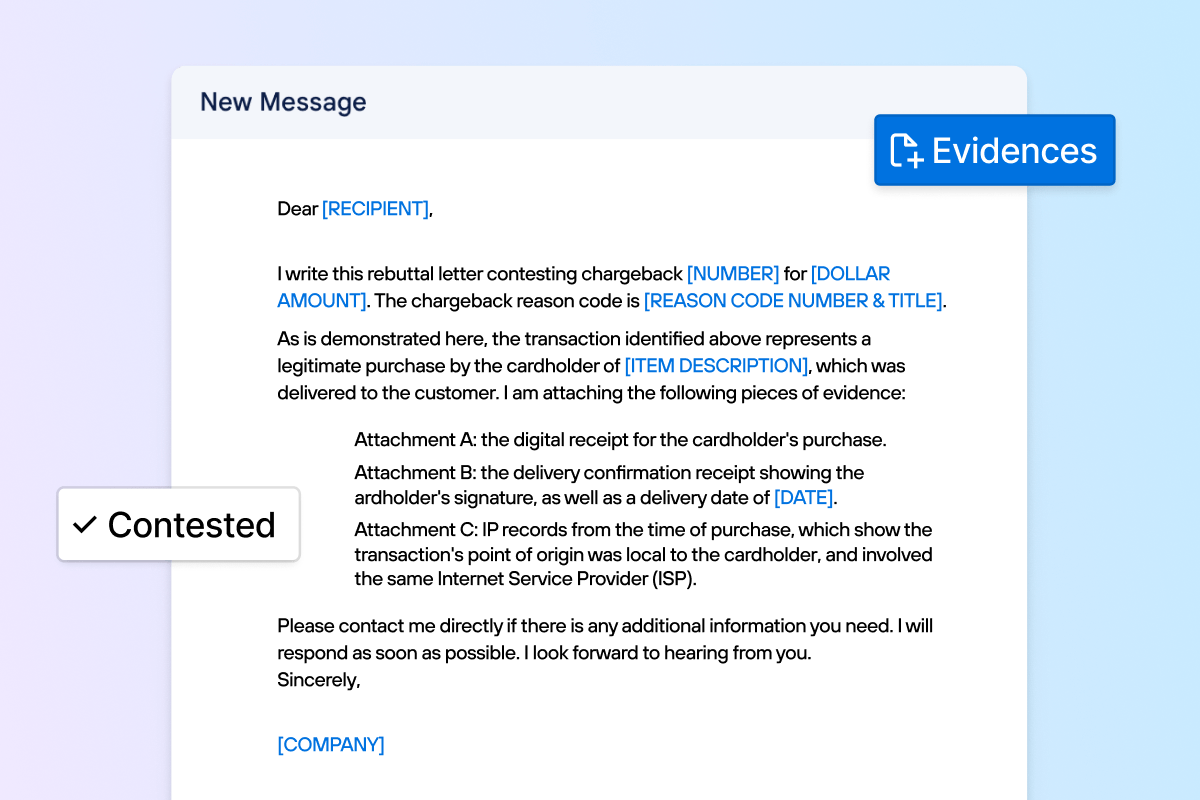
Chargeback rebuttal letter is a succinct, compelling document that merchants submit to contest a . It outlines the merchant's argument against the dispute and summarizes the evidence supporting their case.
The letter persuades the reviewing party, typically the or the , that the original transaction was legitimate and the chargeback was filed in error. It sits at the front of a representment package: the letter frames the argument, and the attached proves it. Without a letter tying that evidence to the specific , a reviewer receives a folder of files and no case.
Key facts
- Also known as: rebuttal letter, dispute response letter, representment letter
- Submitted by: the merchant, through its or PSP
- Reviewed by: the issuer, and the card network if the case escalates to
- Attached to: the representment package holding the supporting evidence
- Structured around: the chargeback reason code, which defines what the issuer will accept as proof
- Filing window: set by the card scheme and varies by reason code – check the current scheme rules or the acquirer agreement
How it works
- The chargeback notification arrives. The issuer files the chargeback with a reason code, and the acquirer forwards the along with the details.
- The reason code sets the argument. Each code carries its own evidence requirements. Visa reason code 13.1, merchandise or services not received, calls for delivery or access records, while a fraud code such as Visa 10.4 calls for proof that the authorized and benefited from the purchase.
- Evidence is gathered. Order records, IP and device data, login or delivery timestamps, prior undisputed transactions from the same account, and the terms the cardholder accepted at checkout.
- The letter is drafted. A short opening states the position, the body answers the reason code point by point and references each exhibit by name, and the closing requests reversal of the chargeback.
- The package is submitted. The acquirer files the letter and the evidence into the scheme's dispute system inside the representment window.
- The issuer rules. Accepting the case produces a and returns the funds. Rejecting it moves the case to a or .
Why it matters
- The letter is the only place the merchant states what the evidence proves. Exhibits filed on their own leave the issuer to infer the argument from raw files.
- Recovery covers the transaction amount. already charged by the acquirer are generally not returned when a representment succeeds, so the letter recovers revenue rather than cost.
- Under scheme monitoring programs, a reversed chargeback generally still counts toward the merchant's , so winning protects revenue and not the ratio.
- A dispute with no response filed before the deadline closes in the cardholder's favor by default, which makes a submitted letter the precondition for any recovery and for a measurable .
Common issues
- Template reuse. A letter written for a fraud code and reused for a "services not received" code answers a question the issuer didn't ask, and gets rejected with the evidence unread.
- Evidence that doesn't match the claim. A screenshot of the published proves the policy exists; it doesn't prove the cardholder saw and accepted it. Timestamped acceptance records do.
- Descriptor mismatch. When the on the statement doesn't match the brand the cardholder recognizes, the dispute often stems from misidentification rather than fraud, and a letter arguing bad faith misreads the case.
- Length. An argument buried in several pages of narrative is harder for a reviewer to match against the exhibits than a one-page statement with numbered references.
- Unsupported claims. Asserting that the cardholder disputed in bad faith carries no weight without records linking the device, IP address, or account login to that cardholder.
- Missed deadlines. Representment windows run from the chargeback date, and a package filed after the window closes is rejected regardless of its strength.