
Ecommerce payment processing: How to optimize for revenue in 2026
Payments 101
Updated 8 Oct 2026
12 min

Anton Tsyslytskyi
Product Manager, Solidgate
Ecommerce payment processing shapes your approval rates, costs, and market reach. Know how to get more out of it as your business grows.
Global ecommerce transaction value reached in 2025.
For scaling businesses, ecommerce payment processing is what determines how much of that growth actually converts to revenue. Decisions around provider selection, routing logic, method coverage, and credential management show up directly in approval rates, processing costs, and checkout conversion. A setup that works in one market often underperforms in another because the payment layer hasn't kept pace.
This guide covers how ecommerce payment processing works, what it costs, and the five practices that keep it optimized as the business scales.
TL;DR
- An online payment clears five steps – authentication, authorization, capture, clearing, and settlement – each handled by a different party; most approval gaps originate at the authorization stage
- Wallets have overtaken cards in ecommerce volume globally; missing the dominant local method in a given market costs more than the global average suggests
- What a merchant pays to process cards is a composite of interchange, network fees, and provider margin – the blended rate most providers quote makes it hard to see which component is rising
- Five levers move payment performance: market-specific method coverage, intelligent routing, keeping stored credentials current, recovering retriable declines, and stopping disputes before they become chargebacks
- Selecting a provider comes down to market and method reach, how much compliance burden they absorb, and how transparent they are on cost – orchestration is worth considering when your stack spans multiple providers or markets
What is ecommerce payment processing?
Ecommerce payment processing is the system that authenticates, authorizes, and settles online transactions. It moves funds from a buyer's account to a merchant's account after a purchase is completed.
Five parties are involved in every transaction, each with a distinct role.
- Cardholder – the buyer making the purchase
- Issuing bank – the financial institution that issued the cardholder's card and holds their funds
- Card network – Visa, Mastercard, or an equivalent scheme; operates the rails connecting issuers and acquirers
- – holds the merchant's account and receives settled funds on their behalf
- Ecommerce – two distinct functions that together handle the technical side of a transaction. The gateway transmits payment data from the merchant's checkout to the processing network; the processor routes the authorization request and manages settlement. Most ecommerce payment providers today combine both functions in a single integration.
Understanding which party controls which layer is what makes approval rate gaps and cost inefficiencies diagnosable.
How ecommerce payment processing works, step by step
An ecommerce payment clears five steps – from checkout and data capture through authentication, authorization, capture and clearing, to settlement. Each step is handled by a different party and produces a specific output the next step depends on.
Step 1 – Checkout and data capture. The customer enters card details at checkout, or authenticates a stored credential through a digital wallet or card-on-file flow. The payment data is transmitted to the merchant's ecommerce payment provider via a secure form or API. For returning customers paying with a stored card, the provider submits a token in place of the raw card number.
Step 2 – Authentication. Transactions in scope for Strong Customer Authentication (SCA) – primarily in Europe under PSD2 – may trigger a challenge. The card network and issuer assess the transaction's risk profile to determine whether to require a challenge or apply a low-risk exemption. adds an identity verification step before the authorization request is submitted to the issuer.
Step 3 – Authorization. The provider routes the authorization request through the card network to the issuing bank. The issuer checks the cardholder's account – available funds, card status, and fraud signals – and returns an approve or decline response.
Step 4 – Capture and clearing. The merchant confirms the transaction and initiates capture – reserving the authorized funds against the cardholder's account. The transaction then enters the clearing cycle: the card network reconciles transaction details between the acquiring bank and the issuing bank, preparing funds for settlement.
For standard ecommerce transactions, capture and clearing follow authorization automatically. For pre-orders or estimated charges, capture may be delayed.
Step 5 – Settlement and payout. The issuing bank transfers settled funds to the acquiring bank. The acquiring bank pays out to the merchant's account – typically within one to three business days.
For merchants processing across multiple providers or currencies, settlement timing and currency fragmentation vary per acquirer.
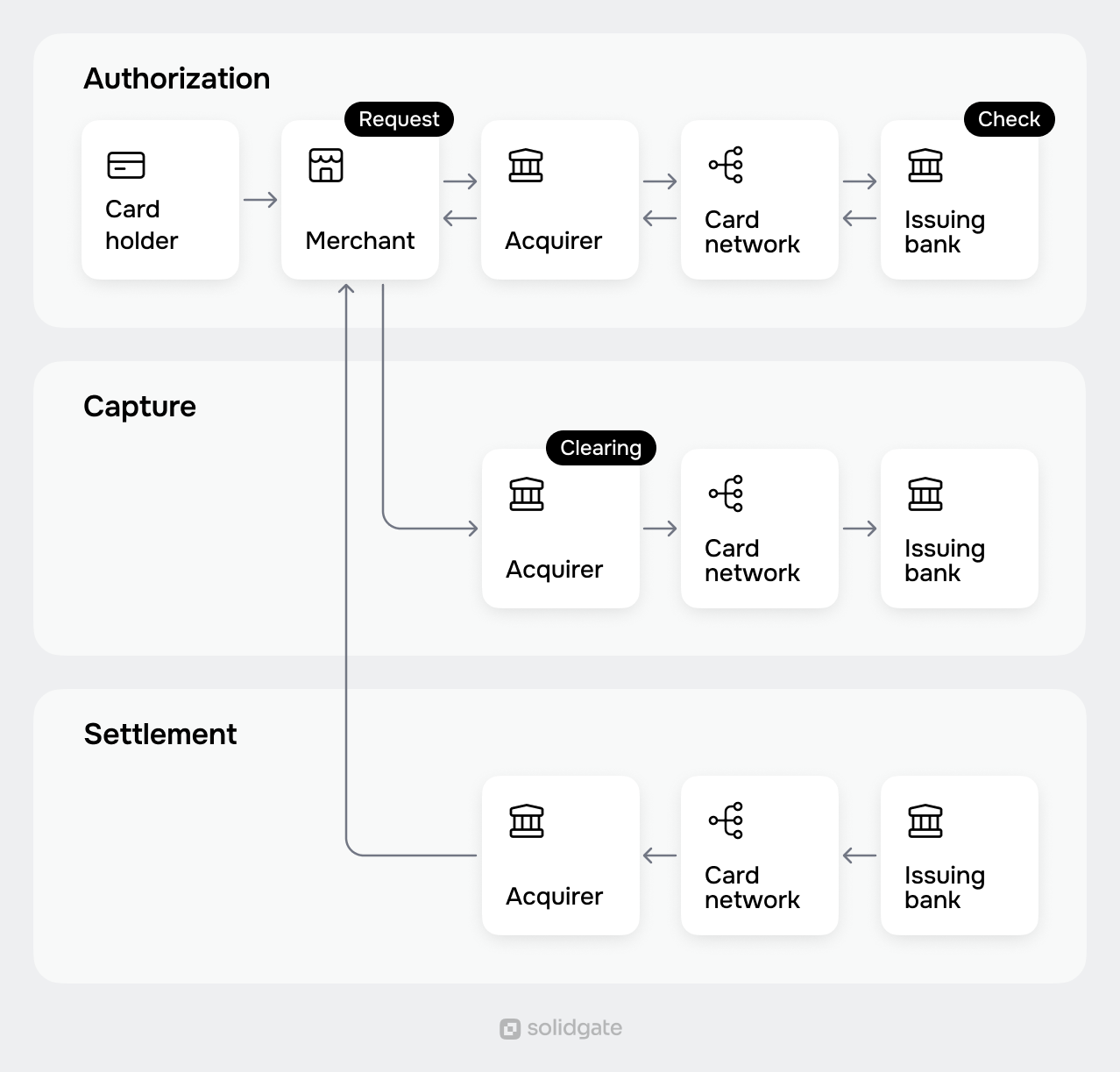
Core insight: Payment processing for ecommerce involves five parties – cardholder, issuing bank, card network, acquiring bank, and PSP – and five sequential steps from checkout to payout. Authorization and authentication are where most approval rate gaps originate; settlement is where cost and timing fragmentation appears for merchants operating across multiple providers or markets.
Ecommerce payment methods worth supporting in 2026
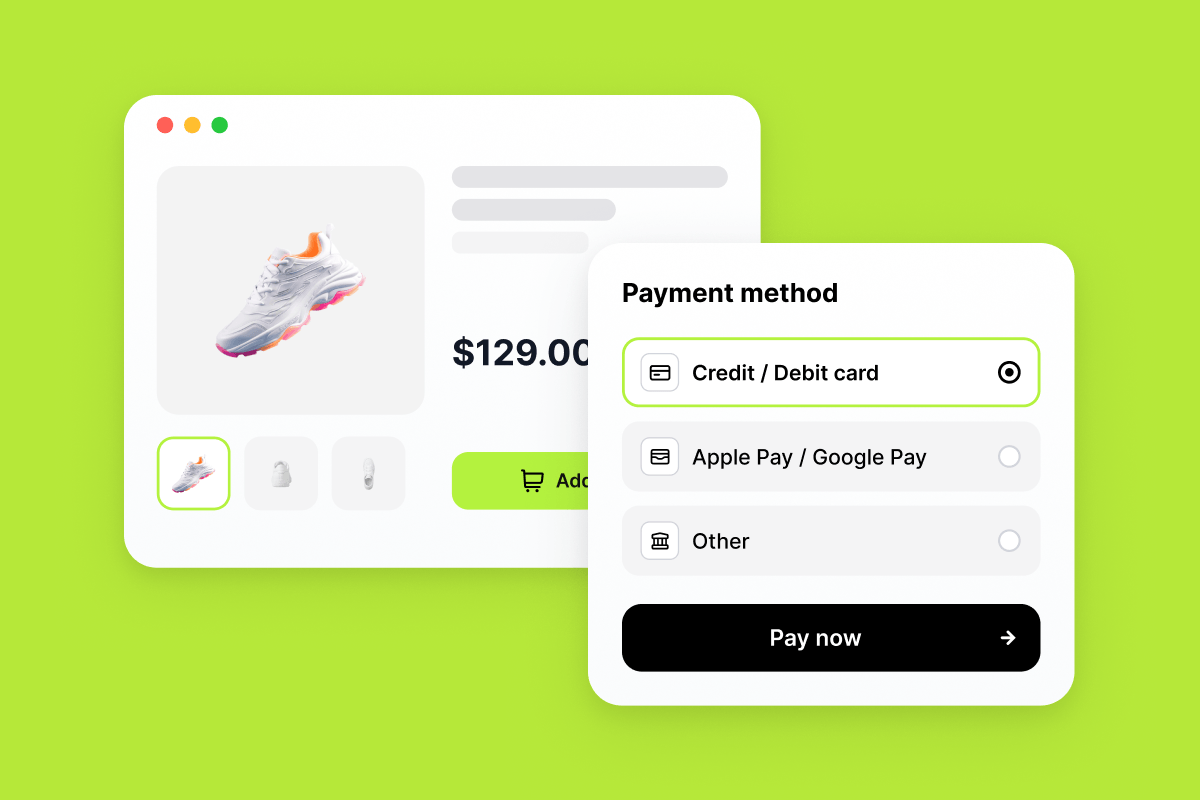
Cards are still the baseline – every ecommerce merchant needs them. But digital wallets now 56% of global ecommerce transaction value versus cards at 31%.
Wallet volume has overtaken card volume in ecommerce, and in many markets a local scheme is the primary payment method entirely. A checkout built around cards alone is structurally incomplete.
Here are some of the common ecommerce worth supporting.
Cards
Cards remain the leading payment method for cross-border ecommerce globally. Visa and Mastercard provide the widest issuer and geographic coverage – accepting them is the baseline for any merchant operating across markets. American Express is worth supporting for merchants with a high-ticket or US-focused customer base, where Amex cardholder spending is concentrated.
Digital wallets and mobile wallets
Mobile wallets – Apple Pay and Google Pay – deliver biometric authentication at checkout. One tap replaces manual card entry, reducing friction on mobile in particular. Both are funded by the card behind them, so no separate acquiring relationship is required.
Account-based wallets like PayPal add buyer protection and reach customers who prefer not to enter card details at a new merchant's checkout. PayPal is accepted globally and widely used across Europe and North America.
Local payment schemes
In many markets, a bank-based or mobile payment scheme is the dominant ecommerce method. Missing it means missing the customers who use it by default. BLIK, iDEAL, PIX, and UPI each represent a large share of online purchase volume in Poland, the Netherlands, Brazil, and India respectively.
BNPL
Buy now, pay later (BNPL) – Klarna, Afterpay, and equivalents – applies where order value and purchase hesitation are both high: fashion, electronics, and home goods. BNPL is most deeply embedded in Germany, Sweden, Norway, the United Kingdom, and Australia, where it functions as a standard checkout option. BNPL ecommerce value is forecast to reach $500 billion by 2030, growing at 13% annually.
The table below maps each method group to common examples and the markets where they are most widely used.
| Method | Examples | Primary markets |
| Cards | Visa, Mastercard, Amex | Global |
| Mobile wallets | Apple Pay, Google Pay | Global, mobile-first |
| Digital wallets | PayPal | Global |
| Local payment schemes | BLIK, iDEAL, PIX, UPI (among the others) | Poland, Netherlands, Brazil, India (respectively) |
| BNPL | Klarna, Afterpay | Germany, Sweden, Norway, United Kingdom, Australia |
Core insight: The ecommerce payment method mix breaks into four groups: cards (global baseline), mobile wallets and digital wallets (frictionless checkout and buyer protection), local payment schemes (market-specific coverage), and BNPL (markets where installment payments are standard). Coverage across all four determines how much addressable demand a checkout can reach.
What ecommerce payment processing costs
Processing costs in ecommerce are made up of three components charged by different parties: interchange, scheme fees, and the provider's markup.
Most providers bundle these into a single blended rate or merchant discount rate (MDR). That simplifies invoicing but makes it harder to identify which component is driving cost changes.
are set by the card networks – Visa and Mastercard – and paid to the issuing bank on each transaction. Interchange is the largest cost component, typically representing 70–90% of the total processing fee.
Interchange varies by card type and geography. A consumer debit card carries a lower rate than a corporate rewards card. Cross-border transactions attract a premium above the domestic rate.
Scheme fees are charged by the card networks themselves for network access, authorization routing, and compliance programs. They are separate from interchange and are often invisible in bundled pricing. The exact fees vary by card brand, volume tier, and which network services the transaction uses.
Provider markup is the PSP's margin added on top of interchange and scheme fees. Pricing models differ on this point. Flat-rate pricing bundles everything into one percentage – simple to forecast but typically more expensive at volume, because high-interchange cards cost the same rate as low-interchange ones. Interchange-plus passes interchange through at cost and adds a fixed markup, giving the merchant visibility into the actual card mix cost.
Beyond the per-transaction rate, merchants may also pay chargeback fees per dispute filed, 3DS authentication fees per call, and on some platforms, refund fees. The specific additional fees depend on the provider and the contract structure.
adds an FX conversion cost on cross-border transactions – either as an explicit markup or embedded in the settlement rate. Merchants expanding internationally should account for both the base processing cost and the FX component when modelling the effective rate per market.
Core insight: Ecommerce payment processing costs have three layers – interchange (paid to the issuing bank), scheme fees (paid to the card network), and the provider's markup – plus potential additional fees for chargebacks, authentication, and FX on cross-border transactions. The effective rate per transaction depends on card mix, geography, and how the provider structures its pricing.
Ecommerce payment processing best practices
Approval rates, checkout conversion, and processing costs each have specific levers the merchant can act on. The five practices below address where revenue most commonly leaks in ecommerce .
Checkout localization per market
Checkout conversion depends on offering the payment methods your customers already use. Industry data shows that of shoppers abandon checkout when their preferred method is absent.
In a market where one local scheme dominates, this percentage goes even higher. A BLIK-first shopper in Poland facing only card fields at checkout is unlikely to complete the purchase at all.
The starting point is knowing which your target markets use and ensuring your checkout supports them.
After having added BLIK to their Polish checkout, Bazhane, a Ukrainian fashion brand, saw a 10% conversion lift.
See the full.
Intelligent routing for higher approval rates
A static routing setup sends every transaction through the same path regardless of card brand, market, or transaction characteristics. When that path underperforms on a specific corridor – a card brand the provider handles poorly, or a market where approval rates are lower – there is no way to reroute and the declines accumulate.
evaluates each transaction by BIN, card brand, country, and cost – then selects the best-performing provider path. When the primary route fails, it switches to an alternative automatically.
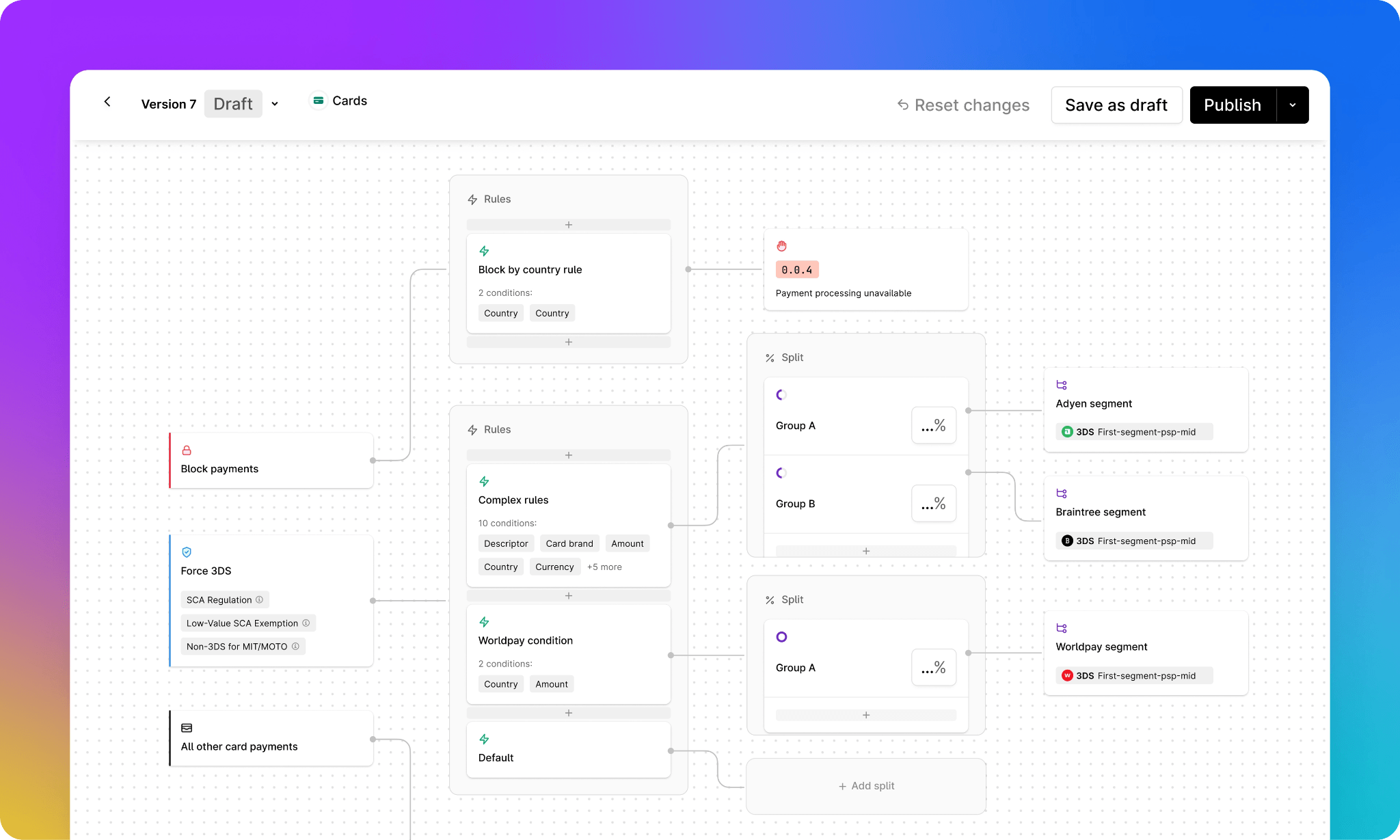
The result is a higher approval rate on corridors where the primary provider underperforms, and uninterrupted processing when a provider degrades. Solidgate data shows merchants using intelligent routing across multiple providers see up to 7% revenue uplift.
Smart retries for failed payment recovery
Not every failed authorization is a lost payment. Soft declines – temporary holds, routing mismatches, transient issuer-side issues – are retriable. Hard declines – invalid card numbers, permanent fraud blocks, stolen card flags – are terminal. The distinction between determines whether a retry is worth attempting and on what schedule.
Retrying immediately after a soft decline often triggers a further decline and, in recurring contexts, risks Merchant Advice Code (MAC) violations and scheme penalties.
read the decline code, classify the decline type, and schedule compliant retry attempts based on issuer behavior patterns, on a compliant schedule. The outcome is a higher recovery rate on retriable failures without accumulating scheme penalty exposure.
Network tokenization and account updater
reports a 4.6% lift in authorization rates for CNP transactions using network tokens versus raw PANs. reports a 2.1% improvement on CNP first-attempt transactions. Both figures reflect the same underlying mechanism: issuers trust tokenized credentials more than raw card numbers.
, issued by Visa (VTS) and Mastercard (MDES), replaces the static PAN with a dynamic token tied to the cardholder's digital account. The card network validates the token before passing the authorization to the issuer, which reduces the fraud scoring burden and improves approval rates. Because the token is linked to the account rather than a specific card number, it stays valid when the underlying card is reissued – the network updates the token automatically.
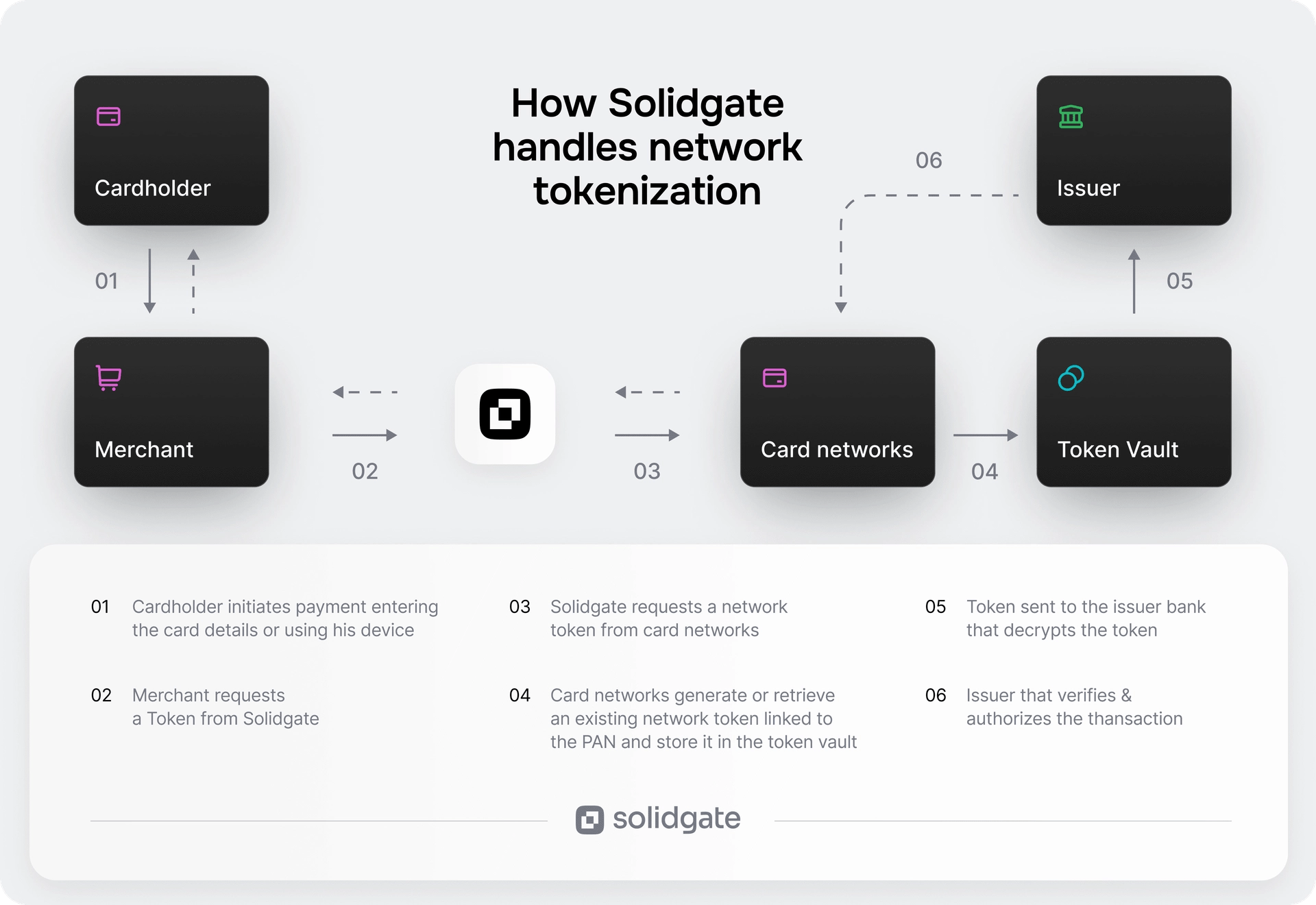
covers the gap for stored raw PANs. When a card expires or is replaced, the account updater pushes the updated credentials to the merchant's provider without any action from the cardholder.
Together, network tokenization and account updater keep card credentials current between billing cycles, cutting failed payments from expired or replaced cards.
MEGOGO reduced subscription churn by approximately 5% after implementing both across their renewal flows.
See the full .
For merchants operating across multiple providers, token portability matters, too. Credentials stored with a single PSP cannot be moved when the merchant adds or switches a provider – customers must re-enter their card details. A provider-agnostic token vault stores credentials independently of any acquirer, making them available to any connected provider without re-collection.
Chargeback prevention
A chargeback is a cardholder dispute that escalates to a formal filing through the card network. The merchant pays the dispute fee regardless of outcome, and the transaction counts against their chargeback ratio.
Card-not-present fraud is the primary driver in ecommerce – the US 42% of global card fraud losses at roughly 25% of global card volume.
starts with intercepting disputes before they escalate – prevention alerts (Verifi, Ethoca, or RDR) notify the merchant of a cardholder complaint early enough to refund or resolve it directly, avoiding the fee and the ratio impact. For disputes that do reach the chargeback stage, representment with structured evidence recovers winnable cases.
Merchants with elevated dispute volumes risk being placed in card network – a threshold worth tracking before it becomes a program risk.
Core insight: Effective ecommerce payment processing solutions address five distinct levers – checkout localization per market, intelligent routing, network tokenization and account updater for stored credentials, smart retries for soft declines, and chargeback prevention.
How to choose an ecommerce payment provider
Choosing a payment provider for ecommerce comes down to three criteria: geographic and method coverage, integration and compliance, and cost transparency.
Geographic and method coverage
The provider's coverage determines which markets the merchant can operate in and which payment methods they can offer. The key question is how many markets and methods activate from a single integration. A provider with strong domestic coverage but limited international rails forces a per-country integration cycle as the merchant expands – each new market requires a new contract or a separate build.
For merchants expanding cross-border, access to local acquiring rails reduces the cost of processing in each market by treating international transactions as domestic from the issuer's perspective.
Integration and compliance
Technical integration and compliance go hand in hand. The integration side covers API quality, documentation, and how much engineering effort the connection requires. The compliance side covers who carries PCI DSS scope, 3DS and SCA handling, and fraud tooling. Providers that handle both reduce time to go live and ongoing overhead.
Cost transparency
Most providers bundle interchange, scheme fees, and their own markup into a single blended rate. Knowing what is inside the effective rate – and what additional fees apply for chargebacks, authentication, and cross-border volume – is the starting point for cost control.
| Criterion | What to evaluate |
| Geographic and method coverage | How many markets and payment methods activate from a single integration |
| Integration and compliance | How quickly you can go live and how much of the PCI DSS, 3DS, and SCA burden the provider absorbs |
| Cost transparency | What's inside the effective rate, and what additional fees apply for chargebacks, authentication, and cross-border volume |
For merchants running multiple providers or scaling across many markets, orchestration is worth considering. A platform sits above existing providers and routes transactions across them from one integration.
Nova Post launched across 15+ markets through a single integration – with PayPal, BLIK, iDEAL, and Open Banking available from day one – and achieved 95%+ approval rates from launch.
See the .
Core insight: Evaluate ecommerce payment providers on three criteria: geographic and method coverage, integration and compliance, and cost transparency.
Process ecommerce payments with Solidgate
Ecommerce payment performance comes down to infrastructure decisions – method coverage per market, how transactions are routed, how stored credentials are kept current, and how disputes are handled before they become chargebacks. Each gap has a measurable cost, and each has a fix.
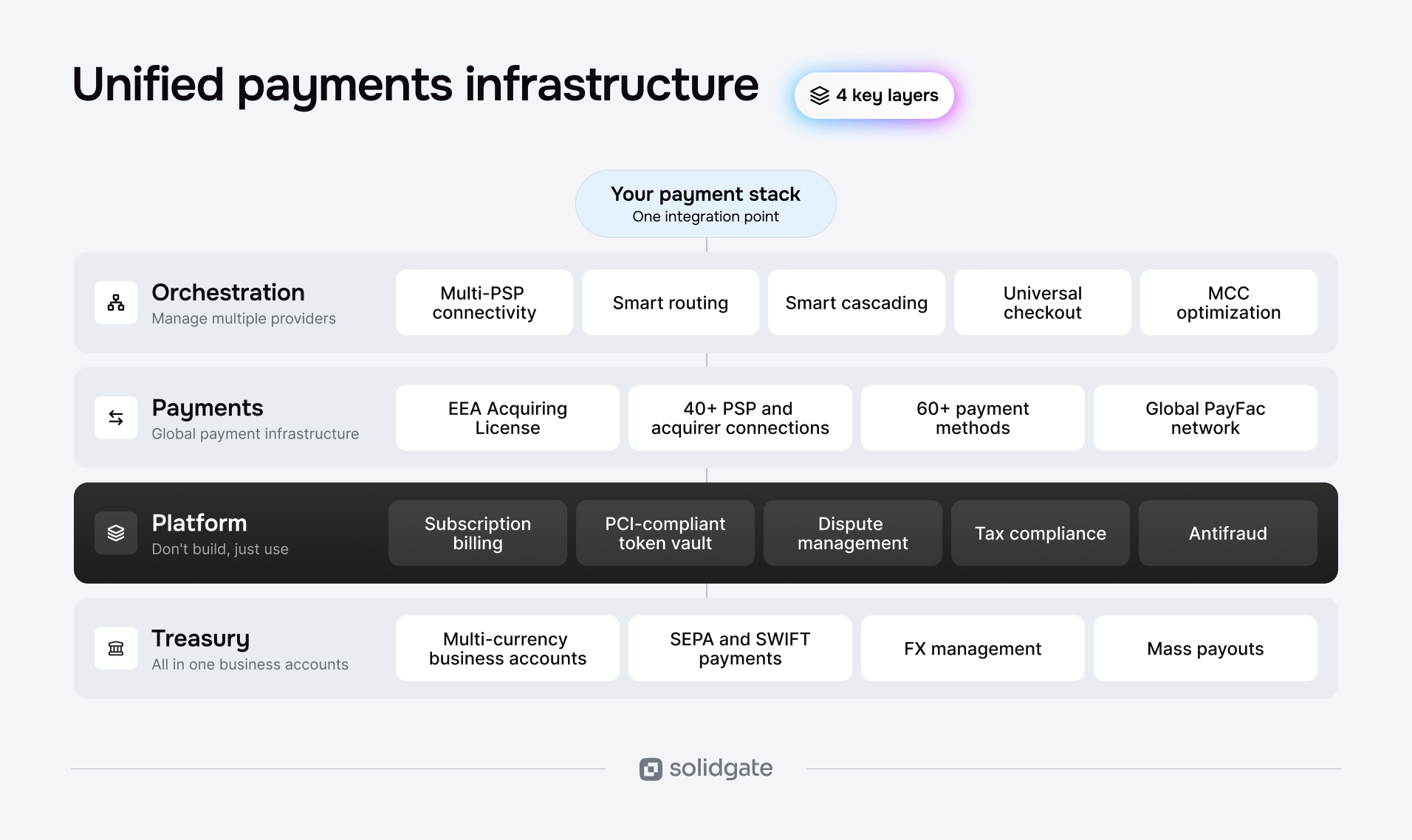
Solidgate is a payment orchestration platform that helps scale globally. One integration gives merchants access to:
- 100+ PSPs, acquirers, and payment methods
- Intelligent routing with automatic failover
- A provider-agnostic token vault with network tokenization and account updater
- Dispute recovery tools and more
If your current setup has gaps – in coverage or approval rates – to map where the friction is and what it's costing you.

+10% checkout conversion
See how Bazhane localized its checkout market by market
Frequently asked questions
Ecommerce payment processing is the chain of steps and parties that authorizes and settles every online transaction. It involves five parties – cardholder, issuing bank, card network, acquiring bank, and PSP – and five sequential steps: checkout and data capture, authentication, authorization, capture and clearing, and settlement.
A payment clears five steps: the customer submits payment details, authentication verifies identity where required, the issuing bank approves or declines the authorization, the merchant captures the transaction, and funds settle to the merchant's account within one to three business days.
A payment gateway is the technical component that securely transmits card data from the merchant's checkout to the payment processor. It sits between the merchant and the acquiring side of the transaction. In practice, many PSPs bundle gateway functionality into a single integration, so the terms are often used interchangeably.
Processing costs have three layers: interchange (paid to the issuing bank, typically 70–90% of the total fee), scheme fees (paid to the card network), and the provider's markup. Most providers bundle these into a blended rate. Additional fees can apply for chargebacks, 3DS authentication calls, and cross-border transactions.
There is no single best option – it depends on the markets you operate in, the payment methods your customers use, and your transaction volume. Evaluate providers on geographic coverage, integration and compliance handling, and cost transparency. For multi-market or multi-provider setups, a payment orchestration platform is worth considering.
Local payment methods are country-specific or region-specific ways to pay that are dominant in particular markets – BLIK in Poland, iDEAL in the Netherlands, PIX in Brazil, UPI in India. Supporting them is essential for merchants selling in those markets, as card-only checkouts exclude the customers who rely on them by default. Check the most common in our guide.
through three main levers: intelligent routing (directing each transaction to the provider most likely to approve it), network tokenization for stored credentials, and smart retries for soft declines. Authorization rates at well-optimized merchants typically run 92–95%.
Yes, when the infrastructure is correctly implemented. PCI DSS compliance governs how card data is stored and transmitted. Network tokenization replaces raw card numbers with dynamic tokens that are useless outside a specific merchant-network relationship. 3D Secure adds identity verification for high-risk transactions. Most providers handle these requirements on the merchant's behalf.
B2B transactions typically involve higher order values, payment terms, invoice-based billing, and a preference for bank transfers or ACH over cards. Interchange rates are higher for corporate cards. Fraud patterns differ from B2C, and reconciliation is more complex. B2B merchants often need separate payment infrastructure from their B2C checkout stack.