What is a payment network? A guide to types, mechanics, and costs
Payments 101
Updated 8 Oct 2026
12 min

Anton Tsyslytskyi
Product Manager, Solidgate
Every card swipe, bank transfer, and digital wallet payment runs on a network. Which one you're on – and how well you're connected to it – determines your costs and approval rates.
The card your customer uses at checkout triggers a chain of approvals, validations, and fund transfers across infrastructure most merchants never see – the payment network. Which network handles the transaction, and how your stack connects to it, determines your interchange costs, settlement timing, geographic reach, and approval rates.
257.5 billion transactions on its network in 2025. Add Mastercard, ACH, SEPA, RTP, and the alternative payment methods your customers use across markets, and the picture gets complex fast.
This article explains what payment networks are, how they work, and what the differences between them mean for your business, your costs, and approval rates.
TL;DR
- A payment network is the infrastructure layer that connects issuers and acquirers and sets the rules under which funds move between them.
- Every transaction moves through three phases: authorization (seconds), capture and clearing, and settlement (1–3 business days on card networks; seconds on real-time networks).
- Payment networks fall into four types – card networks, bank transfer networks, real-time payment networks, and local payment schemes – each with different cost structures, settlement timelines, and geographic reach.
- The network fixes your interchange costs and approval rate baseline. Tokenization improves the trust signal issuers receive. Account Updater keeps credentials current through card changes. Intelligent routing sends each transaction to the acquirer most likely to approve it.
What is a payment network?
A payment network is the infrastructure layer that connects the parties in a transaction and sets the rules under which funds move between them.
In a card transaction, for example, the network receives the authorization request from the acquirer, routes it to the issuing bank, applies its own fraud rules and standards, and returns an approval or decline. It also sets the interchange schedule – the fee structure that flows between banks on every transaction.
Payment networks are sometimes called card networks when referring specifically to Visa, Mastercard, American Express, and Discover. But the term is broader, covering:
- Card networks like Visa and Mastercard
- Bank transfer networks like ACH and SEPA
- Real-time payment networks like FedNow and RTP
- The infrastructure behind digital wallets and
Networks also manage security standards, chargeback rules, dispute resolution frameworks, and compliance requirements like PCI DSS and 3D Secure. Merchants don't interact with the network directly – they interact through acquirers and (PSP) that hold the network relationships on their behalf.
Payment network vs. payment processor vs. payment gateway
The network's role is distinct from the processor and the gateway.
The payment network sets the rules and provides the rail. It publishes , operating regulations, and fraud standards – and owns the routing logic that connects issuing and acquiring banks. It doesn't touch the merchant directly and doesn't process individual transactions.
The payment processor executes transactions on the network's rail. It receives transaction data, routes it to the correct network, manages the authorization response, and handles settlement on the merchant's behalf. Some payment processors have direct network connections; others route through intermediaries.
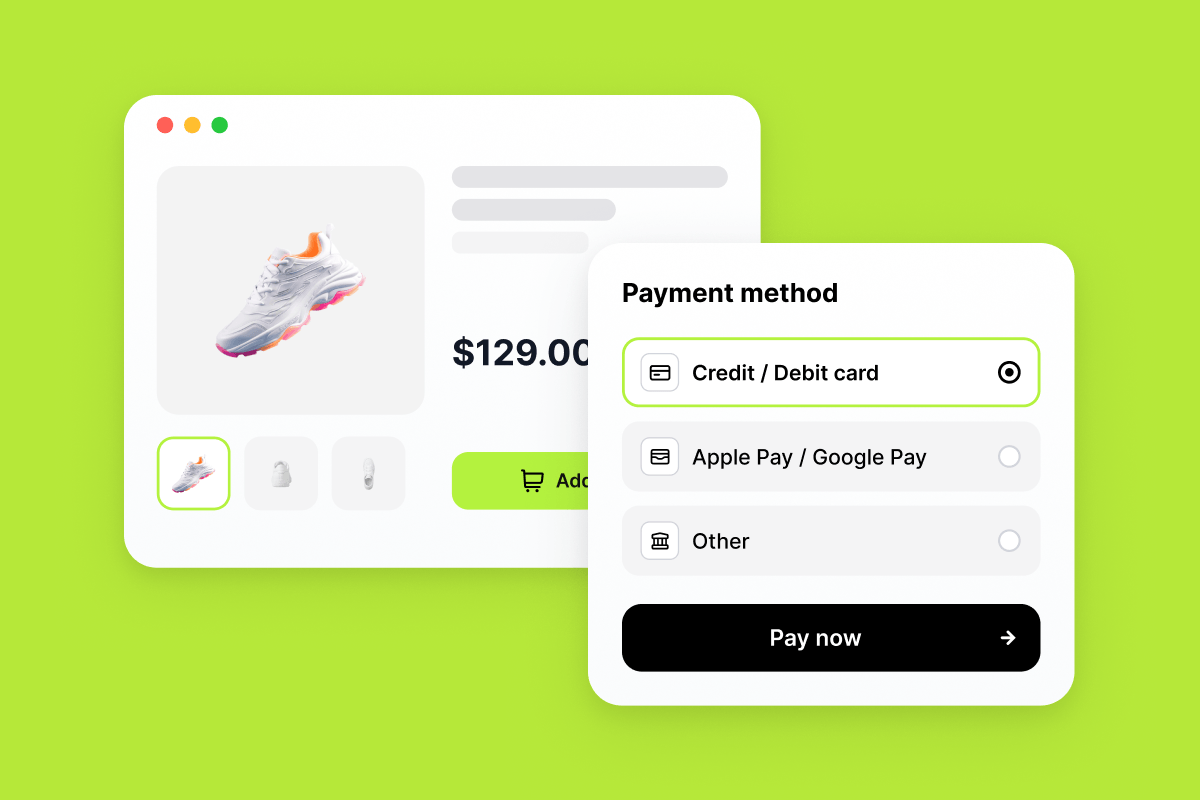
The payment gateway is the entry point. It captures payment data at checkout, encrypts it, and passes it to the processor. In a physical store, the card terminal is the gateway. Online, it's the software handling the payment form.
The gateway doesn't route to networks or manage settlement – it captures, encrypts, and hands off. Many providers bundle gateway and processing into one product, which is why merchants treat them as the same thing.
See our comparison guide on .
| Network | Processor | Gateway | |
| Role | Sets the rules and provides the rail | Executes transactions on that rail | Captures and encrypts payment data |
| Controls | Interchange rates, fraud standards, operating rules | Transaction routing, settlement mechanics | Checkout data capture and transmission |
| Examples | Visa, Mastercard, ACH, SEPA | PSPs that include processing (e.g. Stripe, Adyen) | Checkout form, card terminal |
When something goes wrong – an authorization failure, a cost spike, a settlement delay – the layer where the problem originates determines who you engage to fix it. A network-level block requires scheme or acquirer engagement. A processor error is between the merchant and their PSP. A gateway failure is a technical integration issue. Conflating the three means merchants often chase the wrong fix.
Core insight: A payment processing network, a processor, and a gateway are three different layers with three different owners. When something breaks, the layer where the problem sits determines who you call – and merchants who conflate the three consistently engage the wrong party first.
Types of payment networks
Payment networks fall into four categories. Each moves money differently, settles on a different timeline, and carries a different cost structure.
Card networks
are the most widely used payment networks for digital commerce. Visa, Mastercard, American Express, and Discover are the four major US-origin networks. Outside the US, UnionPay dominates in China with growing international acceptance; JCB leads in Japan; Interac handles most Canadian debit volume.
Card networks fall into two structural models – open-loop and closed-loop – which determine who controls both ends of the transaction and what that means for cost and acceptance.
Bank transfer networks
Bank transfer networks move funds directly between financial institutions without a card as the instrument. The customer authorizes a transfer from their bank account – no card number, no BIN, no issuing bank in the card sense. The cost structure is different too: no interchange, because there's no issuing bank to compensate.
Some of the major bank transfer networks:
- ACH (Automated Clearing House) – the backbone of US electronic payments. Handles direct deposit, payroll, and recurring bill payments. A batch system: transactions accumulate and settle in windows. Standard ACH settles in one to two business days; Same Day ACH settles within the same business day.
- SEPA (Single Euro Payments Area) – the equivalent infrastructure across EU member states. Allows euro-denominated bank transfers across borders with standardized timelines. SEPA Credit Transfer is sender-initiated; SEPA Direct Debit is merchant-initiated with prior customer authorization – the foundation of subscription billing across Europe.
- Fedwire and CHIPS (Federal Reserve Wire Network and Clearing House Interbank Payments System) – used for high-value, time-critical transfers. Fedwire is operated by the Federal Reserve; CHIPS is the largest private USD clearing system in the world. Both provide same-day finality and are used for interbank settlements and large corporate payments.
Real-time payment networks
Real-time payment networks settle transactions in seconds, around the clock, every day of the year. Some of the major real-time payment networks:
- RTP (Real-Time Payments) – the first real-time network in the US, operational since 2017.
- FedNow (US, Federal Reserve) – launched in 2023, expanding financial institution coverage across the US.
- PIX (Brazil) – launched in 2020, now of Brazil's adult population, including 60 million consumers without a credit card.
- UPI (India) – of India's digital payments and nearly 49% of global real-time payment volume.
- SEPA Instant (EU) – the real-time extension of SEPA, settling in seconds across participating EU banks.
Real-time networks carry a different risk profile than card networks. There is typically no chargeback mechanism – settlement is final, which reduces dispute costs for merchants but shifts fraud liability. If a fraudulent transaction settles on a real-time network, recovery depends on banks cooperating voluntarily rather than a formal chargeback process.
Local payment schemes
Local payment schemes are networks built for specific markets that operate outside international card rails. They're not alternative in any meaningful sense – in their home markets, they're often the primary payment method. A merchant entering the Netherlands without iDEAL, or Poland without BLIK, is often missing the default.
Some of the major local payment schemes by market:
- iDEAL (Netherlands) – real-time bank-to-merchant transfers, accounts for the majority of Dutch online transactions.
- BLIK (Poland) – real-time mobile payment network, covers the majority of Polish e-commerce.
- Bizum (Spain) – real-time bank transfer network, growing rapidly among younger consumers.
- Interac (Canada) – handles most Canadian debit volume.
- PayNow (Singapore) – government-backed real-time transfer network.
Some networks span multiple categories. PIX is both a real-time network and a local payment scheme – it operates its own infrastructure and is specific to Brazil. UPI is the same: real-time rails built and operated for the Indian market. Where a network sits depends on which dimension matters most for the decision at hand – settlement speed or geographic scope.
Core insight: Payment networks fall into four types – card networks, bank transfer networks, real-time payment networks, and local payment schemes – each with different cost structures, settlement timelines, and geographic reach.
Closed loop vs. open loop payments
The open vs. closed loop distinction describes the architecture of who controls both ends of a transaction, and it has direct implications for cost, acceptance, data access, and merchant economics.
An open-loop payment network connects independent institutions through shared infrastructure. The cardholder's bank and the merchant's bank are separate entities, linked by the network's rules and routing. Visa and Mastercard are open-loop card networks.
ACH and SEPA are open-loop bank transfer networks – any qualifying bank can participate on either end. The defining characteristic is that funds cross institutional boundaries, which means intermediaries are involved, fees are shared, and data is distributed across the parties.
A closed-loop payment network keeps both ends of the transaction within the same entity or ecosystem. American Express operates as both the network and the issuer – it issues cards directly to cardholders and processes transactions through its own infrastructure, giving it end-to-end visibility across the full transaction lifecycle. Discover operates on the same model.
PayPal balance-to-balance transfers are closed-loop: both parties hold PayPal accounts, and the fund movement happens entirely within PayPal's system, without touching any external bank or card network. Branded BNPL rails that settle directly between the provider and enrolled merchants follow the same principle.
| Feature | Closed-loop | Open-loop |
| Network reach | Restricted to a specific merchant, platform, or ecosystem | Global or regional acceptance across any enrolled merchant |
| Intermediaries | No external banks or card issuers – funds move within one system | Multiple parties: issuing bank, acquiring bank, payment network |
| Transaction fees | Lower – no third-party interchange or network fees | Higher – interchange plus scheme fees apply |
| Data visibility | Deep behavioral data available directly to the operator | Limited merchant-level data – controlled by card issuers and networks |
| Customer experience | Requires a dedicated account, wallet, or prepaid balance | Uses everyday cards or digital wallets with no pre-loading |
| Common examples | American Express, Discover, PayPal balance transfers, branded BNPL rails | Visa, Mastercard, SEPA, ACH, Apple Pay over a card network |
For merchants, most payment stacks are a mix of both.
Core insight: The open vs. closed loop distinction determines who sits between the payer and the payee – and therefore who captures the transaction economics, who holds the data, and what the merchant pays for access.
How do payment networks work?
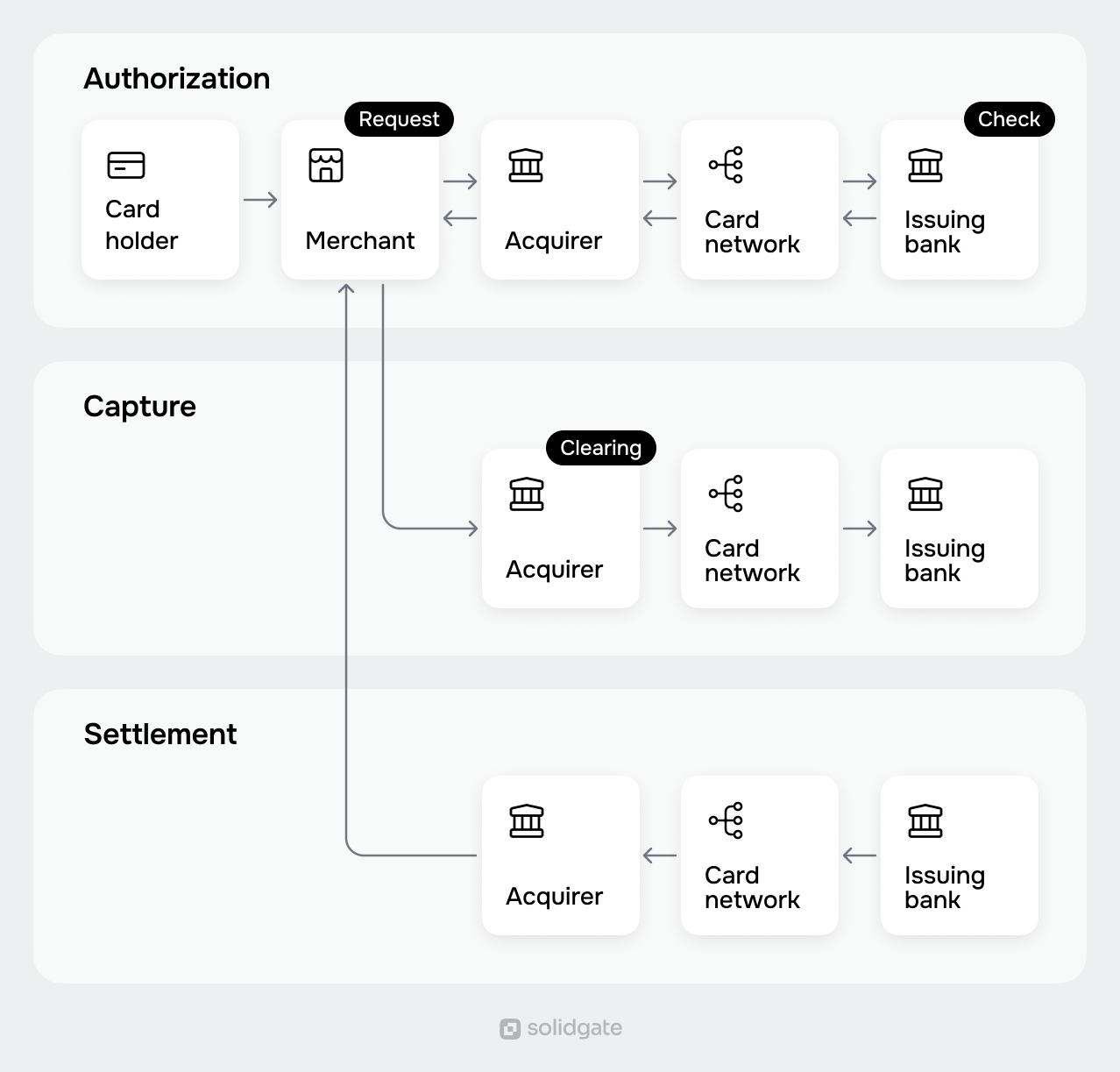
Every transaction on a payment network moves through three phases: authorization, capture and clearing, and settlement. The mechanics differ by network type, but the logic is the same – the network validates the transaction, reconciles obligations, and coordinates the movement of funds.
Authorization
is the network's first gate. The payer's institution checks whether the account is in good standing, funds are available, and the transaction looks legitimate. The network runs parallel checks – validating credentials and screening against its own fraud models. A response comes back in seconds.
The authorization signal differs by network type. On card networks, the issuer returns an approval or. On ACH and SEPA, there's no real-time approval – the merchant learns of a failure only if the bank returns the transaction within the allowed window. On real-time networks like PIX and UPI, authorization and settlement typically happen simultaneously.
An approval is not a guarantee of funds – it confirms the payer's institution is willing to pay. Settlement is a separate event.
Capture and clearing
Capture is when the merchant instructs the acquirer to collect the authorized funds and submit them for clearing. On most e-commerce flows, authorization and capture happen simultaneously. On some transaction types – hotel bookings, car rentals, marketplace payouts – capture is delayed. Capture timing can affect interchange costs: some acquirers apply different rates depending on how quickly capture follows authorization.
After capture, clearing begins. This is the phase – the network calculates who owes what to whom across all transactions in a given period. On card networks and ACH, transactions are batched and positions are netted across the day's volume. On real-time networks, each transaction clears and settles individually and immediately.
Settlement
Settlement is the actual movement of money. The issuing bank debits the cardholder's account; the acquiring bank credits the merchant's account, minus interchange and scheme fees. The timeline depends on the network:
- Card networks – 1–3 business days
- ACH and SEPA – 1–2 business days
- Real-time networks (PIX, UPI, FedNow, RTP) – seconds, irrevocable
Real-time settlement cannot be reversed. Card and ACH transactions can – via chargebacks or ACH returns. On card networks, interchange and scheme fees are deducted at settlement – what the merchant receives is the transaction amount minus the network's costs.
Core insight: Authorization confirms willingness to pay. Capture converts that commitment into a charge. Settlement confirms payment received. The gap between the three – in time, cost, and reversibility – is where most payment performance problems originate.
How payment networks affect your costs and approval rates
A payment network affects costs directly through interchange, and approval rates indirectly through the signals it passes to the issuer.
Setting your cost floor
Every card transaction carries two network-derived costs: interchange and scheme fees. is the fee the acquiring bank pays the issuing bank on each transaction – set by the payment card network and published in their interchange schedules. Scheme fees are charged by the network itself for access to its infrastructure.
Neither is negotiable. But both vary – and understanding what drives that variation is the first lever a merchant has on cost.
Interchange varies by:
- Card type – a premium rewards card carries higher interchange than a standard debit card
- Transaction type – card-not-present transactions carry higher interchange than card-present, because fraud risk is statistically higher online
- Geography – cross-border transactions carry additional fees when the issuing bank's country differs from the merchant's country
- Merchant category – some categories (utilities, government, education) qualify for reduced interchange rates
Scheme fees sit on top of interchange and are set by each card network independently. They're less visible than interchange but compound at scale.
Defining your approval rate baseline
How the network validates a transaction directly affects whether the issuer approves it.
is the most direct lever here. Replacing a raw card number with a network-issued token – specific to a device, merchant, or channel – sends a richer trust signal to the issuer. Tokenized transactions carry device fingerprint data and cryptographic validation that raw card numbers don't. Issuers approve them more often.
Solidgate's data shows network tokenization can deliver up to +15% acceptance improvement and +4.4% LTV uplift.
See in our guide.
For subscription businesses, approval rates at the point of charge are only part of the problem. Account Updater addresses the other part: when a card expires or is replaced, the underlying credentials linked to the token are updated automatically. The next renewal goes through without the merchant or customer doing anything.
When you operate across multiple providers, think also about token portability. A token stored with one PSP is typically locked to that PSP. If a transaction is routed to a different acquirer – because it has better approval rates in a specific market, or your primary acquirer is down – the token doesn't travel with it. The result: re-tokenization, a request for the customer to re-enter their card details, or a lost transaction.
A provider-agnostic vault removes this constraint. Solidgate's stores tokens from Visa Token Service (VTS) and Mastercard MDES independently of any acquirer – so the same token routes across 100+ providers without re-tokenization or PSP lock-in.
Determining how much of that baseline you capture
The network sets the approval rate floor – but the same network performs differently across acquirers. An acquirer with stronger issuer relationships in Germany approves more German-issued cards than one without.
evaluates each transaction in real time and sends it to the acquirer most likely to approve it at the lowest cost – based on card BIN, geography, transaction type, and live approval data.
This compounds the network-level baseline: the network sets the floor, routing determines how close to the ceiling you operate.
For instance, migrated from tier-2 to tier-1 US acquirers over three years – JPMorgan Chase, Adyen US, and Checkout US – with smart routing distributing volume to the acquirer most likely to approve each transaction. Combined with network tokenization, the result was +8pp approval rate lift and 10x processing growth.
For a practical breakdown of , see our guide.
Core insight: The network sets your interchange costs and approval rate baseline. What you control is everything built on top: tokenization to improve the trust signal issuers receive, and routing to send each transaction to the acquirer most likely to approve it.
Make payment networks work for you
Every payment network type – card networks, bank transfers, real-time networks, and local schemes – reaches different customers, costs differently, and settles on a different timeline. Which ones you're connected to, and how well, determines your conversion, your costs, and your market reach.
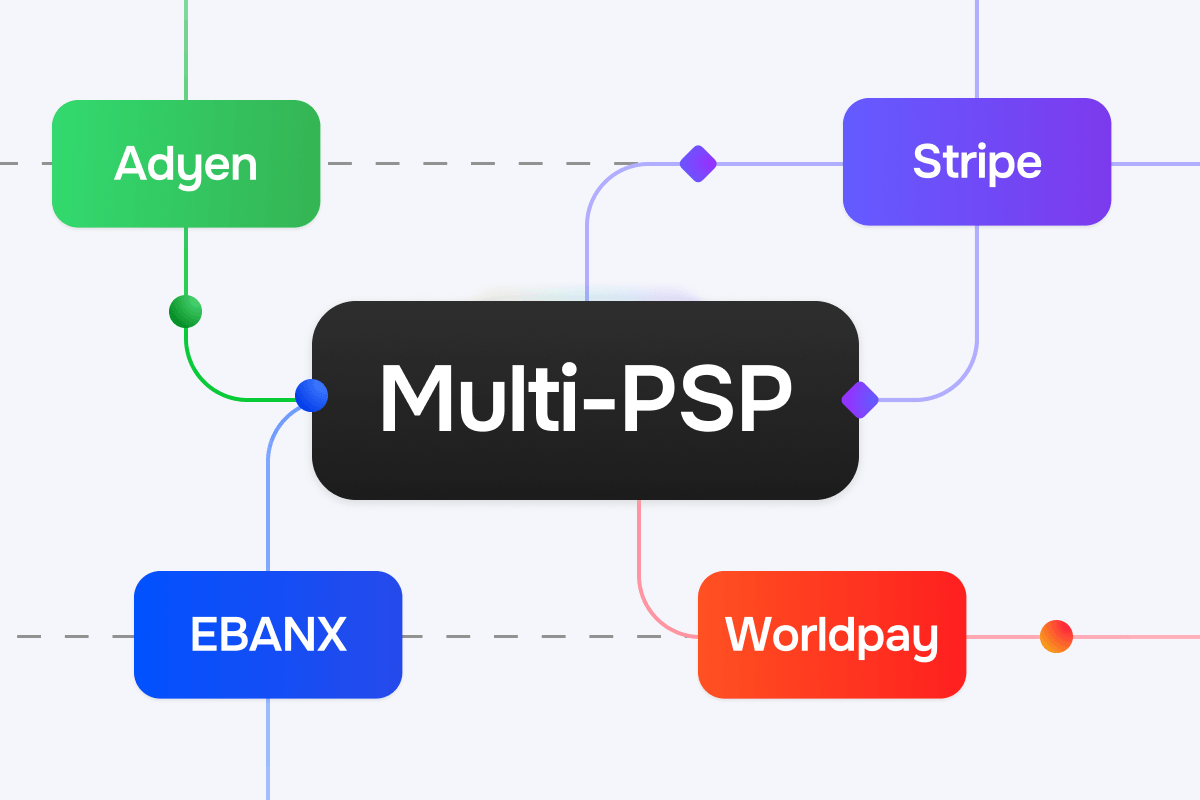
Managing your across multiple PSPs is where it gets hard: token lock-in, per-acquirer routing configuration, fragmented reconciliation, and no automatic fallback when performance drops.
Solidgate is a connecting merchants to 100+ acquirers and through a single integration – with intelligent routing that optimizes every transaction in real time and provider-agnostic tokenization that keeps tokens portable across your full acquirer stack.
If you want to map your current stack performance gaps, .
Frequently asked questions
An international payment network operates across multiple countries and currencies, connecting issuers and acquirers in different markets through shared infrastructure and standardized rules. Visa and Mastercard are the most widely used. SWIFT handles international bank-to-bank messaging for wire transfers. Cross-border transactions typically carry additional fees for currency conversion and cross-border processing, and may be subject to different regulatory requirements in each jurisdiction.
The network sets the rules and provides the rail – interchange rates, fraud standards, and operating regulations. The processor executes transactions on that rail – it handles data flow, manages authorization responses, and coordinates settlement.
The gateway is the entry point – it captures payment data at checkout, encrypts it, and passes it to the processor. The network is the infrastructure the processor connects to. The gateway doesn't route to networks or manage settlement. Many providers bundle gateway and processing together, which is why merchants often treat them as the same thing.
Card networks (Visa, Mastercard, Amex, Discover), bank transfer networks (ACH, SEPA, Fedwire), real-time payment networks (RTP, FedNow, PIX, UPI, SEPA Instant), and local payment schemes (iDEAL, BLIK, Bizum, Interac). Each carries different costs, settles on different timelines, and reaches different customer segments.
Visa, Mastercard, American Express, and Discover are the four US-origin card networks with global reach. Visa and Mastercard are open-loop – any qualifying bank can issue their cards. Amex and Discover are closed-loop – they act as both the network and the issuer.
Visa is a payment network. It provides the infrastructure and rulebook connecting issuing and acquiring banks, but it doesn't hold deposits, issue credit, or lend money. Visa earns revenue from scheme fees and service fees charged to network participants.
A closed-loop network keeps both ends of the transaction within the same entity or ecosystem. American Express acts as both the network and the issuer – processing transactions entirely through its own infrastructure. Discover operates the same way. The result is lower intermediary costs and richer data access for the operator, but narrower acceptance than open-loop networks.
Network tokenization replaces a card's primary account number (PAN) with a network-issued token – a credential specific to a device, merchant, or channel. The token carries cryptographic validation that raw card numbers don't, which issuers treat as a higher-trust signal and approve at higher rates. When a card is replaced or expires, Account Updater refreshes the underlying credentials automatically – so recurring charges continue without the merchant or customer doing anything. Tokens stored in a provider-agnostic can be routed across acquirers without re-tokenization or PSP lock-in.
Recent articles