Cross-border payments: A merchant's guide to costs, challenges, and performance
Payments 101
Updated 17 Sept 2026
14 min

Andrii Kononenko
Head of Merchant Operations, Solidgate
Cross-border payments tend to cost more, convert less, and decline more often than domestic ones until you know which levers to pull.
Cross-border payments introduce failure modes that don't exist in domestic processing – and most of them are invisible until you know where to look. Higher decline rates because the issuer doesn't recognize a foreign acquirer. Checkout abandonment because local payment methods are missing. FX costs compounding across every market. Compliance obligations that vary by jurisdiction.
The infrastructure gap between a domestic payment setup and one that actually performs cross-border is real – but it's addressable.
This guide covers how cross-border payments work, what they cost, the challenges that hit revenue hardest, and the levers that close the gap.
TL;DR:
- A cross-border payment occurs when the buyer's issuing bank and the merchant's acquiring bank are in different countries – that gap drives higher costs, lower approval rates, and additional compliance requirements
- Cross-border payment costs stack across two layers: interchange set by the card networks, and scheme fees including the cross-border assessment fee – neither is negotiable per transaction
- The four challenges that cost merchants the most are lower authorization rates, higher false declines, checkout abandonment from missing local payment methods, and settlement fragmentation
- Selling cross-border into the EU means operating under PSD2 today and preparing for PSD3 and the PSR by 2027–2028, with VAT on digital services applying regardless of where the merchant is established
- Four levers address the gaps: adding local payment methods per market, pricing and settling in local currency, routing and cascading across providers, and using network tokenization and account updater for recurring billing
What are cross-border payments?
Cross-border payments are transactions where a buyer and a merchant are in different countries. More specifically, the buyer's issuing bank and the merchant's acquiring bank sit in different countries – and that gap is what drives the additional costs, higher decline rates, and compliance requirements.
How do cross-border payments work?
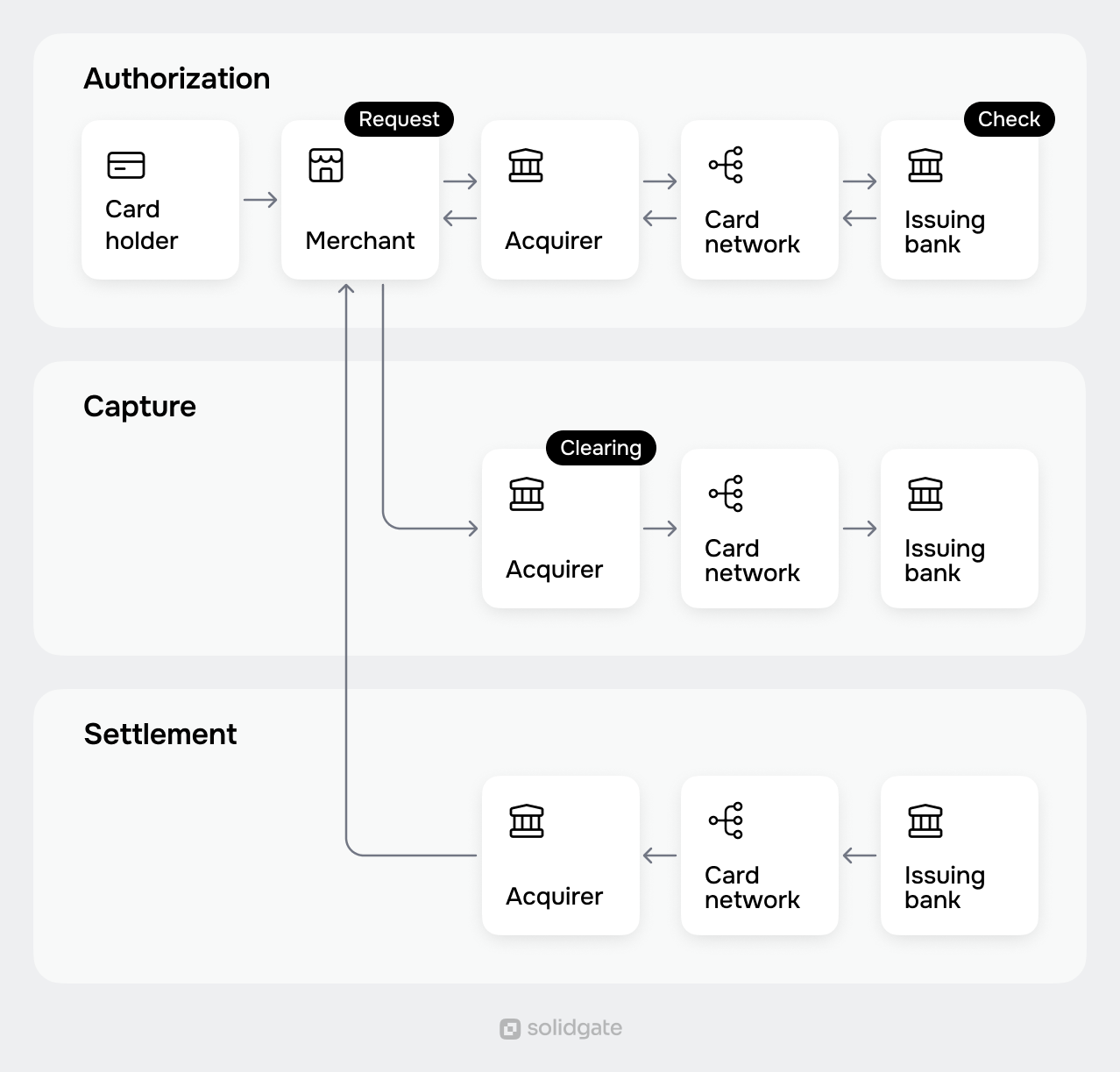
A cross-border card payment follows the same four-stage sequence as a domestic one – authorization, capture, clearing, and settlement – but each stage introduces variables that don't exist when the issuer and acquirer share the same country.
Authorization is where the transaction is approved or declined. The merchant's sends the authorization request through the card network to the issuer, who approves or declines it based on fraud scoring and available funds. Strong Customer Authentication runs at this stage for transactions subject to PSD2 – typically implemented via 3D Secure.
Capture locks the authorized amount. Once the merchant confirms the transaction, the funds are committed for settlement.
Clearing is where the card network processes the transaction between the acquiring and issuing banks. Two cross-border-specific costs attach at this stage: the cross-border assessment fee, charged by Visa or Mastercard on every transaction where issuer and acquirer are in different countries, and FX conversion, which occurs when the transaction currency and the acquirer's settlement currency differ.
Settlement is when funds transfer from the issuing bank through the card network to the acquiring bank, and from there to the merchant's account. The merchant receives settlement in whatever currency their account is configured for – typically the acquirer's settlement currency for that market.
For alternative payment methods – iDEAL, BLIK, Pix, UPI – the sequence is different. There's no issuer-acquirer card-network relationship. The payment moves directly between the buyer's bank and the merchant via a local payment scheme, governed by that scheme's own rules. These methods bypass card network fees entirely but operate on their own settlement timelines and require market-specific integration.
Core insight: Every cross-border-specific cost and decline risk traces to the same root – the issuer and acquirer are in different countries, so each stage of the payment flow introduces a variable that doesn't exist for domestic transactions.
Types of cross-border payments
The most common cross-border payment types merchants encounter are card payments, local payment schemes, digital and mobile wallets, and bank transfers.
The right mix depends on the markets a merchant operates in – payment preferences differ significantly by country, and the method that dominates in one market may be irrelevant in another.
Card payments
Cards – Visa, Mastercard, Amex – are widely accepted across most markets and remain the dominant payment method in many cross-border e-commerce corridors, particularly in North America and parts of Western Europe.
They're also where the issuer-acquirer mismatch problem lives: every card transaction carries cross-border interchange and assessment fees when the buyer's issuing bank and the merchant's acquiring bank are in different countries.
Local payment schemes
Local payment schemes run outside the card networks entirely. Each is specific to one or a small number of markets: iDEAL in the Netherlands, BLIK in Poland, Pix in Brazil, UPI in India, Pay by Bank across the UK and parts of the EU.
In the markets where they're dominant, they often outperform cards on conversion – buyers who expect to pay by iDEAL and don't see it at checkout abandon, regardless of how smooth the card checkout experience is. Local payment schemes don't carry cross-border interchange, but each requires its own integration and operates under its own scheme rules.
For a closer look at the most common options across Europe, see our guide to.
Digital and mobile wallets
Wallets – PayPal, Apple Pay, Google Pay – store payment credentials and let buyers complete transactions without entering card details at checkout. PayPal is available across 200+ countries and supports . Apple Pay and Google Pay are embedded in iOS and Android respectively and use device-level biometric authentication at the point of payment.
All three use tokenized credentials rather than raw card numbers, which typically produces a better risk profile at authorization than a manually entered card.
Pay by Bank and bank transfers
Open banking infrastructure in the EU and UK enables direct bank-to-bank transfers at checkout – the buyer authenticates directly with their bank and the funds transfer account-to-account without a card network in the middle.
These methods carry lower fees than card transactions and settlement can be near-instant on SEPA Instant rails. Coverage is narrower than cards and the buyer experience varies by market and bank.
For a full breakdown of, see our APM guide.
Core insight: Cross-border payments involve four common method types – cards, local payment schemes, digital and mobile wallets, and bank transfers – and the right mix varies by market.
What cross-border payments actually cost
Selling cross-border typically adds three cost layers on top of standard payment processing:
Network fees apply because card schemes charge more when transactions cross borders. are the largest component – cross-border rates are higher than domestic rates and vary by card type, card origin country, and merchant category code.
On top of interchange, card networks charge scheme fees for network access, authorization, and processing. The most significant of these on cross-border transactions is the cross-border assessment fee – a per-transaction levy that applies specifically because the issuing and acquiring banks are in different countries.
None of these are negotiable at the transaction level – they're set by the card networks and apply regardless of which provider processes the payment.
FX costs arise wherever transaction currency and settlement currency differ. FX conversion happens during clearing – the card network converts at that stage. The rate the merchant receives reflects the provider's FX spread: the gap between the mid-market rate and the settlement rate applied.
Dynamic currency conversion (DCC) is one structural option – it lets the merchant offer buyers their home currency at checkout. But the trade-off is real: buyers presented with unfavorable conversion rates may abandon, so DCC decisions require careful testing by market.
A cleaner structural approach is settling in the transaction currency (like-for-like), which eliminates the card-network conversion step and gives the finance team predictable payouts per market.
Processing fees are provider-determined and vary by corridor, card type, and volume. They're the cost layer most directly within a merchant's control. Routing each transaction to the lowest-cost provider for that specific combination of market, card brand, and amount is the primary lever for reducing per transaction.
| Cost layer | What drives it | Controllable? |
| Network fees | Interchange + cross-border assessment fee + scheme fees | No |
| FX costs | Spread between mid-market and settlement rate | Partially |
| Processing fees | Provider rates per corridor, card type, volume | Yes |
Core insight: Most of the cross-border fee stack is fixed at the scheme level – interchange, assessment fees, and scheme fees apply regardless of how a merchant's stack is configured. What's controllable is which provider processes each transaction and how settlement is structured.
Cross-border payment challenges
Cross-border payment performance fails at four distinct points – authorization, risk scoring, checkout conversion, and settlement – and each has a different cause. Here are the challenges that cost merchants the most.
Lower authorization rates
When the acquiring bank is in a different country from the issuing bank, the issuer's automated fraud model scores the transaction as higher risk than an equivalent domestic one. It doesn't recognize the acquiring bank's routing patterns. The BIN metadata reads as foreign.
Velocity and behavioral checks calibrated on domestic transaction patterns trigger on a transaction that doesn't fit them. The result is a higher decline rate on legitimate purchases – not because the buyer is a fraud risk, but because the infrastructure signals look unfamiliar to the issuer's model.
The effect compounds in corridors where a merchant hasn't established a local acquiring presence. A business processing UK transactions through a US-based provider presents every UK card as a cross-border transaction to the issuing bank – even for regular buyers. in these corridors requires addressing the issuer-acquirer country mismatch at the infrastructure level.
Higher false declines
A false decline is a legitimate transaction refused because the issuer's risk model produces a false positive. Cross-border payments generate more of them because the combination of foreign merchant, unfamiliar acquirer country, and unusual purchase geography triggers automated rules built on domestic data. The buyer's card is valid, their funds are available, and the purchase is real but the issuer declines it anyway.
False declines are a different problem from fraud-driven declines. A fraud decline is the risk model working correctly. A false decline is the risk model applying domestic calibration to a cross-border signal set – and losing a real sale in the process. At scale, false decline rates in cross-border corridors erode revenue without appearing in fraud reports.
Growing checkout abandonment
Buyers who don't see their preferred payment method at checkout leave before authorization is attempted. Around of shoppers abandoned a checkout specifically because there weren't enough payment methods.
No decline is logged – only a lost sale with no payment signal. The gap is invisible in standard payment analytics but very visible in market-level conversion data.
The markets where this loss is largest are the markets where local payment preference is strongest. A Dutch buyer expects iDEAL. A Polish buyer expects BLIK. A Brazilian buyer expects Pix. A card-only checkout in these markets excludes buyers before a single authorization attempt is made.
Settlement fragmentation
Merchants operating across multiple markets through a single provider typically receive settlement in one currency, regardless of where the transaction originated. Every payout absorbs FX conversion at the provider's rate, applied market by market. At volume, the spread compounds across every corridor.
The reconciliation burden compounds alongside it – matching payouts to transactions across multiple currencies and settlement timelines requires manual finance work that grows with each new market added.
The deeper problem is control: settlement timing, settlement currency, and payout structure are all determined by the provider's configuration. A merchant with no per-market settlement visibility has no clean way to forecast cash flow by geography.
Core insight: The four challenges operate at different points in the payment flow – authorization scoring, risk model calibration, checkout conversion, and settlement structure – which means addressing one doesn't address the others. Merchants who treat cross-border payment performance as a single problem leave most of the recoverable revenue on the table.
Regulation and compliance across borders
Selling internationally means operating inside multiple regulatory frameworks at once. Three areas have the most direct operational impact for merchants selling cross-border into the EU.
– currently requires Strong Customer Authentication for remote card transactions processed through an EEA acquirer. In practice, this means 3D Secure runs at checkout for EEA-acquired transactions.
A merchant whose transactions are processed through a non-EEA acquirer sits outside the formal enforcement perimeter. But EEA issuers can still soft-decline transactions that lack 3DS, making SCA compliance a practical necessity regardless of legal obligation.
PSD2 will be replaced by PSD3 and the PSR – final texts are confirmed and applicability is expected around 2027–2028.
VAT on digital services – EU rules require merchants to collect and remit VAT on digital services sold to EU consumers regardless of where the merchant is established. The obligation applies even without a physical EU presence.
Core insight: Merchants selling cross-border into the EU operate under PSD2 today – with SCA/3DS as a practical requirement regardless of acquiring jurisdiction – and should prepare for PSD3 and the PSR by 2027–2028. VAT on digital services applies independently of both, with no physical presence required to trigger the obligation.
How to improve cross-border payment performance
Merchants who operate across borders consistently leave revenue on the table in four places: checkout conversion from missing payment methods, checkout conversion from currency friction, card authorization rates, and recurring billing performance.
Here's how to address each.
Add local payment methods for each market
Local payment schemes – iDEAL, BLIK, Pix, UPI, Pay by Bank – need to be present at checkout from day one in the markets where they matter. Adding them after launch means losing conversion during the period when customer acquisition costs are highest and first impressions matter most.
The complexity is real. Each local payment method carries its own technical specification, scheme rules, reconciliation behavior, and settlement timeline. Integrating them market by market through separate contracts and separate technical builds is the bottleneck that keeps most merchants on card-only checkout longer than they should be.
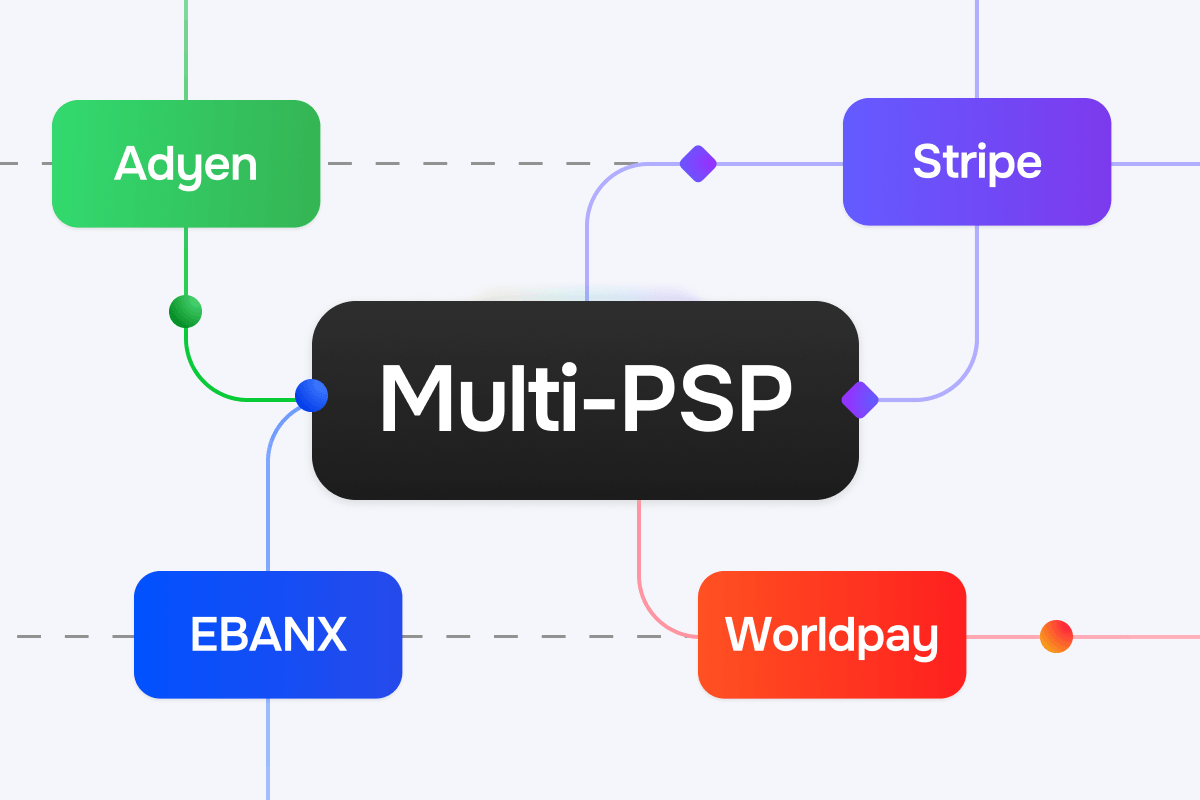
A payment orchestration platform sits above all existing providers and payment methods, enabling merchants to add and route across multiple providers and acquirers through a single integration – with automatic fallback when a payment fails on the primary route.
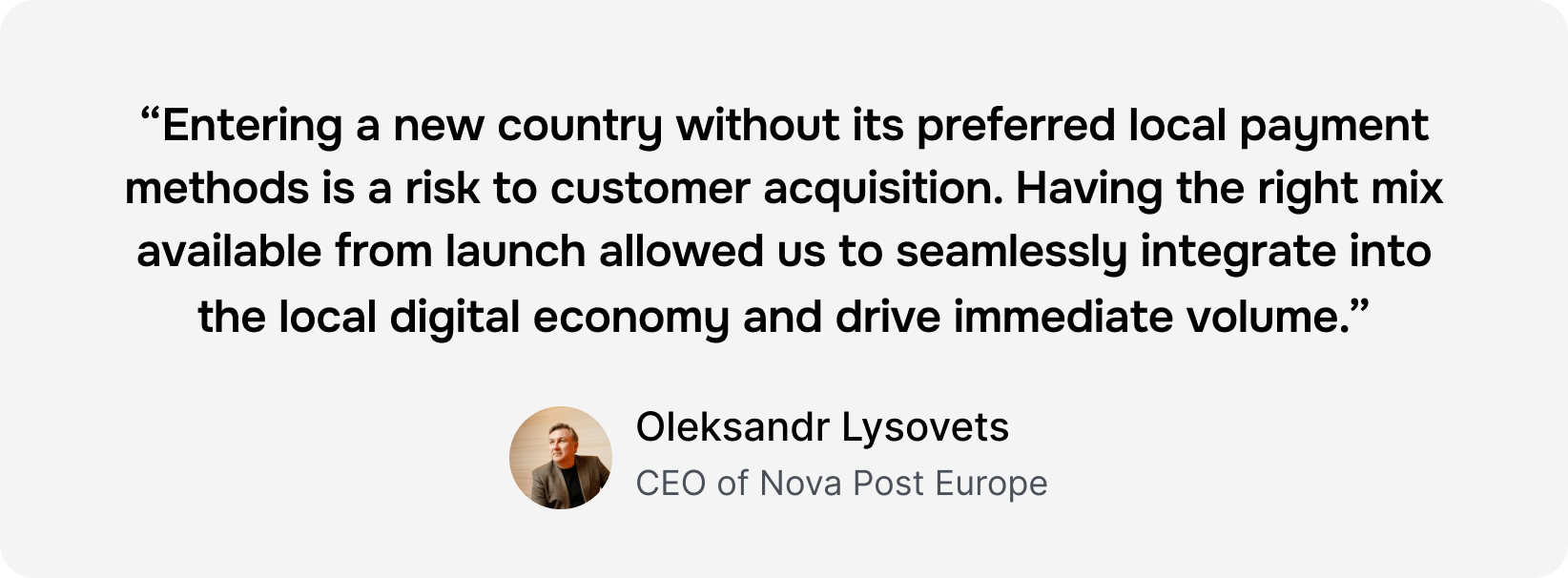
When Nova Post expanded to 15+ markets across Europe and the US, BLIK, iDEAL, Open Banking, and PayPal were live in each market from day one. The result: 95%+ approval rates across all markets from launch.
See the full .
Optimize checkout for local currency
A buyer presented with a price in a foreign currency at checkout faces two friction points:
- The cognitive load of converting the price mentally into their own currency
- Uncertainty about what the final charge will actually be after conversion
Both reduce conversion. Displaying prices in the buyer's local currency removes both friction points before the buyer reaches the payment step.
Settling in local currency goes further. Like-for-like means receiving payouts in the transaction currency rather than converting everything to a single settlement currency. It eliminates one FX conversion step, gives the finance team predictable cash flow per market, and keeps per-market revenue data clean – no conversion layer distorting what each market actually generates.
Nova Post settled in PLN for Poland, GBP for the UK, USD for the US, and EUR across the rest of Europe – each currency arriving in the denomination that matched their operating costs in that market, with no forced conversion step absorbing spread.
Route and recover transactions with smart routing and cascading
Card authorization rates across borders vary by provider, by corridor, and by card type. One provider may deliver strong approval rates on German Mastercard debit while underperforming on Dutch Visa credit. Routing every transaction to a single provider means accepting whatever performance that provider delivers in each corridor – with no recovery mechanism when it underperforms.
evaluates each transaction against historical performance data – by market, card brand, BIN range, and transaction amount – and routes it to the provider most likely to approve it at the lowest cost.
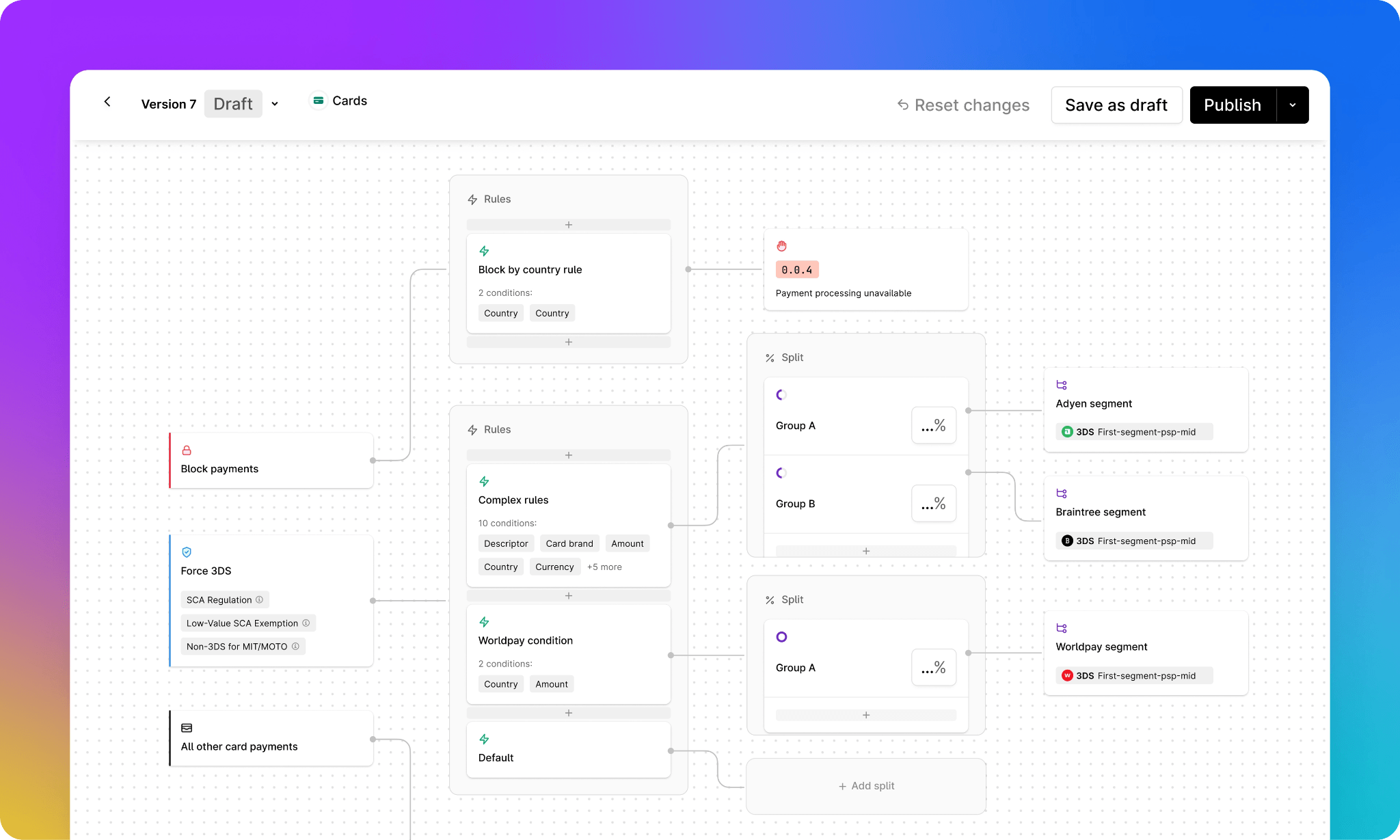
When a transaction fails on the first route, retries it automatically through a different provider.
works within the same routing logic. When a local acquiring rail is available for a given market, the routing engine sends the transaction through it – which changes how the issuer sees the transaction from cross-border to domestic, improving authorization rates without requiring the merchant to manage separate acquirer contracts per country.
Use network tokenization and account updater
Approval rates for recurring and returning buyers improve when static card numbers are replaced with network tokens. A network token is issued by Visa (VTS) or Mastercard (MDES) and linked to the underlying card account – not the physical card number. When a card is reissued, the number changes but the token stays valid. Issuers approve tokenized transactions at higher rates because the token carries a richer authentication signal than a raw card number presented cross-border.
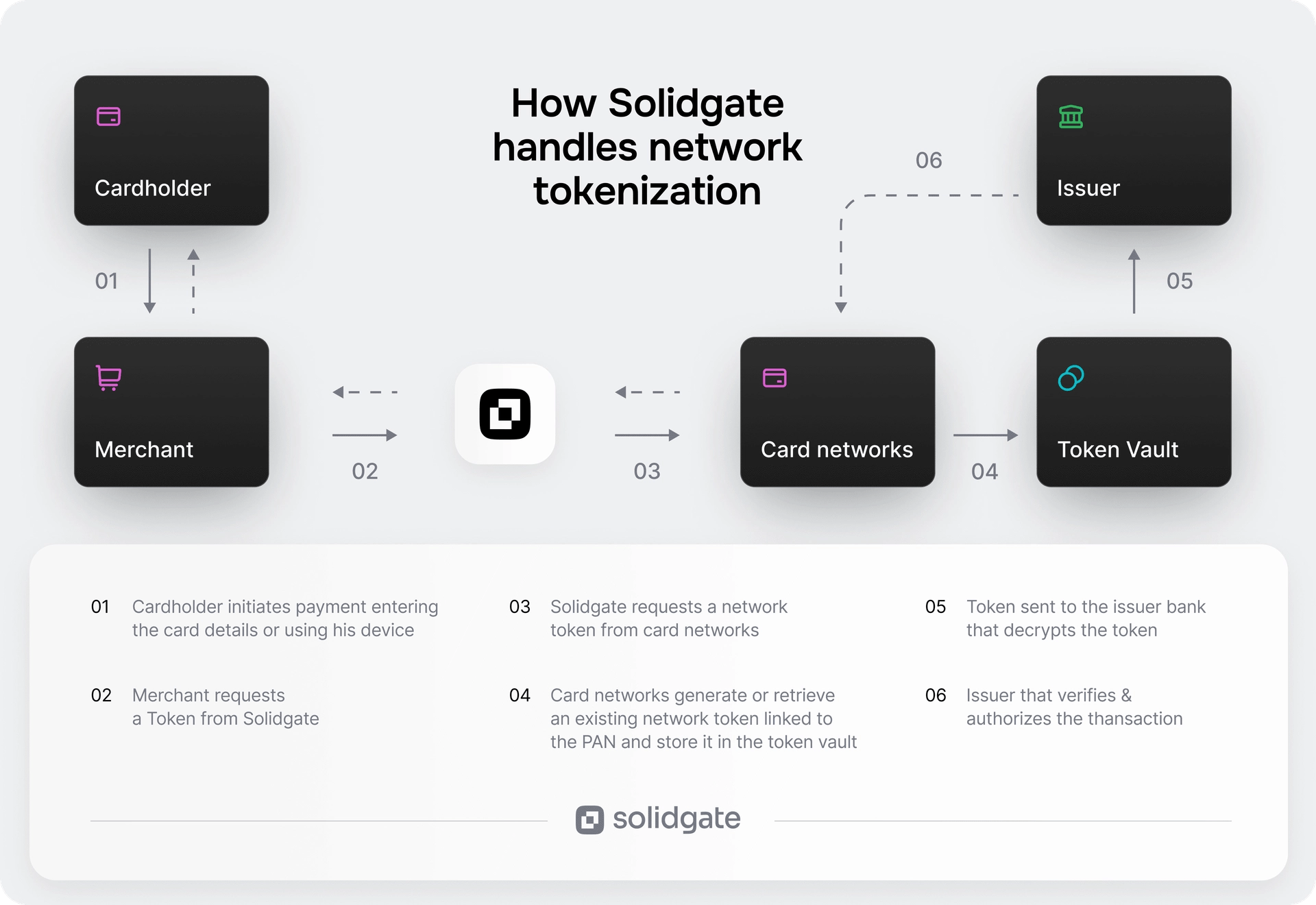
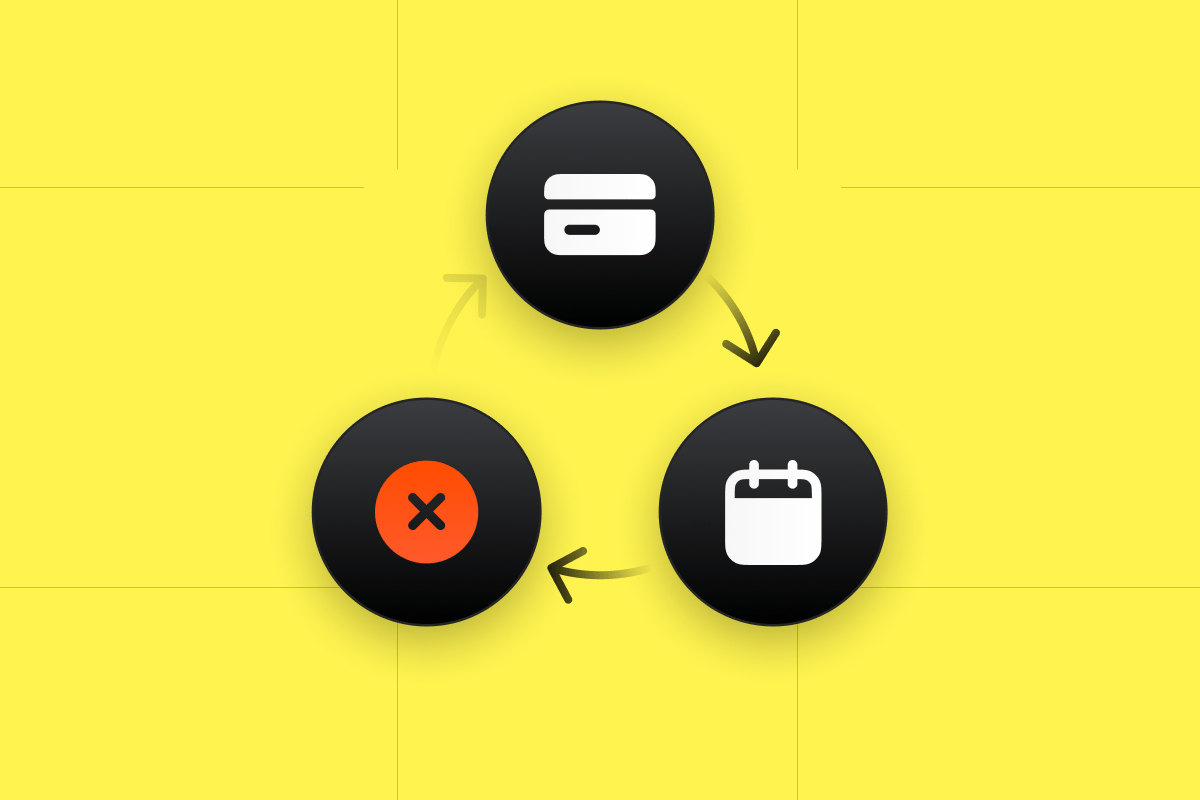
works on the same problem from a different angle. When a card expires or is replaced, the account updater automatically refreshes the stored credential before the next billing attempt – reducing failed payments caused by stale card data.
Together, and account updater address the two most common causes of failed recurring payments: credential staleness and issuer trust gaps on cross-border billing.
For MEGOGO, network tokenization and account updater working in combination with smart retries produced an approximate 5% reduction in subscription churn.
See the full .
Core insight: Improving cross-border payment performance requires fixing four distinct layers – payment method coverage, currency experience, authorization rates, and credential maintenance. Each addresses a different failure point; together they compound.
What's changing in cross-border payments in 2026
Three developments are actively reshaping the infrastructure of selling globally – one already complete, one in final legislative stages, and one expanding across markets.
Here are some of the most common cross-border payments trends:
Here are some of the most common cross-border payments trends:
ISO 20022 – completed. The coexistence period between legacy MT messaging and ISO 20022 on the SWIFT network ended on 22 November 2025. ISO 20022 is now the mandatory standard for all SWIFT cross-border payment messages.
The migration improves the underlying infrastructure for cross-border bank transfers – richer, structured data travels with each payment, reducing the manual reconciliation work and AML false positives that incomplete payment references historically caused. For merchants, the practical effect is more reliable bank-based cross-border payment rails and cleaner settlement data over time.
and the PSR – incoming. PSD3 replaces PSD2 entirely, alongside the PSR which takes over the conduct rules – SCA, fraud liability, and transparency requirements. Final texts were published April 2026; most rules apply approximately 21 months after entry into force, putting applicability around 2027–2028.
For merchants selling cross-border into the EU, three changes are most operationally relevant: SCA requirements tighten, fraud liability shifts more toward providers who fail to apply adequate controls, and currency conversion costs must be disclosed more clearly at checkout. The compliance window is open now – the rules are stable enough to prepare for before the clock starts.
Real-time payment rails – expanding. More than 70 countries have now real-time domestic payment systems. The direction is toward faster cross-border settlement – the UPI-PayNow corridor between India and Singapore is the live example of two national instant payment systems linked for cross-border use.
For merchants, the near-term implication is faster domestic settlement in each market they operate, improving cash flow visibility and reducing float. True instant cross-border settlement remains the exception – interoperability between national real-time systems is still early-stage for most corridors.
Core insight: Three forces are reshaping cross-border payment infrastructure in 2026 – ISO 20022 improving bank transfer data quality, real-time rails expanding settlement speed market by market, and PSD3 bringing updated compliance requirements for EU-facing merchants by 2027–2028.
Sell like a local, cross-border
Cross-border payment performance comes down to one question: does your stack let you show up as a local business in each market, or does it expose the seams of a foreign integration? Local payment methods, local currency pricing, routing that adapts per corridor, and credentials that survive card reissuance – these are the levers. None of them requires rebuilding from scratch.
Solidgate is a that gives merchants access to 100+ payment providers, acquirers, and alternative payment methods through a single integration with intelligent routing, fallback logic, and network tokenization built in.
If you're expanding into new markets and want to see what the setup looks like for your specific corridors, .
Frequently asked questions
Card cross-border payments for businesses typically authorize in seconds. Settlement takes longer – usually 1–3 business days for card transactions, depending on the acquirer and the market. Bank transfers and local payment schemes vary by market and rail: instant payment schemes settle in seconds, standard bank transfers in 1–3 business days, and some international corridors can take longer.
Cross-border card payments carry interchange fees, a cross-border assessment fee, and scheme fees – all set by the card networks and non-negotiable per transaction. FX spread adds cost wherever transaction and settlement currencies differ. The controllable levers are routing transactions to the lowest-cost provider per corridor, settling in local currency to reduce FX conversion steps, and offering local payment schemes that bypass card network fees entirely.
The terms are used interchangeably. Both describe transactions where the buyer and merchant are in different countries. "Cross-border" is the more precise term in payments infrastructure – it specifically refers to the issuer-acquirer country gap that drives additional fees and decline rates.
When the acquiring bank is in a different country from the issuing bank, the issuer's fraud model scores the transaction as higher risk – even for legitimate buyers. The issuer doesn't recognize the foreign acquirer's routing patterns, the BIN metadata reads as foreign, and velocity checks calibrated on domestic data trigger. The fix is closing the issuer-acquirer country gap through local acquiring access and intelligent routing.
No – a local legal entity is not required to accept payments in most markets. What matters is having a provider with local acquiring access in that market. Local acquiring changes how the issuer sees the transaction – from cross-border to domestic – without requiring the merchant to establish a local business presence. Tax obligations, including VAT on digital services in the EU, are a separate question and apply regardless of whether a local entity exists.
Recent articles