What is involuntary churn and how to reduce it
Payments 101
Updated 8 Oct 2026
9 min

Valentyn Pidpalyi
Product Manager, Solidgate
Failed payments are behind more subscription churn than most businesses realize – and most of it is recoverable.
Every second churned subscriber might have stayed.
drive half of all subscription churn – expired cards, soft declines, issuer friction, stale credentials. Most of these failures are preventable with the right payment infrastructure in place. Yet most subscription businesses treat involuntary churn the same way they treat voluntary churn: exit surveys, re-engagement campaigns, discount-led save flows – tools built for subscribers who made a decision to leave, applied to subscribers who never did.
The result is retention spend directed at the wrong problem while the billing layer – where the actual failure happened – goes unaddressed. Subscribers disappear silently, renewal failures accumulate, and the churn rate stays elevated for reasons that never show up in cancellation data.
This guide covers what involuntary churn is, what causes it, what it costs, and how to reduce it – so your retention effort targets the problem that's actually there.
TL;DR
- Involuntary churn happens when a renewal payment fails, accounting for roughly half of all subscription churn.
- Voluntary and involuntary churn look identical in aggregate metrics but require completely different fixes. Conflating them means spending a retention budget on the wrong problem.
- Involuntary churn stems from four distinct failure types – expired credentials, soft declines, hard declines, and issuer friction – each requiring a different recovery approach.
- Left unaddressed, each failed renewal removes LTV, inflates effective CAC, and suppresses NRR simultaneously.
- Prevention comes first: network tokenization and account updater keep credentials valid; broader payment method coverage eliminates structural gaps. Recovery follows: decline-aligned retry logic and proactive dunning communication recover what slips through.
What is involuntary churn
Involuntary churn is the loss of a subscriber due to a failed payment – a card declined at renewal, a bank transaction blocked, or stored credentials that no longer match the issuer's records.
The subscriber didn't intend to leave, but the access lapsed because the system couldn't complete the charge.
Voluntary vs involuntary churn
Voluntary churn and involuntary churn are both subscriber loss – but the causes, signals, and fixes are entirely different.
Voluntary churn happens when a subscriber actively decides to cancel. The decision reflects something about the product, pricing, or perceived value. Involuntary churn happens when a renewal payment fails and the subscription lapses without any cancellation decision from the subscriber.
The two also produce different signals. Voluntary churn typically leaves traces: cancellation survey responses, a drop in product usage before the cancellation, or a support interaction.
Involuntary churn often leaves none. The subscriber doesn't know what happened until they lose access, and the business only sees the churn number.
| Voluntary churn | Involuntary churn | |
| Cause | Subscriber decides to cancel | Renewal payment fails |
| Subscriber intent | Wants to leave | Wants to stay |
| Typical signal | Cancellation survey, usage drop | Decline code, retry failure |
| Financial impact | Lost LTV, requires re-engagement | Lost LTV, CAC already spent, requires billing fix |
| Fix | Product, pricing, onboarding, engagement | Retry logic, credential management, dunning |
Core insight: Voluntary and involuntary churn look identical in aggregate churn metrics but reflect completely different problems. Treating them the same means solving the wrong one – and leaving recoverable subscriber loss unaddressed.
What causes involuntary churn
Reasons for involuntary churn vary. Here are the most common ones.
Expired and reissued cards
Banks reissue cards regularly – after fraud incidents, when cards expire, or during account upgrades. When that happens, the card number or expiry date stored in the billing system no longer matches what the issuer holds.
The next renewal attempt hits stale credentials and fails. The subscriber's account is still open and their intent to pay is intact – the payment simply goes out on outdated data.
Soft declines
A soft decline means the card is valid but the charge couldn't go through at that specific moment – most often due to insufficient funds, a temporary hold, or a cautious "do not honor" from the issuer. The subscriber has the funds and intends to pay, but the timing is wrong.
Soft declines make up 80–90% of all declines in subscription businesses.
Hard declines
Permanent issuer refusals – a cancelled card, a fraud block, a revoked authorization – have no via retry. In this case, the card itself is the problem, and continued retry attempts can trigger card network penalty fees.
A subscriber who receives a hard decline needs to provide a new payment method.
False declines
Sometimes a subscriber wants to pay and the card is legitimate, but the issuer's risk scoring flags the transaction anyway. These false declines are more common in cross-border renewals and in markets where recurring card-not-present transactions face tighter risk thresholds.
They also occur when credentials haven't been refreshed after a card reissuance, which causes the issuer's fraud model to treat a valid renewal attempt with suspicion. False declines are an problem – there's no underlying payment issue, just issuer-level friction blocking a transaction that should have gone through.
Core insight: Involuntary churn stems from four distinct failure types – expired credentials, soft declines, hard declines, and issuer friction.
What involuntary churn actually costs you
Failed payments nearly half of all subscription churn. Yet only a third of subscription businesses treat them as the most significant contributor.
Left unaddressed, involuntary churn erodes revenue and distorts the business metrics used to track growth.
Lost lifetime value
Losing a subscriber to a failed renewal doesn't cost one month's revenue – it removes their full remaining lifetime value (LTV) from the business.
A subscriber paying $30 per month with an expected 18-month lifetime is worth $540. Losing them in month three removes the $450 of remaining value that would have continued accumulating.
At scale this compounds quickly. Industry data shows average monthly involuntary churn potential of 7.2% across 1,200 subscription businesses.
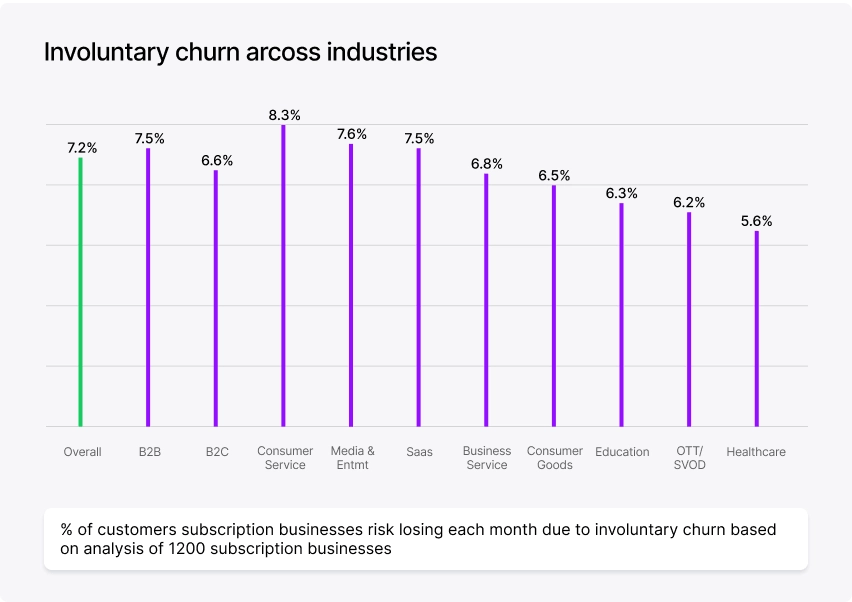
At $500k MRR, a 7.2% churn exposure puts $36k of recurring revenue at risk every billing cycle.
Wasted customer acquisition cost
Every subscriber lost to a failed renewal was a paid acquisition – marketing spend, conversion effort, trial cost. When involuntary churn cancels that subscription, the business needs to pay customer acquisition cost (CAC) again to maintain the same subscriber count.
A business adding new subscribers while running high involuntary churn is spending acquisition budget to stay in place.
Suppressed net revenue retention
Involuntary churn pulls down net revenue retention (NRR) independently of how well the rest of the business performs. A subscription business can execute well on upsell and expansion while NRR deteriorates because payment failures are canceling subscriptions at the base.
This makes NRR a misleading indicator of health when involuntary churn runs unchecked – expansion metrics can look healthy while a billing problem erodes the base.
Core insight: Each failed renewal removes LTV, inflates effective CAC, and suppresses NRR simultaneously – three separate financial consequences from a billing failure that can prevent.
How to reduce involuntary churn
Involuntary churn reduction works in two modes: preventing failures before they happen, and recovering revenue after a payment fails. Here are some of the common solutions.
Keep credentials valid and portable
via Visa Token Service (VTS) and Mastercard Digital Enablement Service (MDES) addresses the expired and reissued card problem before it reaches the billing system.
Instead of storing a static card number (PAN), the billing system holds a dynamic token linked to the cardholder's digital account. When the physical card is reissued, the token stays valid – the renewal charges against a credential that survives card changes automatically, without any action from the subscriber or the merchant.
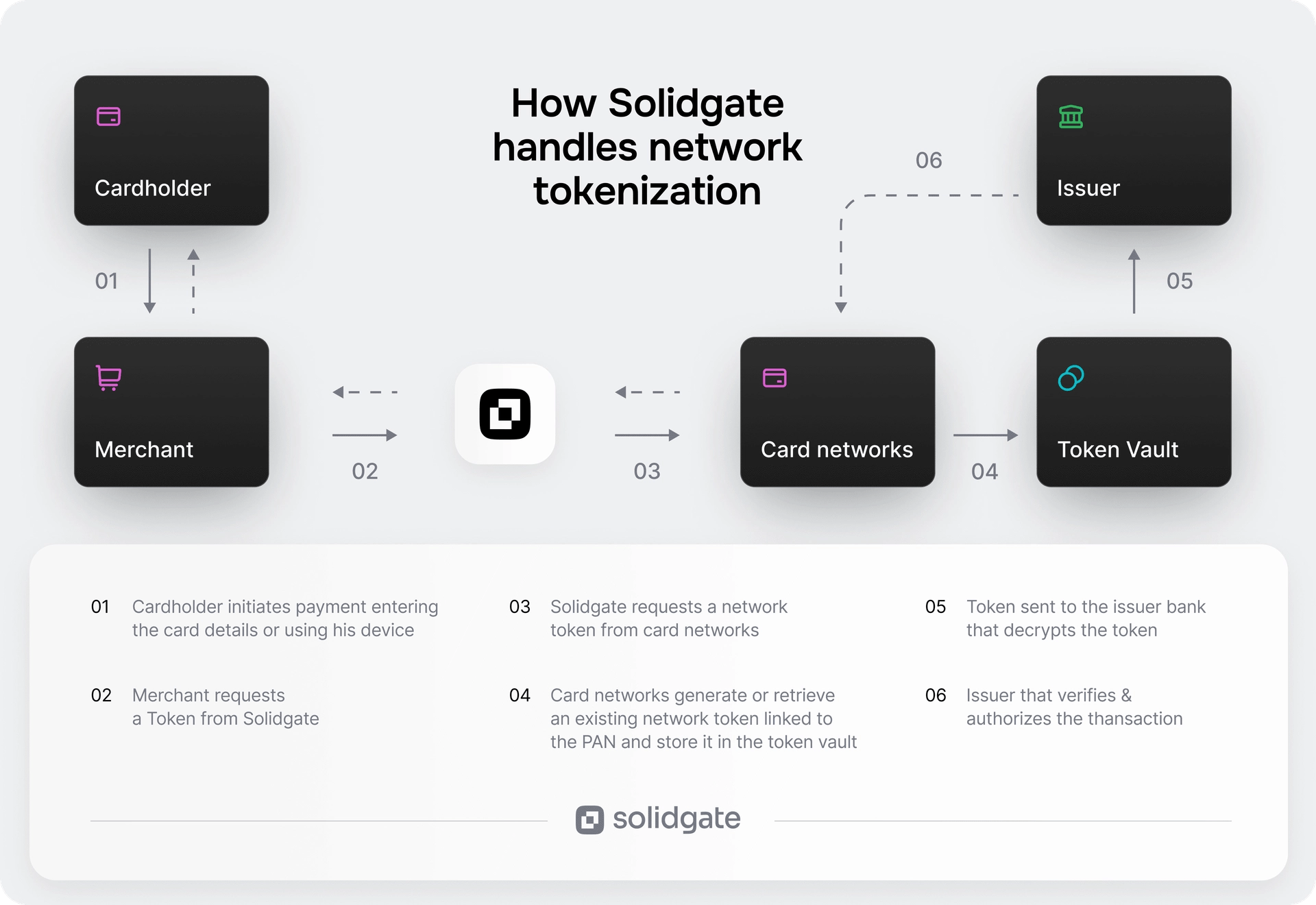
Not all cards are eligible for network tokenization. For those cases, Visa Account Updater (VAU) and Mastercard Automatic Billing Updater (ABU) provide a complementary layer – they push refreshed card data to merchants when a subscriber's card is reissued, catching the credential change before the next renewal attempt fails on stale data.
Together, tokenization and account updater cover the full spectrum of credential-related failures: tokenization prevents them at the account level; account updater catches the cases tokenization doesn't reach.
If you're running a multi-provider setup, token portability matters just as much as token validity. Tokens stored with a single provider typically can't move when that provider is replaced or a new acquirer is added.
A provider-agnostic vault holds credentials independently of any one provider, so they can route to any connected provider without re-collecting card data from the subscriber.
When one of Zeely's tier-2 banks closed, all tokens were preserved on the Solidgate side. Their transferred to new acquirers with near-zero loss.
See the full .
Expand payment method coverage
abandon a purchase specifically because their preferred payment method isn't available. In subscription billing, the same gap shows up at renewal: a subscriber whose card fails and who has no alternative method stored has no path to stay subscribed.
The payment methods a subscriber stores at checkout are the ones available when renewal runs – a wider selection at signup means more fallback options.
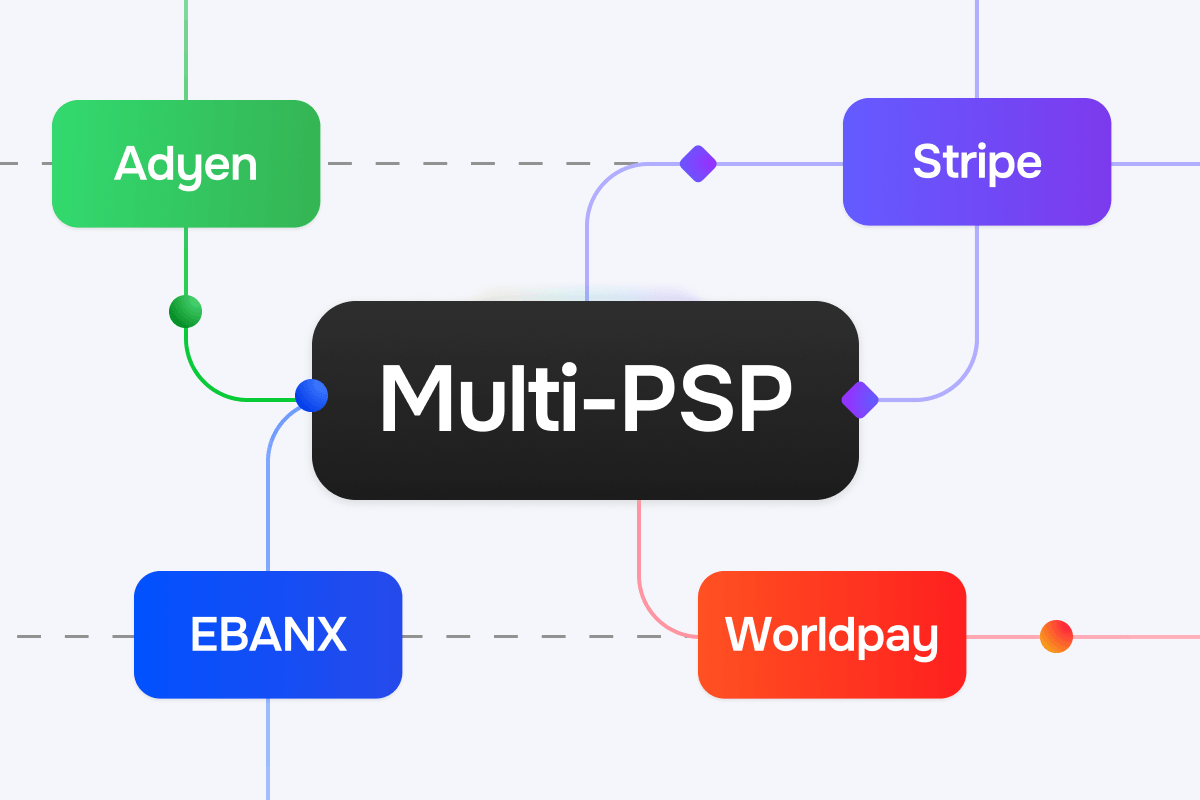
However, expanding your payment setup adds complexity not only in terms of onboarding more providers but also in terms of routing payments across all of them.
routes each payment to the best-performing provider at that moment, accounting for card type, geography, and provider performance.
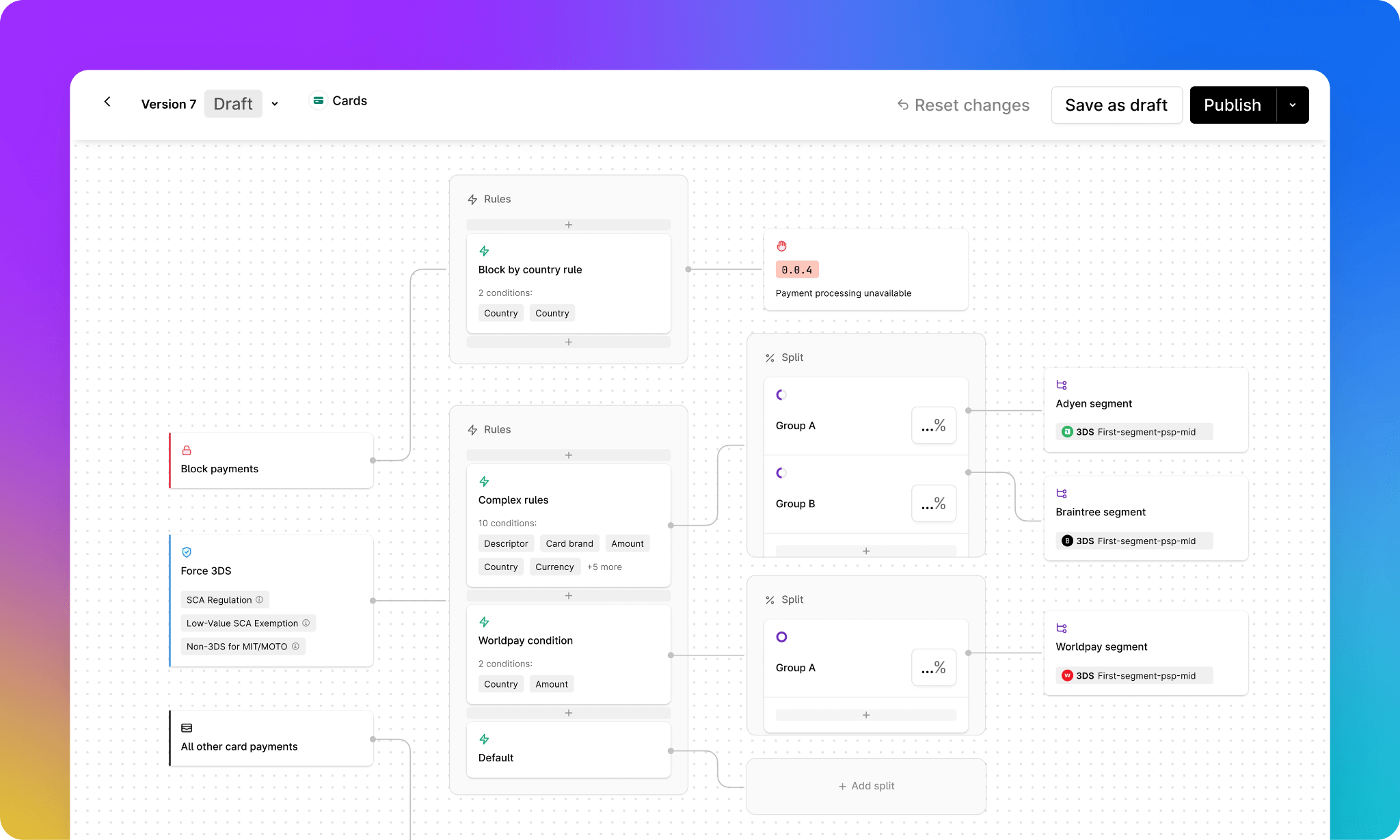
When the first provider declines, cascading logic retries the transaction at the next provider in the sequence before the subscriber sees a failure – lower failure rate on first attempt, higher recovery rate on subsequent ones.
Give subscribers more flexibility
Some subscribers want to stay but hit a billing constraint they can't resolve without help. A subscriber who can replace a declined card themselves – through a self-service payment method update rather than a support ticket – stays subscribed.
A subscriber who can pause instead of cancel during a financially difficult month returns later. Proactive cancellation alerts, triggered before a failed payment escalates to a permanent cancellation, give both the subscriber and the merchant a window to act while the subscription is still recoverable.
Align retry logic to decline type
Not all payment failures are the same – and neither are the fixes.
read the decline type before scheduling the next attempt. Temporary issues – insufficient funds, card activity limits – get retried with timing adapted to the billing cycle and the subscriber's payment history. Permanent issues – closed accounts, fraud blocks – don't get retried at all.
Each card network sets its own rules on retry attempt limits within a given window, and exceeding those limits can result in penalty fees. Smart retry logic that stops on hard declines and times soft decline retries correctly recovers more revenue with fewer total attempts.
MEGOGO – a streaming platform operating across Eastern Europe and Central Asia – reduced subscription churn by 5% after combining network tokenization, account updater, and smart retries on renewal flows.
See the .
Run proactive dunning communication
Retry logic handles the payment side. handles the subscriber side.
When a payment fails and retries haven't recovered it, reaching the subscriber quickly – across channels, in plain language, with a clear action step – recovers revenue that retry logic alone can't. A subscriber who updates their payment method stays subscribed. One who doesn't know a charge failed, and discovers access was cut days later, may not return.
Multichannel outreach – email, SMS, and in-app notification – performs better than email alone because it increases the chance the subscriber sees the message while the subscription is still recoverable. Messaging that names the specific failure reason and gives the subscriber a clear next step performs better than a generic "update your card" prompt.
Core insight: Involuntary churn prevention and recovery work in sequence. Valid credentials stop card-data failures before they happen. Broader payment coverage eliminates structural gaps. Billing flexibility keeps subscribers who have a temporary constraint. Retry logic and dunning recover what slips through.
How Solidgate helps recover revenue
Solidgate is a payment orchestration platform that to 100+ payment providers, acquirers, and via one integration – with intelligent routing, , a PCI-compliant token vault, and chargeback management built in.
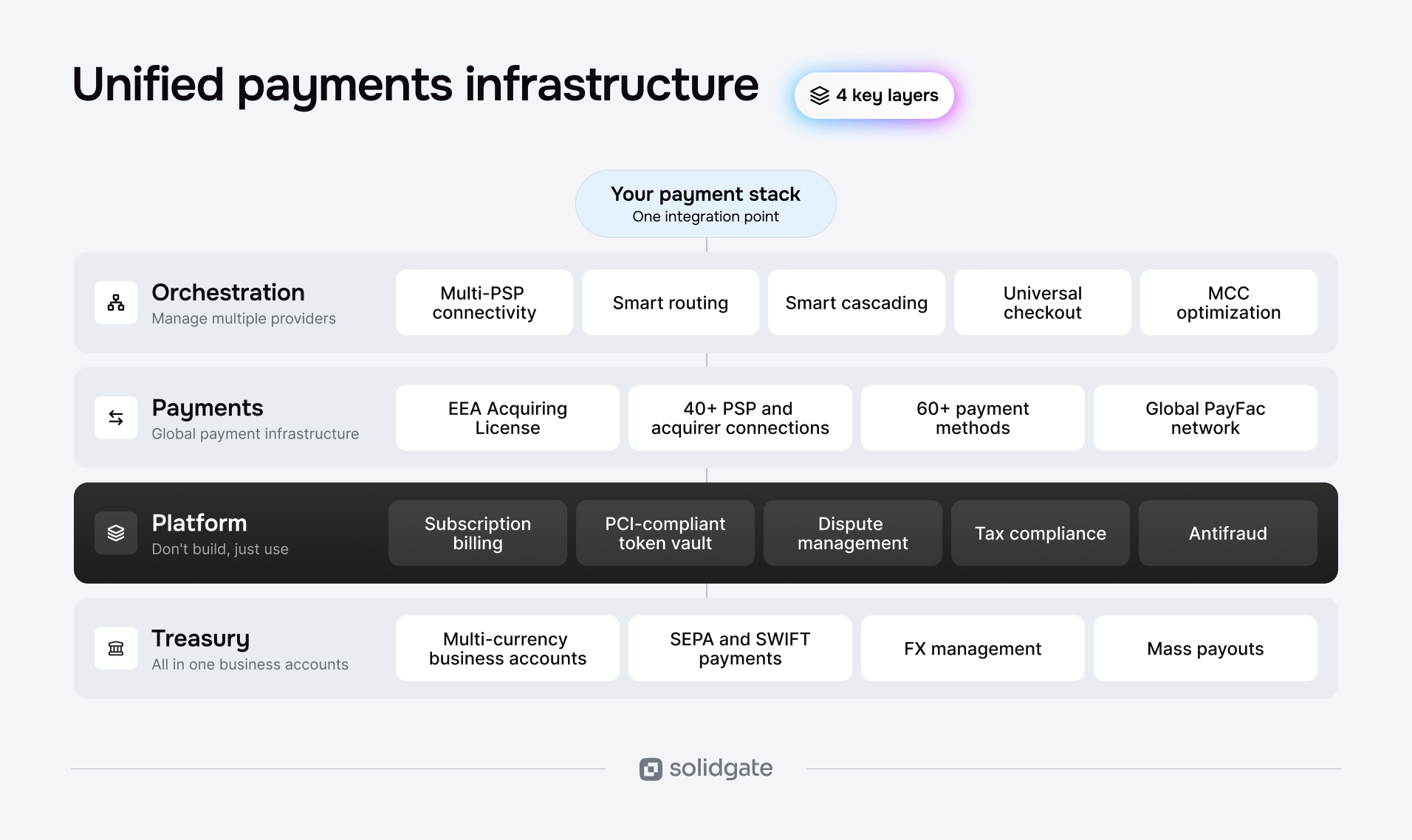
Solidgate offers two approaches to automatically recover failed subscription payments and reduce churn.
- Smart retries – when a renewal payment fails, Solidgate automatically identifies whether the decline is temporary or permanent. Temporary failures – insufficient funds, card activity limits – are retried with adaptive timing based on payment history, billing cycle, decline type, and subscriber behavior.Permanent failures – closed accounts, fraud blocks – are stopped immediately, with no wasted attempts. Default configuration is four retries within four weeks; adjustable per product.
- Retry strategies – for businesses that prefer a defined schedule, Solidgate offers predefined retry strategies with configurable intervals and optional progressive discounts per attempt. Discounted retries can be applied specifically to insufficient-funds declines, offering a reduced price on the next attempt to improve recovery where timing alone isn't enough.
If you want to find where payment failures are costing you subscribers and what it would take to recover them, .

-5% Subscription churn
How MEGOGO scaled their global payments and saved €100K annually
Frequently asked questions
To calculate involuntary churn, divide the number of subscribers lost to failed payments in a given period by the total number of active subscribers at the start of that period, then multiply by 100.
Involuntary churn rate benchmarks vary by vertical and price point. On average, below 1% annually is strong performance for most subscription businesses. Involuntary churn above 2% typically signals a payment operations gap worth investigating.
Voluntary churn is when a subscriber actively cancels – the decision reflects a product, pricing, or value problem. Involuntary churn is when a renewal payment fails and the subscription lapses without any cancellation decision from the subscriber. The fixes are entirely different: voluntary churn requires product and engagement improvements; involuntary churn requires improvements.
Dunning is the communication layer of failed payment recovery. When retry logic hasn't recovered a failed renewal, automated outreach – across email, SMS, and in-app channels – prompts the subscriber to update their payment method before access is cut. A subscriber who receives a timely, clear message with a specific action step is far more likely to resolve the issue and stay subscribed than one who discovers access was lost days later.
Recent articles